Ignition Damaged After an Attempted Theft: What to Check and What It Costs
Someone tried to steal your car and left a broken steering column or a wrecked ignition. How to tell what was damaged, whether it is safe to drive, what the repair costs and who should do it.
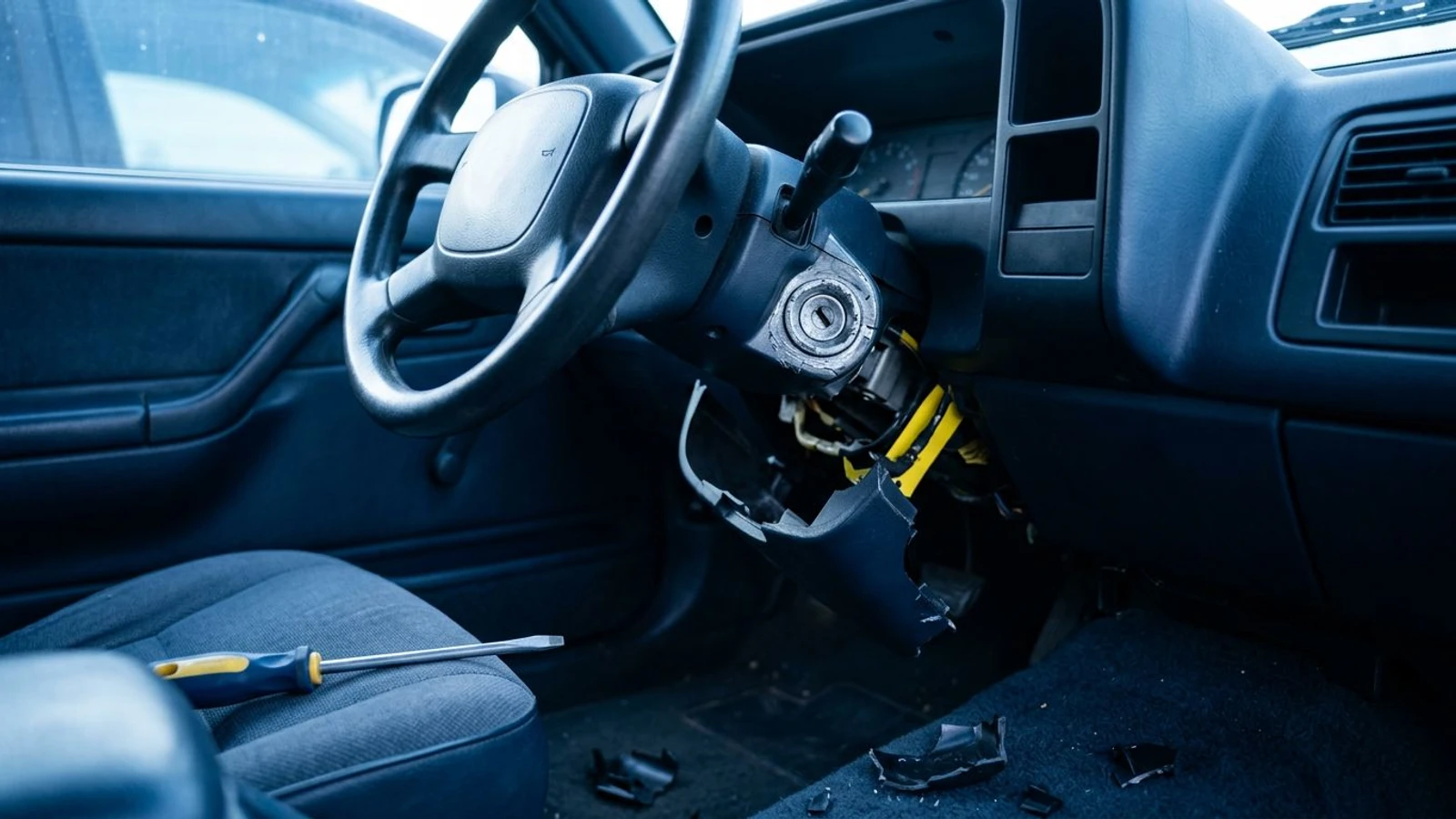
If someone tried to steal your car and damaged the ignition, the repair is usually a replacement lock cylinder keyed to your existing key. As of October 2026 that runs $220 to $450 through a mobile specialist or $400 to $750 at a dealership, and a forced door lock adds $140 to $320. Do not drive the car until someone has checked the steering lock. The broken plastic around the column, any cut wiring and any broken glass are separate repairs.
Finding your car with the steering column torn open is unsettling, and the first instinct is usually to see whether it still starts. Hold off. What you do in the first hour affects your insurance claim, your safety and the size of the bill. This guide walks through what to check, what each kind of damage means, what it costs to put right and who should do which part.
Before you touch anything
- Photograph everything. The column, the ignition, each door lock, any broken glass, and anything left behind in the car. Take the photos before you move or tidy anything.
- File a police report. You will need the report number for an insurance claim, and in many places you can file online or by phone for a vehicle that was damaged but not taken.
- Call your insurer before authorising repairs. Ask whether they want to inspect the car first.
- Check what is missing. A spare key, a garage door opener, the registration or anything with your address on it changes what you need to do next.
- Do not force the key. If the key will not go in or will not turn, stop. Forcing it into a damaged cylinder can break the key and add an extraction to the job.
What to look at, and what it tells you
A thief attacking an ignition is trying to do one of two things: turn the lock without the key, or get past the lock to the switch behind it. The damage tells you which they tried and how far they got.
| What you see | What was probably damaged | Who fixes it | Published price |
|---|---|---|---|
| Plastic cover under the column hanging or missing, lock looks intact | Column shroud only | Mechanic or body shop | Quoted by the shop |
| Lock face chewed or gouged, key will not go in | Ignition lock cylinder | Automotive locksmith | $220 – $450 mobile; $400 – $750 dealer |
| Lock cylinder missing, or it spins freely | Cylinder destroyed, possibly the housing | Locksmith first, then a shop if the housing is cracked | $220 – $450 for the cylinder; housing quoted separately |
| Key turns but nothing happens | Ignition switch or wiring behind the lock | Locksmith to diagnose; mechanic for wiring | Quoted after diagnosis |
| Engine starts without the key | Lock defeated and switch exposed | Locksmith, urgently | $220 – $450 mobile for the cylinder |
| Door lock punched in or loose | Door lock cylinder | Automotive locksmith | $140 – $320 mobile; $280 – $500 dealer |
| Steering will not unlock or feels notchy | Steering lock mechanism | Do not drive; locksmith or dealer | Quoted after inspection |
The prices are the ranges published on our automotive locksmith page. Where the table says "quoted", it is because we do not publish a standing figure for that repair, and an invented one would not help you.
The likely causes, from least to most serious
The cover was broken but the lock held
This is the best outcome. Many attempts end at the plastic shroud around the column because the thief was interrupted or gave up. If the lock face is undamaged, the key goes in smoothly, turns through every position and comes back out, the ignition itself may be fine. The shroud is a trim part that a mechanic or body shop can replace.
Test it gently: insert the key, turn to accessory, to on, start the engine, switch off, and remove the key. If any step feels gritty or sticks, treat the cylinder as damaged even if it works.
The lock cylinder was forced
The most common real damage. A tool was driven into the keyway or the cylinder was twisted with force, and the wafers inside are bent or broken. Symptoms are a key that will not go in fully, will not turn, or turns only part of the way. Sometimes the key goes in and then will not come back out.
A forced cylinder is replaced rather than repaired. Our guides to a key that will not turn in the ignition and a key stuck in the ignition describe the same symptoms from ordinary wear, which is worth reading if you are not sure whether the damage is new.
The cylinder was pulled out
On some vehicles the whole lock cylinder can be extracted, leaving the switch mechanism behind it exposed. If you can see a hole where the lock was, or the engine can be started by turning the exposed part with a tool, this is what happened. The car is now trivially easy to take. It needs a new cylinder, and until it has one it should be parked somewhere secure, ideally with a visible steering wheel lock fitted.
The switch or wiring was damaged
Behind the lock is the electrical ignition switch, and behind the shroud is wiring. If either was cut or broken, the key may turn normally and nothing happens, or accessories work and the starter does not. A locksmith can tell you whether the lock is intact and the fault is electrical. Repairing cut wiring is mechanic work.
The steering lock was damaged
The steering lock is the bolt that engages the column when the key is out. Forcing the steering wheel against it can bend it or its housing. A damaged steering lock is the one that makes the car unsafe to drive, because a lock that binds while you are moving takes away your steering. If the wheel does not release cleanly when you turn the key, or feels notchy afterward, have the car inspected where it sits.
What it costs to put right
As of October 2026, these are the published ranges.
- Ignition cylinder replacement: $220 to $450 through a mobile specialist, $400 to $750 at a dealership.
- On-site ignition rekey or replacement, per-make band: $175 to $385, the figure our individual make pages publish for cylinder work depending on the model.
- Door lock cylinder replacement: $140 to $320 mobile, $280 to $500 at a dealership.
- A spare transponder key, if you want one cut while the specialist is there: $140 to $220.
At a dealership, add the tow. Our service pages put that at $75 to $200 before any work begins, and a car with a destroyed ignition almost always has to be towed in.
What those figures do not include is the collateral damage: the column shroud, any broken glass, damaged trim or cut wiring. Those are priced by the shop that repairs them. Ask for them as separate lines so that your insurer, if you claim, can see what each one is.
Our ignition repair cost guide breaks the ignition figures down further, including why the range is as wide as it is.
Ask for the new cylinder to be keyed to your old key
This is the single most useful request you can make, and many owners do not know to ask.
A replacement ignition cylinder arrives with its own key pattern. Fitted as it comes, you would have one key for the ignition and your old key for the doors and trunk. A specialist can instead set the wafers in the new cylinder to match the key you already carry. The result is one key for everything, as before.
On a car with an immobilizer, there is a second benefit. If your existing key turns the new lock, the chip in that key is already registered with the car, so no programming is needed at all. The job stays a mechanical one.
The exception is when a key is missing. If a spare disappeared in the break-in, you want the opposite: new cuts on the locks so the missing key no longer fits. Our guide to what to do differently when car keys are stolen covers when to rekey and when to simply erase a key from the car's memory.
The Hyundai and Kia situation
If your damaged car is a Hyundai or a Kia, you are not unlucky. You are part of a known pattern.
Many US-market Hyundai and Kia vehicles built roughly from 2011 through 2021 with a turn-key ignition, rather than push-button start, left the factory without an engine immobilizer. With no chip to check, defeating the lock was all it took to start the engine, and once the method was widely shared, theft attempts on those models rose sharply. The affected Kia models listed on our Kia make page include the Soul, Sportage, Forte, Optima and Rio in base trims. The Hyundai lineup of the same era shares the architecture.
Three things follow from that.
The free software upgrade is worth having, and it is not a repair. Both makers offer an anti-theft software upgrade at no charge at their dealers. As our Hyundai cost guide explains, it extends the alarm and requires the car to be unlocked with the fob before the starter will crank. It does not add an immobilizer and it does not fix a broken ignition. Have the ignition repaired first, then have the upgrade done if your car is eligible and has not had it.
An attempt can happen even on an upgraded car. A thief cannot tell from outside whether the software has been installed, so the column may be broken open before they discover the car will not start. The upgrade prevents the theft, not always the damage.
The key is still a plain key. On an affected car without an immobilizer, a replacement key is a cut blade with nothing to program, which keeps that part of the bill small. Our Hyundai and Kia key types guide shows how to tell which system your car has. Our Kia make page also lists a $25 to $45 charge for verifying whether the upgrade is installed when a key is being made.
Check your VIN against the NHTSA recall database as well. If an open recall covers part of the work, the dealer performs it free.
Who should do which part
Think of the repair in three layers.
The lock: an automotive locksmith. Replacing the ignition cylinder, keying it to your existing key, replacing a punched door lock, and programming a key if one is needed. This comes first, because until the ignition works the car cannot be moved under its own power or secured.
The electrics and trim: a mechanic or body shop. The column shroud, any cut wiring, a damaged switch, and broken glass.
The software and recalls: the dealer. The anti-theft upgrade on eligible Hyundai and Kia vehicles, and any open recall.
The practical advantage of starting with a mobile specialist is that the car does not have to move. They can make it drivable where it sits, and you can then take it to a shop for the rest rather than paying for a tow to each. If you would rather have one place do everything, a dealer can, at the higher band and with a tow.
In states that license locksmiths, ask for the licence number before the visit. In Texas, for example, that is a licence under the Department of Public Safety's Private Security Program. After a break-in is exactly the moment a too-cheap advertised price turns into a much larger one on arrival, and our guide to what a legitimate shop asks for lists the warning signs.
When to stop and call a professional
Call before doing anything else if any of these is true:
- The engine starts without the key, or with a tool.
- The lock cylinder is missing or spins freely.
- The steering does not release cleanly or feels different.
- The key will not come out of the ignition.
- There are cut or exposed wires under the column.
- A key, a spare or your registration is missing from the car.
If none of those applies and the only damage is a broken plastic cover, you may not need a locksmith at all, only a trim repair.
After the repair
A car that has been targeted once is sometimes targeted again, particularly if it is a model thieves look for. Three inexpensive steps help.
- Fit a visible steering wheel lock. It is a deterrent a thief can see before breaking anything.
- Have the software upgrade done if the car is an eligible Hyundai or Kia.
- Get a spare key cut while the specialist is on site. With a working key present it is the cheapest key you will buy for that car, and you will not be stranded if the next problem is a lost key rather than a thief.
If the engine starts and then cuts out after the repair on a car with an immobilizer, that is a key-recognition issue rather than a lock problem. Our guide to a car that starts then dies immediately explains what is happening.
Getting the ignition fixed
Tell whoever you call the year, make and model, what you can see at the column, whether the key still goes in and turns, and whether any key is missing. Say that it was an attempted theft, so the specialist brings a replacement cylinder rather than expecting a worn one. We match drivers with vetted automotive specialists across 15 states, including Ohio, Illinois, Washington and Tennessee. Start at get help, or read how it works first.
Frequently asked questions
How much does it cost to fix an ignition after an attempted theft?
As of October 2026, an ignition cylinder replacement runs $220 to $450 through a mobile specialist and $400 to $750 at a dealership, per our service pages. If a door lock was forced as well, a door lock cylinder replacement adds $140 to $320 mobile or $280 to $500 at a dealer. Broken steering column covers, wiring and glass are separate repairs priced by whoever does them.
Is it safe to drive a car with a damaged ignition?
Usually not until someone has looked at it. If the lock cylinder was pulled or the column forced, the steering lock may be damaged and could engage or bind unpredictably, and a car that starts without its proper key can also be taken by the next person who tries. If the steering feels notchy, the key will not return to off, or the engine starts with a screwdriver, do not drive it.
Will my key still work after the ignition is replaced?
It can, if you ask for the new cylinder to be keyed to your existing key. A specialist can set the wafers in the replacement cylinder to match the key you already carry, so one key still works the doors and the ignition. If that is not done, you end up with one key for the doors and a different one for the ignition.
Does insurance cover ignition damage from an attempted theft?
Damage from an attempted theft is typically handled under comprehensive coverage, less your deductible, but policies differ and only your insurer can confirm it. File a police report first, photograph everything before it is repaired, and ask the insurer whether they need to inspect the car before work starts. If the repair costs less than your deductible, a claim may not be worth making.
Why are Hyundai and Kia ignitions damaged so often?
Many US-market Hyundai and Kia vehicles built roughly from 2011 through 2021 with a turn-key ignition left the factory without an engine immobilizer, which made them a target once the method became widely known. Both makers offer a free anti-theft software upgrade at their dealers. It is a deterrent, not a repair: it does not fix an ignition that has already been broken.
Do I need a locksmith, a mechanic or a body shop?
Often more than one. An automotive locksmith replaces and keys the ignition cylinder and the door lock, and can program keys if the car has an immobilizer. A mechanic or body shop handles broken column covers, damaged wiring and glass. Start with the ignition, because the car cannot be moved under its own power or locked properly until it works.
Can the ignition be repaired where the car is parked?
In most cases, yes. A mobile specialist can replace and key an ignition cylinder on site, which matters because a car with a destroyed ignition usually cannot be driven to a shop. A dealership will normally need the car towed in. If the steering column housing itself is cracked or the wiring was cut, the specialist will tell you what has to go to a shop afterward.
Should I change my keys after an attempted theft?
If nothing was taken and the thief never had a key, your existing keys are not compromised. If a key, a spare or the vehicle paperwork is missing, ask the specialist to erase the missing key from the car on vehicles with an immobilizer, and to rekey the locks on vehicles with a purely mechanical key, so the missing key no longer works.