Deposits, Card Details and Cash-Only: What a Legitimate Car Key Shop Asks For
Payment requests are where a questionable car key job shows itself first. Here is which deposits are normal, which requests should stop the call, and why the invoice you get afterwards matters more than most drivers realise.
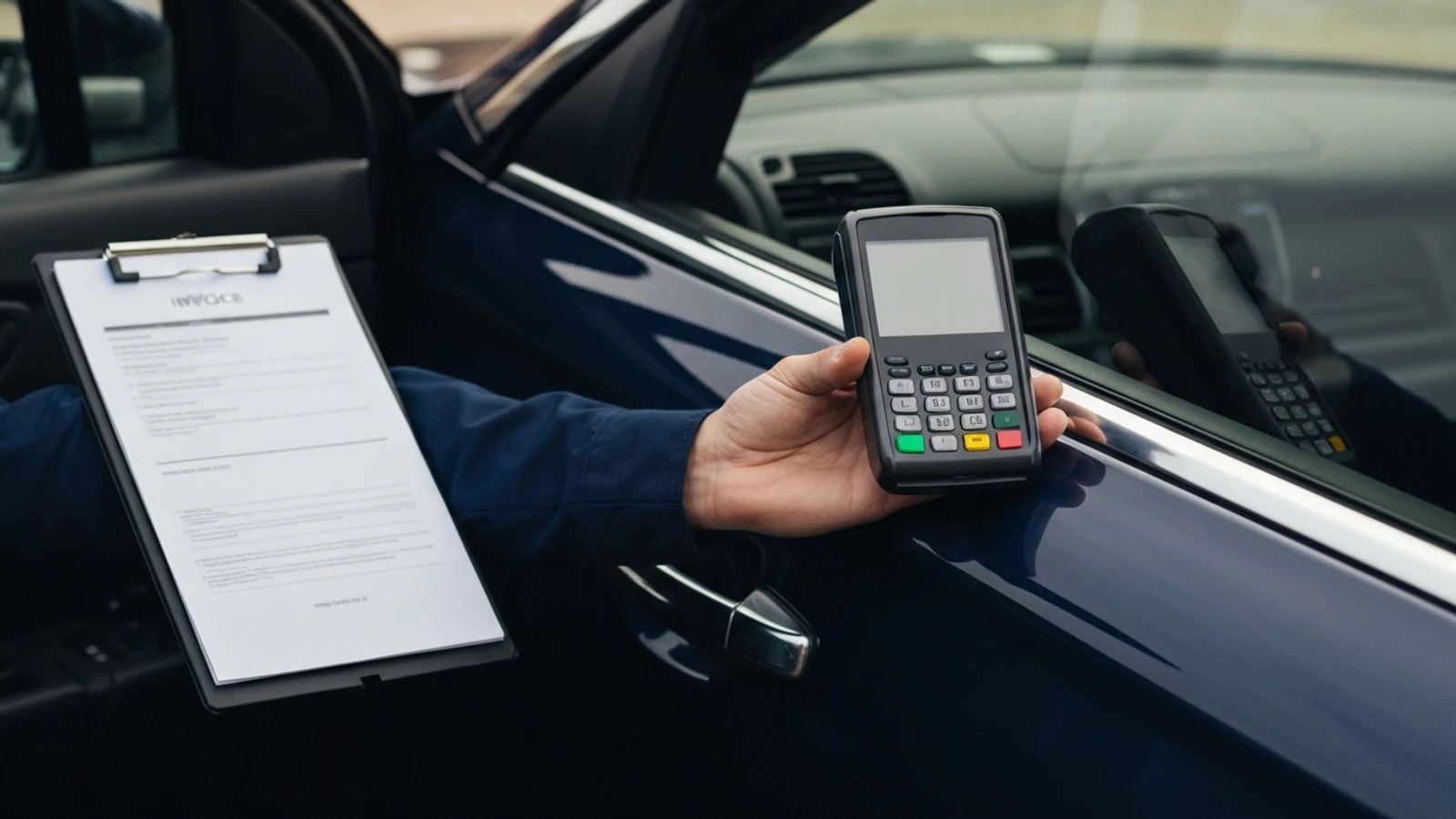
Most guidance about avoiding a bad car key job focuses on the quote. That is the right place to start, but it is not where a questionable job actually reveals itself.
It reveals itself at payment. The requests a shop makes about when and how you pay tell you more about how the rest of the transaction will go than the headline number does — and unlike the price, these signals are easy to read without knowing anything about immobilizers.
This guide covers which payment requests are normal, which should end the call, and why the piece of paper you receive at the end matters more than most drivers expect.
Figures referenced are as of August 2026 and reflect the ranges published across our service pages.
When a deposit is reasonable
Deposits are not inherently a warning sign. There is one situation where they are straightforwardly fair.
When a part has to be ordered for your specific vehicle. A fob sourced against your VIN is bought for your car. On many vehicles it is not generic stock the shop can resell if you change your mind, and on luxury European models it can represent real money — smart fob blanks range from $80 to $400 wholesale across the market. A deposit covering that hardware is a shop protecting itself against a cost you asked them to incur.
The test is whether the deposit names a part. "A deposit against the fob we're ordering for your VIN, credited against the total" is a specific, checkable statement. "A deposit to book you in" on a routine job using stock the van already carries is not securing anything.
| Situation | Deposit reasonable? | What it should secure |
|---|---|---|
| Fob ordered against your VIN | Yes | The specific part, credited to total |
| Luxury European or JLR hardware | Yes | High-value part not resellable |
| Routine same-day job, stock in van | Usually not | Nothing identifiable |
| Standard lockout, $50 to $150 | No | Nothing |
| Full prepayment before any work | No | Decline |
The requests that should stop the call
Four, in rough order of seriousness.
Payment in full before the work. This removes your only leverage. A shop that has been paid for labour it has not performed has no commercial reason to return if the key develops a fault, and no incentive to finish the job properly on the day. A deposit against a part is not this.
Card details taken over the phone "to hold the appointment." Booking a slot does not require the ability to charge you. Where a deposit is genuinely needed for an ordered part, it should be a stated amount you agree to, not open-ended access to a card.
Cash-only insistence with no invoice offered. Cash by itself is not the problem. Cash plus no written quote, no itemised invoice, and a price well below every published range is a coherent pattern rather than three coincidences. The issue is that you end up with no record of a transaction you may need to evidence.
A "diagnostic fee" on a key job. The diagnosis here is which key does this car take, and it is answerable from the VIN over the phone. A separate fee for establishing something a phone call resolves is a fee for nothing. Our guide to what the VIN changes about your quote covers why that conversation should happen before dispatch anyway.
The price that changes on arrival
This is the most common payment dispute in the trade, and the resolution depends entirely on one question: did the job change, or only the number?
There are legitimate reasons for a figure to move once a technician is at your vehicle:
- You believed a spare key existed and it does not, converting an add-a-key job into an all-keys-lost procedure. That is a genuinely different job and carries a $100 to $250 surcharge through a locksmith.
- The vehicle turns out to be a different trim or security architecture than described.
- Additional damage exists — a snapped blade requiring extraction, or a lock cylinder needing replacement at $140 to $320.
There is one illegitimate reason: the same job, at a higher price, once you have stopped shopping.
The question to ask is precise: "What specifically changed about the job?" A real answer describes a different procedure. A non-answer describes your situation back to you.
If the answer does not hold up, you are entitled to decline the revised figure and pay what was agreed for what was done. This is far easier to hold to if you got the original quote in writing — a text message is sufficient and takes ten seconds to request.
Getting the quote in a form you can hold
Before anyone is dispatched, ask for the figure by text or email. Not a contract, just a message containing:
- The service and key type
- The all-in price, explicitly including blank, cut and programming
- Any drive-out or mileage charge for your address
- Whether the all-keys-lost surcharge applies
Most shops send this without hesitation because it protects them too. A refusal is informative.
That message costs nothing and converts every later disagreement from a memory contest into a document check.
The invoice, and why it matters after the fact
The transaction is not finished when the car starts. What you are left holding has real downstream value.
A complete invoice names:
- The key by type — "smart proximity key," not "part."
- Cutting, where a blade exists. Push-to-start fobs contain an emergency blade that still gets cut.
- Programming, ideally distinguishing immobilizer work from body-control-module work on a smart key.
- All-keys-lost surcharge, stated separately if it applied.
- Drive-out or mileage, if you are outside the normal service radius.
Three reasons to keep it. Some comprehensive auto policies and manufacturer roadside programmes reimburse key replacement, and an itemised invoice showing key type and programming labour is normally what they want to see. If the key later develops a fault, the invoice establishes what was fitted and when. And if you need an additional key in future, it tells the next technician exactly what is already paired to the vehicle.
Verify the work before you pay
Payment and verification belong in the same two minutes, while the technician is still standing there.
Per ALOA service standards, the job should be completed in one visit with engine start and all lock, unlock and panic functions verified. Check them yourself:
- Start the engine with the new key.
- Lock and unlock using the remote buttons.
- Test the panic button.
- On a smart key, confirm proximity detection — the car should recognise the fob without you pressing anything.
- On any key with a blade, check the blade opens the driver's door.
A key that starts the car but will not unlock the doors is a half-finished job. Resolving that in your driveway takes two minutes; resolving it by phone the next morning takes considerably longer.
Why paying by card is worth a small inconvenience
Card payment is standard equipment for professional mobile shops, and it gives you something cash does not: a dispute mechanism.
If a job is not completed, or the figure charged differs from the figure agreed, a card transaction can be challenged through your issuer. A cash transaction cannot be challenged by anyone, because there is no third party in it. That is the entire practical difference, and it is why "the reader is broken, cash only" at the point of payment deserves a pause rather than a shrug.
None of this makes cash illegitimate. Sole traders often prefer it, and a shop with a written quote, an itemised invoice and a completed job is fine to pay in cash. The concern is the combination — cash plus no paperwork plus a price that did not match what was agreed leaves you with no record and no recourse simultaneously.
If cash is genuinely the only option, ask for a written receipt naming the business, the date, the vehicle, the work performed and the amount. A legitimate operator will produce one without hesitation.
Deposits done properly
When a deposit is warranted, four things make it a normal commercial arrangement rather than an exposure:
- A stated amount, not "a deposit."
- Named against a specific part for your VIN.
- Credited against the total, confirmed in writing.
- Paid by card, so it is traceable.
That last point matters more than it sounds. A card deposit against an ordered part is an ordinary transaction with a paper trail on both sides. An untraceable payment to hold an appointment is a different thing wearing the same word.
If a deposit is requested and the shop cannot say which part it is securing, the honest reading is that it is securing your commitment rather than their cost — which is not what a deposit is for.
The four-line paper trail
The whole of this article reduces to four artifacts. Collect them and almost nothing can go wrong that you cannot resolve.
| Artifact | When | Why it matters |
|---|---|---|
| Written quote by text or email | Before dispatch | Settles any later dispute about the figure |
| Stated deposit, credited to total | If a part is ordered | Distinguishes a deposit from a prepayment |
| Function check at the vehicle | Before payment | Catches half-finished work while it is fixable |
| Itemised invoice | At completion | Reimbursement, warranty, and the next technician |
None of the four requires technical knowledge, and none takes more than a minute. Together they convert an unfamiliar roadside transaction into an ordinary documented one.
The reason this matters more here than in most trades is timing. You are usually buying this service at the worst possible moment — stranded, hurried, without the leverage of being able to walk away and think about it. The paper trail is what substitutes for the comparison shopping you cannot do. Our guide to same-day versus scheduled appointments covers how much of that leverage you get back when the car still drives.
Credentials, one more time
Payment questions are downstream of a more basic one: is this person allowed to do the work?
In Texas, automotive locksmiths are regulated under the Department of Public Safety Private Security Program. Other states we cover use different authorities — some at state level, some local, some not at all — and the wrong agency gets cited online constantly. Ask which applies where you are.
The portable credential is NASTF SDRM registration, required for pairing keys on many 2010-and-newer vehicles and meaning the same thing in every state. Our comparison of who can actually program a car key covers why that one question filters most of the market.
The short version
Reasonable: a stated deposit against a part ordered for your VIN, credited to the total. Card payment at the roadside. A written quote before dispatch. An itemised invoice afterwards.
Unreasonable: full prepayment for unperformed work, open-ended card details to hold a slot, a diagnostic fee for a phone-answerable question, and a price that rises without the job changing.
None of that requires any technical knowledge to evaluate — which is precisely why it is the most reliable signal available to you while standing next to a car you cannot start.
Want a written all-in quote before anyone is dispatched? Request a specialist and we will match you to a vetted local technician for your exact vehicle. You can also read how the matching process works or about our network.
Frequently asked questions
Is it normal for a locksmith to ask for a deposit?
For some jobs, yes. When a shop has to order a specific fob for your vehicle, that part is bought for your car and often cannot be returned, so a deposit against it is reasonable. What should be unusual is a deposit on a routine same-day job using stock the technician already carries. Ask what the deposit is securing — a legitimate answer names a part.
Should I ever pay in full before the work is done?
No. Payment in full before a technician has confirmed the job at your vehicle removes your only real leverage if something goes wrong. A deposit against ordered hardware is different from full prepayment for unperformed labour, and any shop asking for the latter should be declined.
Is cash-only a warning sign?
On its own, no — some sole traders genuinely prefer it. Combined with a headline price far below published ranges, no written quote, and no itemised invoice, it becomes part of a recognisable pattern. The concern is not cash; it is the absence of a paper trail on a job you may need to prove later.
What should the final invoice contain?
The key named by type rather than as a generic part, the cutting line where a blade exists, the programming line, any all-keys-lost surcharge stated separately, and any drive-out or mileage charge. Keep it — reimbursement claims and any later fault with the key both depend on it, and reconstructing one afterwards is unpleasant.
The price went up when the technician arrived. Do I have to pay it?
You are entitled to an explanation that reflects a genuine change in the job, such as discovering that no working key exists when you believed one did. What is not acceptable is the same job at a higher number. Ask what specifically changed, and if the answer does not describe a different procedure, decline and pay only what was agreed.
Can I pay by card at the roadside?
Almost always. Mobile card readers are standard equipment for professional shops, and card payment gives you a route to dispute a charge that cash does not. If a technician tells you their reader is broken and only cash will do, treat that as a reason to pause rather than a minor inconvenience.
Does a deposit protect the shop or me?
Primarily the shop, and legitimately so on ordered parts — a fob bought for your specific VIN is stock they cannot resell. What protects you is a written quote, a stated deposit amount credited against the total, and an itemised invoice at the end. Those three together make the transaction verifiable in both directions.