Transponder Key Programming
Every car built after 1996 uses an immobilizer-paired chip key. We connect you with a specialist who has the right programmer and a clean OEM-compatible blank. Most jobs run $180 to $320, completed on-site in 30 to 60 minutes.
- All makes 1996+
- OEM-quality blanks
- Full immobilizer pairing
- Same-day, on-site
What a transponder key actually is — and why programming is required
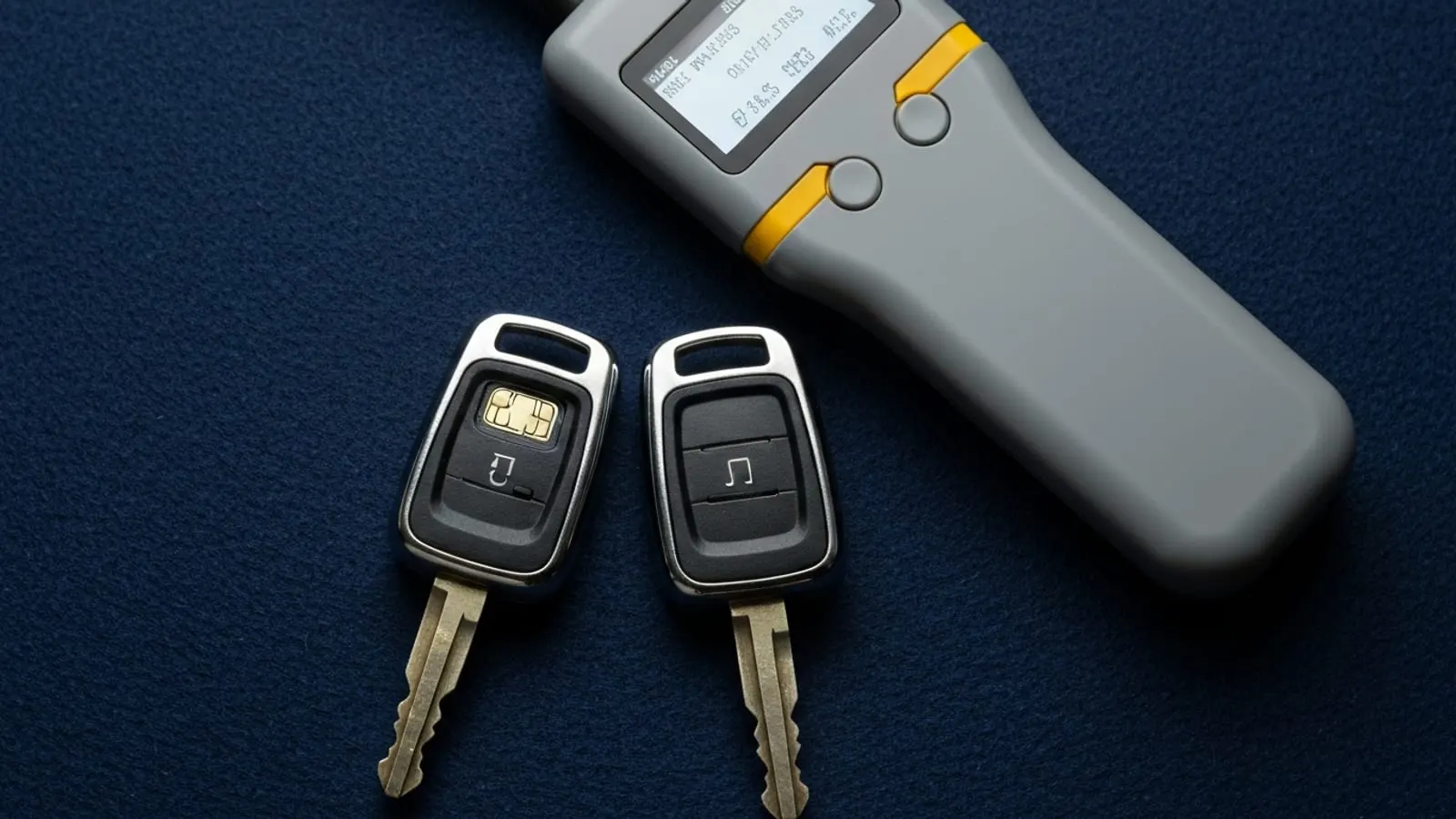
A transponder key is a mechanical key with a small radio- frequency identification (RFID) chip embedded in the plastic head. When you insert the key and turn the ignition (or, on push-to-start vehicles, when the key is in proximity), the vehicle's engine control module sends a low-power radio signal that energizes the chip. The chip responds with a coded ID — and if that code does not match what the vehicle has on file, the engine will not start. The blade is the lock; the chip is the alarm.
Transponder technology became effectively universal in the United States starting with model year 1996 vehicles, driven by federal anti-theft equipment standards and by an insurance industry that was paying for an epidemic of hot-wired thefts. Per the National Insurance Crime Bureau (NICB), the introduction of immobilizer systems dropped certain categories of vehicle theft by 40 percent or more over the following decade — until attackers adapted to attack the keys directly rather than bypass the ignition.
Programming a new transponder key means writing your vehicle's unique immobilizer code to a blank chip and registering that chip with the engine control module — a process that requires a diagnostic tool, a clean OEM-compatible blank, and (on most 2010-and-newer vehicles) NASTF Secure Data Release Model credentials for the technician. Per NASTF, the SDRM program exists specifically to ensure that key-coding access is granted only to vetted, background-checked locksmiths — the same credential we screen for in our partner network.
What it costs to cut and program a transponder key in 2026
Transponder replacement is the lowest-cost segment of modern automotive key work, but the gap between qualified mobile locksmiths and dealerships is still meaningful. Here is the honest 2026 pricing:
| Vehicle / key type | Mobile locksmith | Dealership |
|---|---|---|
| Basic transponder (most 1996-2010) | $180 - $260 | $280 - $400 |
| Basic transponder (2011-2018) | $200 - $300 | $320 - $475 |
| Flip / switchblade transponder | $220 - $320 | $330 - $475 |
| European basic transponder (Audi, VW, MINI, Volvo) | $260 - $400 | $420 - $650 |
| All-keys-lost surcharge | +$80 - $200 | +$200 - $500 (plus tow) |
Per the U.S. Bureau of Labor Statistics OEWS data for automotive technicians, the dealer labor rate is the largest cost driver in the dealership replacement gap. Dealerships carry overhead that mobile shops simply do not — facility, parts inventory, dealer-mandated tooling, and corporate warranty processing. The second driver, on all-keys-lost jobs, is the tow: dealerships almost always require the vehicle be brought in, adding $75 to $200 before any key work begins.
Per the AAA Your Driving Costs 2024 report, the average American driver spent over a thousand dollars on roadside-incident-related costs last year, and key-replacement events were among the most common cost categories. The mobile-locksmith path materially reduces both the cost and the day-of-event time penalty.
How CarKeyNation works for transponder jobs
Transponder programming is the most volume-heavy work in the automotive locksmith trade, and capability across our partner network is broad — but tool capability still varies by partner. We match by vehicle:
- Submit the form with year, make, model, and a one-line situation description. Takes 90 seconds.
- We route to a partner who covers your ZIP, has the tool for your specific make, and is currently available.
- One match, not five. The partner contacts you directly, confirms pricing in writing, and dispatches.
- Job completed on-site, with engine start verified before the technician leaves and a written invoice referencing VIN, key part number, and warranty.
What to expect on-site for transponder programming
- Identity and ownership verification. Driver's license and proof of ownership before any work begins. Per FTC and ALOA standards, this is required.
- Key file pull and decode. The technician connects a diagnostic tool to your OBD-II port, reads the vehicle's key file, and decodes the existing keys (where present).
- Blank cutting. Either on a code-driven cutter in the van (sidewinder, edge-cut, or laser-cut as appropriate) or by hand for some older vehicles.
- Programming. The new chip is paired to the vehicle's immobilizer. On all-keys-lost jobs, this also includes invalidating any previously-lost keys from immobilizer memory.
- Verification. Engine start, lock/unlock, panic, and (where applicable) remote-start are all tested. You should watch the technician perform every test before signing off.
- Written invoice + warranty. Per ALOA service standards, the invoice references the VIN, the specific key blank used, and the warranty terms on both work and hardware.
Typical timing: 20 to 45 minutes on most 1996-2010 vehicles, 30 to 60 minutes on most 2010-and-newer vehicles, plus 15 to 45 minutes for all-keys-lost programming. There is no shortcut — the pairing sequence is determined by the vehicle manufacturer's immobilizer protocol.
Why the marketplace model matters even for "simple" transponder jobs
Transponder programming looks like a commodity service — the same job done a million times a year across the country. In practice, the fragmentation of vehicle key architectures means that a partner who is excellent on a 2012 Camry may have no tool capability for a 2024 Volkswagen. Routing matters even when the underlying job sounds simple.
Per the FTC consumer protection bulletin on locksmith scams, scam operations buy Google Ads aggressively for low-cost emergency keywords like "transponder key cheap" — and the technician who arrives is unlicensed, undertrained, and quotes a much higher price on-site. Stranded customers in a hurry are the perfect target. A vetted marketplace filters that out upstream of the dispatch.
Per BrightLocal's 2024 Local Consumer Review Survey, 87 percent of consumers read online reviews before calling — but reviews on Google Maps for the locksmith category are increasingly poisoned by the same scam networks. The marketplace solves this by doing the verification once, centrally, and routing your job to a partner who has actually passed the bar.
The chip technology behind transponder keys, briefly explained
Understanding the underlying chip technology helps you avoid getting the wrong key. Modern automotive transponder chips fall into a handful of major families, and each family requires a different programming tool and different blank inventory.
- Megamos / Megamos Crypto — used by Audi, Volkswagen, SEAT, Skoda, Porsche, certain MINI, and some Honda. The crypto variant requires more advanced tools and a longer pairing sequence.
- Texas Instruments DST / DST+ / DST80 — used by Toyota, Lexus, Subaru, Ford, Mazda, Lincoln, and others. Among the most widely supported chips; nearly every qualified mobile shop handles these.
- Philips / NXP HITAG / HITAG-2 / HITAG Pro — used by BMW, Mercedes, Land Rover, and certain Hyundai/Kia. Newer HITAG generations require advanced diagnostic equipment.
- Hyundai / Kia 4D / 8A / 8C — Hyundai and Kia have run several generations of in-house chip technology. Tool support varies by year and specific model.
You do not need to remember any of this — your year, make, and model determine the chip type and tool requirement, and CarKeyNation's partner-matching system handles the lookup for you. The point of listing the families is to show why "just go to any locksmith" stopped being a viable strategy around 2010 when chip generations began fragmenting aggressively.
Industry insight on transponder work
“The transponder job has been around for thirty years, and people assume it is a commodity. It is not. The tool capability across manufacturers fragments harder every year — Volkswagen MQB, Hyundai 4D, Toyota H, Ford 80-bit — and the independent who is current on every one of those is a different operator than the independent who is current on two of them. The customer cannot tell the difference on a phone call. That is exactly what a marketplace is for: pre-screen the tool capability before the dispatch, so the customer is not paying for a wasted truck-roll.”
— ALOA-credentialed Automotive Locksmith, 12 years mobile specialty, Texas (anonymized)
Per the Associated Locksmiths of America (ALOA), the Master Automotive Locksmith (MAL) certification is the recognized industry credential for vetted automotive technicians and covers practical examinations on cutting, decoding, and programming. We screen for ALOA credentialing in our partner network, alongside NASTF Secure Data Release Model registration for vehicles that require it.
Common transponder scenarios we route every day
Scenario 1: Spare transponder for a new vehicle purchase
The most common non-emergency request: a recently-purchased vehicle came with only one working key. Adding a second key before you need it avoids the all-keys-lost surcharge that hits when the only key fails or goes missing. Most second-key jobs run at the low end of the ranges above and complete in 20 to 30 minutes on-site.
Scenario 2: Broken key blade with chip intact
A snapped blade with the chip head still in your hand is much cheaper than full replacement. The technician can transfer the existing chip to a new blank, cut the new blade to your door lock, and skip the immobilizer pairing entirely — typical cost is $80 to $140.
Scenario 3: All keys lost (no working key exists)
This is the most expensive transponder situation because the technician has to generate a new key file from the vehicle's immobilizer, cut a fresh blank, and pair the chip — all without a working key as a starting point. Expect 45 to 90 minutes on-site and pricing at the top of the ranges above, plus the all-keys-lost surcharge. Still meaningfully cheaper than the dealer path, which also requires a tow.
Scenario 4: Key turns ignition but engine cranks and stalls
Classic transponder rejection symptom. The blade is correct, the starter motor engages, but the engine immediately shuts down because the immobilizer did not recognize the chip. Most common causes: chip damage, interference from another nearby key, depleted (rare) chip battery, or a fault in the vehicle's immobilizer antenna. Diagnostic takes 10 to 20 minutes.
Frequently asked: transponder key programming
How much does transponder key programming cost?
A basic transponder key cut and programmed by a qualified mobile locksmith runs $180 to $260 on most domestic and Japanese vehicles, $220 to $320 for flip-style or switchblade transponders, and higher for European luxury. Dealerships typically run 35 to 60 percent more for the same key. Per the J.D. Power 2024 Customer Service Index Study, dealer service has continued to slip on price transparency, so the mobile-locksmith path is both cheaper and faster for most owners.
What is a transponder key and how do I know if I have one?
A transponder key has a tiny radio-frequency chip embedded in the plastic head of the key. When you turn the ignition or push start, the engine control module queries the chip — if the chip's coded response does not match what is on file in the vehicle, the engine will not start, even if the blade fits and turns the cylinder. Effectively every car built and sold in the United States from 1996 forward has a transponder system, per NHTSA's anti-theft equipment standards.
Can I program a transponder key myself?
On a handful of older Ford, Chrysler, Toyota, and Honda models from roughly 1996 through 2010, an on-board (ignition-cycle dance) procedure exists, and requires you to already have two working keys. For nearly every vehicle 2010 and newer, on-board procedures are gone — programming requires a professional diagnostic tool, an OEM key file pull, and (on many makes) NASTF Secure Data Release Model credentials.
How long does it take to cut and program a transponder key?
Typical timing is 20 to 45 minutes from technician arrival to a verified engine start on most pre-2010 vehicles, and 30 to 60 minutes on most 2010-and-newer models because of the additional immobilizer pairing step. All-keys-lost (no working key exists) can add 15 to 45 minutes depending on the make. Per ALOA service standards, the job should be completed in one visit on-site, never requiring a tow to a shop.
What if my key turns the ignition but the engine will not start?
That is the textbook symptom of a transponder failure — the mechanical blade is correct but the immobilizer is rejecting the chip. The most common causes are a worn or damaged chip, a depleted transponder battery (rare, most chips are passive), interference from another key, or a fault in the vehicle's immobilizer antenna. A qualified mobile automotive technician can diagnose in under 15 minutes and replace or reprogram as needed.
The bottom line on transponder keys
A modern transponder key job is no longer a commodity. It has become a tool-driven, credential-driven, chip-family-driven service where the difference between a routine 30-minute job and a wasted truck-roll is almost entirely about whether the technician who shows up has the right equipment for your specific vehicle. The cheapest path is not always the cheapest path, because a $99 dispatch that arrives without the right tool turns into two truck-rolls and a tow before you get your new key.
CarKeyNation exists to do the screening upstream of the dispatch. When you submit a transponder request through the form on our homepage, we match your year, make, and model against the tool capability profile of every partner in our network, and we send your job to one partner who is qualified, available, and within your service area. If the match fails for any reason, we re-route — at no additional cost to you, and without you re-filling the form. That is the entire value of a vetted marketplace over a Google Maps listing.
Sources & further reading
- NICB. Vehicle theft trends and immobilizer effectiveness data. nicb.org
- NASTF. Secure Data Release Model (SDRM) Program. nastf.org
- U.S. BLS. OEWS — Automotive Service Technicians, 2024. bls.gov
- AAA. Your Driving Costs 2024. aaa.com
- FTC. Locksmith Scams: When You Need a Locksmith. consumer.ftc.gov
- BrightLocal. Local Consumer Review Survey 2024. brightlocal.com
- ALOA. Master Automotive Locksmith (MAL) Certification. aloa.org
- J.D. Power. 2024 U.S. Customer Service Index (CSI) Study. jdpower.com
Need help right now? Submit a transponder-key request. Also useful: lost car keys, key fob programming, and automotive locksmith near me.
Frequently asked questions
Answers to what drivers ask most before requesting a specialist.
Ready to get rolling again?
Request a local specialist now — vetted, accountable, and matched to your vehicle.