Smart Key Replacement & Programming
Lost or broken push-to-start key? We match you with a specialist who has the OEM-compatible fobs and the right diagnostic tool for your exact vehicle. Most jobs run $280 to $475 on mainstream brands, $450 to $1,200 on luxury European, completed in one visit.
- Push-to-start and keyless entry
- OEM-compatible fobs
- On-site immobilizer pairing
- All major brands
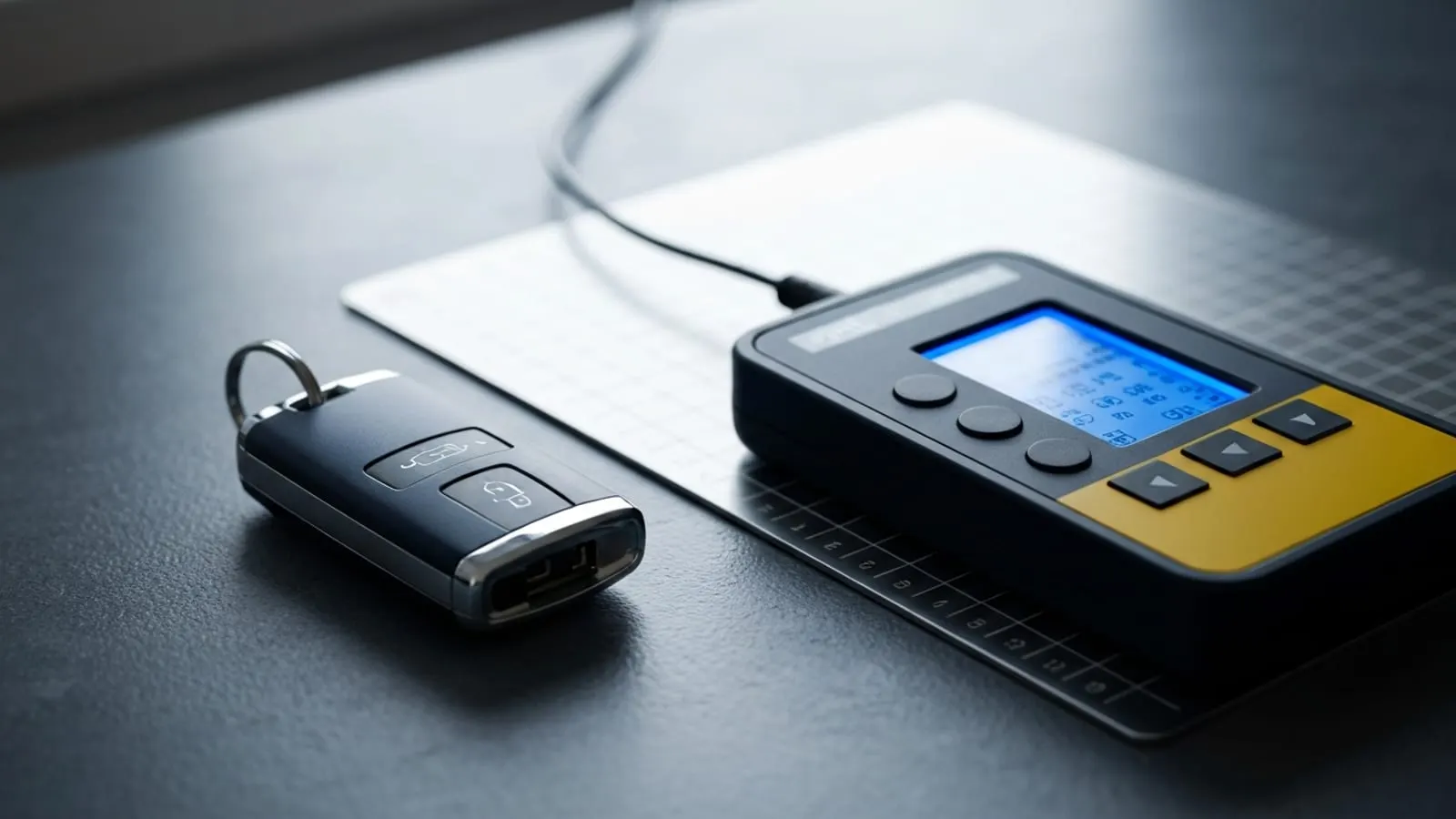
What a smart key actually is — and why replacement is different
A smart key (also called a proximity key, push-to-start fob, keyless-entry key, or by brand names like Toyota Smart Key, Ford Intelligent Access, BMW Comfort Access, Mercedes Keyless Go) is a small electronic device that does three jobs at once. It contains a low-power radio transmitter that lets the car detect when the key is near, an immobilizer chip that proves to the engine control module that this is an authorized key, and a button-driven remote that sends lock, unlock, panic, trunk, and remote-start commands. None of the three are interchangeable across vehicles — and that is what makes replacement more complex than a traditional key.
When a smart key is lost or broken, replacing it requires three coordinated steps: sourcing an OEM-compatible blank fob with the right frequency and chip type for your specific vehicle, cutting the emergency mechanical blade inside the fob to your door lock, and programming both the immobilizer and the body control module so the car recognizes the new fob for both starting and entry. Skipping any of those steps results in a key that either starts the car but does not unlock doors, unlocks the doors but does not start the car, or does neither — all of which we have seen on calls into CarKeyNation from customers who paid an underqualified locksmith somewhere else.
The growth of smart keys has been steep. Per the National Highway Traffic Safety Administration (NHTSA), keyless-ignition systems are now standard or available on the overwhelming majority of new vehicles sold in the United States, and the fleet of smart-key-equipped vehicles on the road continues to grow each model year. That means a service network has to keep up with the architecture of each new model — which is one of the reasons a marketplace that matches by VIN and tool capability outperforms a generic directory listing.
What it costs to replace a smart key in 2026
Smart-key replacement is more expensive than traditional transponder replacement, but the gap between qualified mobile locksmiths and dealerships has if anything widened in 2026. Here is the honest 2026 pricing picture:
| Brand / system | Mobile locksmith | Dealership |
|---|---|---|
| Toyota / Lexus Smart Key | $280 - $420 | $450 - $700 |
| Honda / Acura Smart Entry | $300 - $450 | $450 - $700 |
| Hyundai / Kia Smart Key | $280 - $400 | $400 - $650 |
| Ford Intelligent Access | $300 - $475 | $475 - $750 |
| GM (Chevy / GMC / Cadillac) | $320 - $475 | $475 - $800 |
| BMW Comfort Access | $450 - $850 | $700 - $1,300 |
| Mercedes Keyless Go | $500 - $900 | $850 - $1,500 |
| Audi Advanced Key | $450 - $850 | $700 - $1,300 |
| Range Rover / JLR | $650 - $1,200 | $950 - $1,800 |
Per the U.S. Bureau of Labor Statistics OEWS data for automotive technicians, the dealer labor rate is the single largest cost driver in the dealership replacement gap — dealers carry significant overhead that mobile locksmiths simply do not. The second driver is the tow: dealerships nearly always require a tow when no working key is present, adding $75 to $200 before any key work begins.
Per J.D. Power's 2024 U.S. Customer Service Index Study, dealer service satisfaction has declined in consecutive years, with wait time and price transparency cited as the top complaints by surveyed owners. A qualified mobile smart-key technician resolves both at the customer's location, on the same day.
How CarKeyNation matches you to the right smart-key specialist
Smart-key work is the most tool-intensive segment of the automotive locksmith trade. A technician who is excellent at cutting and programming a 2024 Toyota Camry may not have the OEM-licensed tool for a 2024 BMW X5. We solve that with a routing model that pre-screens for tool capability:
- You submit the form with year, make, model, and VIN (when you have it). Takes about 90 seconds.
- We filter the partner network by ZIP, by the specific tool capability your vehicle requires, and by current availability. For a 2024 Range Rover all-keys-lost, that filter is aggressive — and that is the point.
- One partner is matched, not five. The matched partner contacts you, confirms scope and price in writing, and dispatches.
- If the match fails for any reason, we re-route to the next best partner without you re-filling the form.
The marketplace model exists because tool capability is the real bottleneck in smart-key replacement — and a customer in a stressful situation should not be expected to vet that themselves over the phone. We do that work upstream of the dispatch.
Brands and systems we cover
The brands above are the systems we route most often, but we also handle Subaru, Mazda, Nissan / Infiniti, Volvo, Mini, Jaguar, Land Rover, Tesla (where applicable), and Stellantis (Chrysler, Dodge, Jeep, Ram). If your vehicle is not on the list above, submit a request and we will tell you within minutes whether we have a tool-qualified partner in your service area.
What to expect on-site for a smart-key job
- ID and ownership verification. The technician will ask for your driver's license and proof of vehicle ownership before programming begins. Per FTC and ALOA standards, this is required — never let a technician skip it.
- VIN read and key file pull. The tech connects a diagnostic tool to your OBD-II port and reads the vehicle's key file and security state.
- Mechanical blade cutting. The emergency blade inside the fob is cut to your specific door lock so the fob will open the door even if the battery is dead.
- Immobilizer programming. The new fob's chip is paired to the engine control module so the vehicle recognizes it as an authorized key.
- Body control module programming. The fob's remote functions (lock, unlock, panic, trunk, remote start) are paired to the body control module.
- Verification of every function. Engine start, push- to-start, walk-up unlock, all remote buttons, and remote-start (where equipped) are all tested. You should watch the tech perform every test.
- Written invoice + warranty. Per ALOA standards, you receive an invoice referencing the VIN, the specific fob part number, and the warranty terms on both the hardware and the programming.
Why a marketplace beats Google Maps for smart-key replacement
The biggest single risk in smart-key replacement is paying for a truck-roll where the technician arrives without the right tool. Per the FTC consumer protection bulletin on locksmith scams, scam locksmith operations buy local Google Ads with fake addresses specifically to capture emergency search traffic. The technician who arrives is unlicensed, undertrained, and quotes a much higher price on-site than what was promised on the phone — and stranded customers often pay rather than wait for a second tech.
Per BrightLocal's 2024 Local Consumer Review Survey, 87 percent of consumers read online reviews before calling — but reviews on Google Maps are increasingly poisoned by the same scam networks that buy fake addresses. A vetted marketplace does the verification once, centrally, with insurance verification, license verification, and tool capability mapping — then routes the job to a partner who actually has the equipment to finish it.
Industry insight on smart-key work
“The smart-key tool stack has become a real capital investment for mobile shops. A full kit — Autel, AVDI, CG Pro, OEM-licensed subscriptions — can run thirty to sixty thousand dollars and requires constant software updates. The independent who is keeping that tool stack current is who you want on a 2024 BMW or a 2024 Range Rover. The independent who is doing smart-key work with a five-hundred-dollar starter kit is who gets you a second truck-roll. A marketplace that screens for that investment is doing real value for the customer, because the customer cannot verify it themselves on a panicked phone call.”
— ALOA-MAL credentialed Master Automotive Locksmith, 18 years mobile automotive specialty, DFW metro (anonymized)
Per NASTF's Secure Data Release Model program, automotive locksmiths who pair keys on 2010-and-newer vehicles for many makes must hold an active SDRM registration. Per the Associated Locksmiths of America (ALOA), the Master Automotive Locksmith (MAL) certification indicates the technician has passed practical examinations on cutting, decoding, and programming across multiple vehicle architectures — and remains the most reliable credential for vetting smart-key technicians.
Common smart-key scenarios we route every day
Scenario 1: Spare smart key for a new vehicle purchase
The most common non-emergency request: you just bought a new (or new-to-you) vehicle and it came with only one smart key. Industry best practice and most manufacturer owner manuals recommend two working keys at all times — partly so you have a backup if one is lost, partly because all-keys-lost programming on a modern smart-key vehicle is meaningfully more expensive than adding a second key when you still have one working. Typical second-key cost is at the lower end of the ranges above because no all-keys-lost surcharge applies and the immobilizer pairing is faster.
Scenario 2: Damaged or broken smart fob
A cracked case, water damage from a washing-machine cycle, or a broken emergency blade can all kill a smart fob. Most of the time the chip inside survives, which means the existing fob can be re-housed in a new shell rather than fully replaced — a 20-minute job at roughly half the cost of a fresh key. If the chip is also damaged, full replacement is required and pricing follows the table above.
Scenario 3: All keys lost on a luxury European vehicle
The most complex routine job in modern automotive locksmithing. The technician has to source an OEM-compatible blank with the correct frequency, cut the emergency blade, and run a full immobilizer pairing sequence — often requiring removal and bench-programming of a vehicle module on Range Rover, certain BMW, and certain Mercedes models. Pricing runs at the top of the ranges above, but a qualified mobile technician is still meaningfully faster and cheaper than the dealer path (which requires a tow plus several days of scheduling).
Scenario 4: Fob works intermittently or only at very close range
Usually a dying fob battery, but sometimes a failing low-frequency antenna in the vehicle or interference from another nearby fob. A mobile technician can diagnose in 10 to 15 minutes, swap the battery on the spot if that is the issue, or re-pair with the diagnostic tool if a software issue is the cause.
Frequently asked: smart key replacement
How much does smart key replacement cost?
Mobile smart key replacement runs $280 to $475 for most mainstream brands (Toyota, Honda, Hyundai, Ford, GM) and $450 to $1,200 for luxury European brands (BMW, Mercedes, Audi, Range Rover). Dealerships typically charge 40 to 60 percent more for the same key and almost always require a tow when no working key is present. Per J.D. Power's 2024 Customer Service Index, dealership service has continued to lose ground on both wait time and price transparency.
Can a locksmith really program a smart key, or do I have to go to the dealer?
Yes — a qualified mobile automotive locksmith with the right diagnostic tool can program smart keys for most vehicles, including the immobilizer pairing and the keyless-entry / push-to-start functions. Per NASTF's Secure Data Release Model program, automotive locksmiths who pair keys on 2010-and-newer vehicles for many makes must hold an active SDRM registration — a credential that requires background check and ongoing compliance. CarKeyNation only routes smart-key jobs to partners with the right tool and credential for your specific vehicle.
Why are smart keys so much more expensive than regular keys?
Two reasons: the hardware and the labor. The fob itself contains an LF (low-frequency) coil, an RF transmitter, the immobilizer chip, plus the casing and battery — OEM-compatible blanks cost $80 to $400 wholesale versus $5 to $25 for a basic transponder. The labor is also more involved because pairing a smart key requires both immobilizer programming (to allow engine start) and body control module programming (to allow keyless entry and remote start).
How long does smart key programming take?
Plan on 45 to 90 minutes for most mainstream smart keys, and 60 to 120 minutes for luxury European systems with full all-keys-lost programming. The pairing sequence is determined by the vehicle manufacturer's security protocol — there is no shortcut, and a technician who claims one is the wrong technician. Per ALOA service standards, the job should be completed in one visit with engine start, lock/unlock, panic, and remote-start (where equipped) all verified before the tech leaves.
Can I program a smart key myself with a kit from Amazon?
Generally no, with very few exceptions. The cheap programming kits sold online work only on a handful of older Honda and Toyota models, and even on those they often fail to pair the remote functions correctly. For any vehicle 2015 or newer, professional programming with a manufacturer-licensed diagnostic tool is required. The savings of DIY are not real when you count the time, the failed attempts, and the eventual professional callout to undo the mess.
Sources & further reading
- NHTSA. Vehicle Safety Research and Keyless Ignition Data. nhtsa.gov
- U.S. Bureau of Labor Statistics. OEWS — Automotive Service Technicians and Mechanics, 2024. bls.gov OEWS 49-3031
- J.D. Power. 2024 U.S. Customer Service Index (CSI) Study. jdpower.com
- Federal Trade Commission. Locksmith Scams. consumer.ftc.gov
- BrightLocal. Local Consumer Review Survey 2024. brightlocal.com
- NASTF. Secure Data Release Model (SDRM) Program. nastf.org
- ALOA. Master Automotive Locksmith (MAL) Certification. aloa.org
Need help right now? Submit a smart-key request. Also useful: lost car keys, proximity key replacement, and automotive locksmith near me.
Frequently asked questions
Answers to what drivers ask most before requesting a specialist.
Ready to get rolling again?
Request a local specialist now — vetted, accountable, and matched to your vehicle.