Proximity Key Replacement
Proximity keys let you unlock and start your vehicle without taking the fob out. We match you with a specialist who has the right blank and the tool to pair it. Most jobs run $280 to $1,200 depending on brand, completed in one visit.
- Keyless entry pairing
- Engine-start verification
- All major brands
- Mobile service
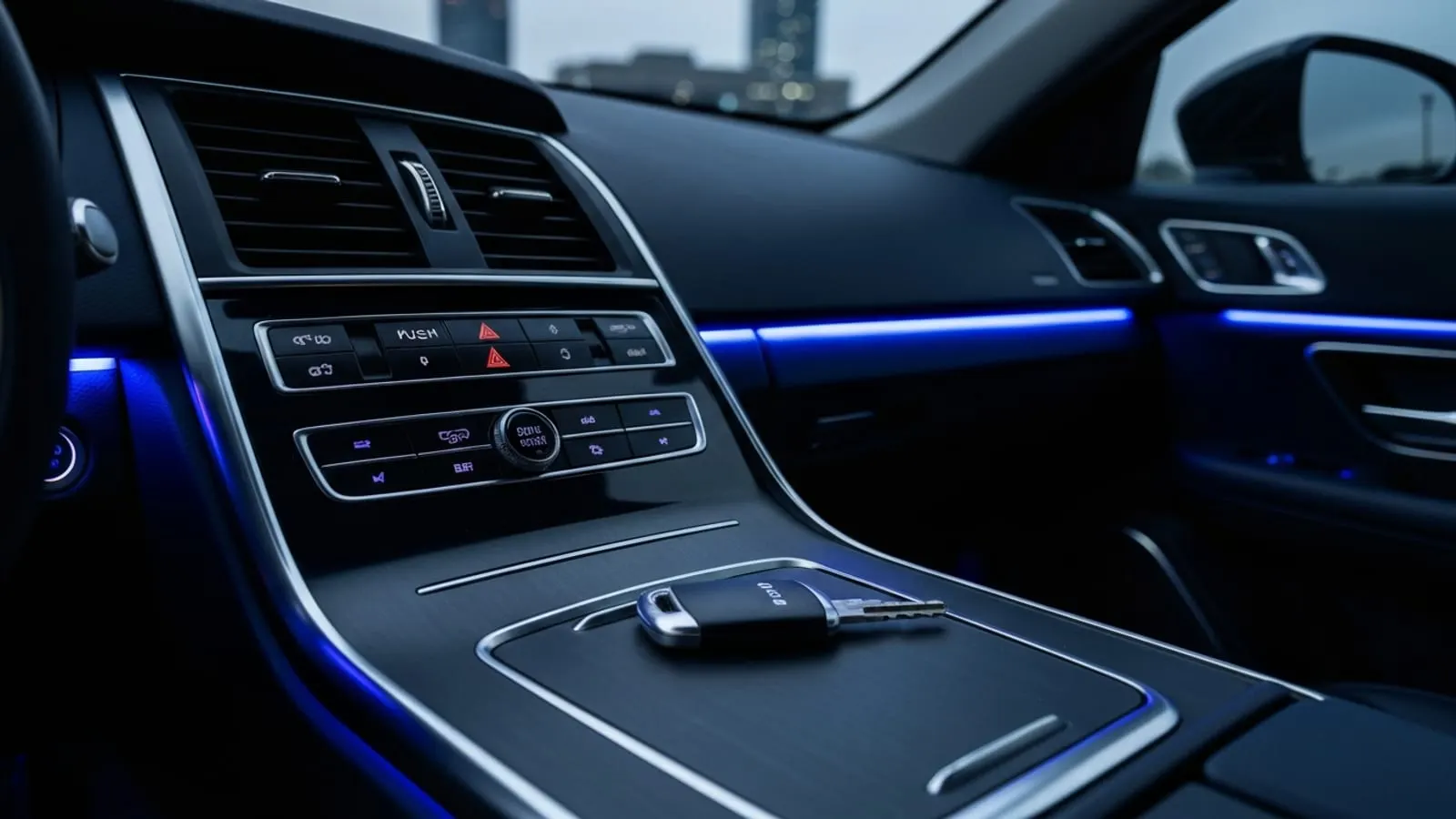
What a proximity key is — and why it is the modern standard
A proximity key (also called a smart key, push-to- start fob, walk-up-and-unlock fob, or by brand names like Toyota Smart Key, Ford Intelligent Access, BMW Comfort Access, Mercedes Keyless Go) is a small electronic device that lets you unlock the doors by walking up to the vehicle and start the engine with a button press — all without taking the key out of your pocket. The fob and the car communicate via low-frequency radio when the fob is within a few feet, which is what proximity means in this context.
Under the hood, a proximity key contains four things: an immobilizer chip (proves to the engine control module that this is an authorized key), a low-frequency receiver (listens for the vehicle's wake-up ping), an RF transmitter (sends lock/unlock/panic/trunk commands when you press a button), and an emergency mechanical blade (lets you unlock the door if the fob battery dies). All four have to be working and paired correctly for a proximity key to fully function.
The growth of proximity keys has been dramatic. Per the National Highway Traffic Safety Administration (NHTSA), keyless-ignition systems are now standard or available on the overwhelming majority of new vehicles sold in the United States. The fleet of proximity-key-equipped vehicles continues to grow each model year, which has steadily raised the technical bar for automotive locksmith work — a partner who is current on 2024 model-year proximity systems is a different operator from one who stopped updating their tool stack in 2018.
What it costs to replace a proximity key in 2026
| Brand / system | Mobile locksmith | Dealership |
|---|---|---|
| Toyota / Lexus Smart Key | $280 - $420 | $450 - $700 |
| Honda / Acura Smart Entry | $300 - $450 | $450 - $700 |
| Hyundai / Kia Smart Key | $280 - $400 | $400 - $650 |
| Ford Intelligent Access | $300 - $475 | $475 - $750 |
| GM (Chevy / GMC / Cadillac) | $320 - $475 | $475 - $800 |
| BMW Comfort Access | $450 - $850 | $700 - $1,300 |
| Mercedes Keyless Go | $500 - $900 | $850 - $1,500 |
| Audi Advanced Key | $450 - $850 | $700 - $1,300 |
| Range Rover / JLR | $650 - $1,200 | $950 - $1,800 |
| All-keys-lost surcharge | +$100 - $250 | +$200 - $500 (plus tow) |
Per the U.S. Bureau of Labor Statistics OEWS data for automotive technicians, the dealer labor rate is the largest cost driver in the dealer replacement gap. Dealerships carry overhead that mobile shops simply do not — facility, parts inventory, dealer-specific tooling, and corporate warranty processing. The second driver, on all-keys-lost jobs, is the tow: dealerships almost always require the vehicle be brought in, adding $75 to $200 before any key work begins.
Per the AAA Your Driving Costs 2024 report, the average American driver spent over a thousand dollars on roadside-incident-related costs last year, and lost-key situations were among the most common categories. The mobile-locksmith path materially reduces both the dollar cost and the day-of-event time penalty.
How CarKeyNation matches you to a proximity-key specialist
- Submit the form with year, make, model, and a one- line description of the situation. Takes about 90 seconds. No account needed.
- We filter the partner network by ZIP, by the specific tool capability your vehicle requires (proximity-key tool stacks vary widely by brand), and by current availability.
- One partner is matched, not five. The matched partner contacts you, confirms scope and price in writing, and dispatches.
- If the match fails for any reason (technician on a longer job than expected, equipment problem, change of plans), we re-route to the next best partner without you re-filling the form.
Proximity-key work is the most tool-fragmented segment of the automotive locksmith trade. A technician who is excellent on a 2024 Toyota Camry may not have the OEM-licensed tool for a 2024 BMW X5. We solve that by pre-screening tool capability before the dispatch, rather than asking the customer to do that vetting on a stressed phone call.
What to expect on-site for a proximity-key job
- ID and ownership verification. Driver's license and proof of ownership before any work begins. Per FTC and ALOA standards, this is required.
- VIN read and key file pull. The technician connects a diagnostic tool to your OBD-II port and reads the vehicle's key file and security state.
- Mechanical blade cutting. The emergency blade inside the fob is cut to your specific door lock so the fob will open the door even if the battery is dead.
- Immobilizer programming. The new fob's chip is paired to the engine control module.
- Body control module programming. The fob's remote functions (lock, unlock, panic, trunk, remote start) are paired to the body control module.
- Verification of every function. Walk-up unlock, push-to-start, all remote buttons, and remote-start (where equipped) are all tested. You should watch the technician perform every test.
- Written invoice + warranty. Per ALOA standards, the invoice references the VIN, the specific fob part number, and warranty terms.
Common proximity-key scenarios we route every day
Scenario 1: Spare proximity key for a new vehicle
The most common non-emergency request: a newly-purchased vehicle came with only one proximity key. Adding a second key before you need it avoids the all-keys-lost surcharge and is meaningfully cheaper than waiting until the only key is gone.
Scenario 2: Damaged or cracked smart fob
A cracked case, water exposure, or a broken emergency blade can all compromise a proximity fob. Most of the time the chip and circuit board inside survive, which means a shell swap restores the fob for roughly half the cost of a full replacement.
Scenario 3: All keys lost on a modern luxury SUV
The most complex routine job in modern automotive locksmithing. The technician has to source an OEM-compatible blank, cut the emergency blade, and run a full immobilizer pairing sequence — often requiring removal and bench-programming of a vehicle module on Range Rover, certain BMW, and certain Mercedes models.
Scenario 4: Walk-up unlock works intermittently
Usually a dying fob battery, but sometimes a failing low-frequency antenna in the vehicle (most modern vehicles have multiple antennas distributed around the car for proximity detection). A mobile technician can diagnose in 10 to 15 minutes.
Why the marketplace model matters for proximity-key work
Per the FTC consumer protection bulletin on locksmith scams, scam locksmith operations aggressively target the emergency lockout and lost-key search space — exactly where stranded proximity-key owners go for help. Per BrightLocal's 2024 Local Consumer Review Survey, 87 percent of consumers read reviews before calling, but reviews on Google Maps for the locksmith category are increasingly poisoned by the same scam networks. A vetted marketplace solves this once, centrally.
Industry insight on proximity-key work
“Proximity-key work is where the automotive locksmith trade has gotten really technical in the last five years. The tool licensing alone for a current BMW or current Range Rover can run several thousand dollars a year, and the software updates have to be kept current weekly. The independent who is making that investment is a different operator than the independent who is winging it with a three-year-old tablet. A marketplace that screens for that investment is doing real value for the customer.”
— ALOA-MAL credentialed Master Automotive Locksmith, 17 years mobile automotive specialty, Texas (anonymized)
Per NASTF's Secure Data Release Model program, automotive locksmiths who pair keys on 2010-and-newer vehicles for many makes must hold an active SDRM registration. Per the Associated Locksmiths of America (ALOA), the Master Automotive Locksmith (MAL) certification is the recognized industry credential. We screen for both in our partner network.
Frequently asked: proximity key replacement
How much does proximity key replacement cost?
Proximity key replacement runs $280 to $475 on mainstream brands (Toyota, Honda, Hyundai, Ford, GM) and $450 to $1,200 on luxury European brands (BMW, Mercedes, Audi, Range Rover). Dealerships typically run 40 to 60 percent more for the same key and almost always require a tow when no working key is present. Per J.D. Power's 2024 Customer Service Index, dealership service has continued to slip on price transparency.
What is the difference between a proximity key and a smart key?
There is no functional difference — the terms are used interchangeably by different manufacturers. Toyota and Lexus call them Smart Keys; Ford calls them Intelligent Access; BMW calls them Comfort Access; Mercedes calls them Keyless Go. All of them are proximity-detected fobs that allow walk-up unlock and push-to-start with the fob in your pocket. The underlying technology is the same.
Can a locksmith program a proximity key, or do I have to go to the dealer?
Yes — a qualified mobile automotive locksmith with the right diagnostic tool can program proximity keys for nearly all makes and models, including the immobilizer pairing and the keyless-entry / push-to-start functions. Per NASTF's Secure Data Release Model program, technicians who pair keys on 2010-and-newer vehicles for many makes must hold an active SDRM registration.
Why is my proximity key not detected by the vehicle anymore?
Most common: dead fob battery (a $3 fix). Second most common: the fob has lost its pairing with the body control module due to a battery disconnect, a low vehicle battery, or a firmware reset. Less common: a failed low-frequency antenna in the vehicle, or physical damage to the fob's internal coil. A qualified mobile technician can diagnose in 10 to 15 minutes.
How long does proximity key programming take?
45 to 90 minutes for most mainstream proximity keys, and 60 to 120 minutes for luxury European systems with full all-keys-lost programming. The pairing sequence is determined by the vehicle manufacturer's security protocol — there is no shortcut, and a technician who claims one is the wrong technician.
The bottom line on proximity-key replacement
Proximity keys are now the dominant key architecture across the modern fleet, and replacement has become more tool-driven and more credential-driven than at any point in the trade's history. The difference between a routine 60-minute job and a wasted truck-roll is almost entirely about whether the technician who shows up has the right OEM-licensed diagnostic tool for your specific vehicle. That is not a verification a customer can reasonably do over the phone in a stressed moment.
CarKeyNation exists to do the screening upstream of the dispatch. When you submit a proximity-key request through the form on our homepage, we match your year, make, and model against the tool capability profile of every partner in our network, and we send the job to one partner who is qualified, available, and in your service area. If the match fails for any reason, we re-route — at no additional cost to you, and without you re-filling the form. That is the entire value of a vetted marketplace over a Google Maps listing.
Pricing transparency, mobile service that does not require a tow, and accountability for the work all come from the same source: a partner network we have already vetted on insurance, license, and tool capability before they ever get dispatched to a customer. The customer's job becomes simple — submit the form, wait for one partner to call, schedule a time. Everything else happens upstream.
One last practical note for proximity-key customers specifically: the single highest-leverage action any owner can take, regardless of make or model, is to keep a verified spare fob programmed and stored somewhere off-vehicle. Per the U.S. Bureau of Labor Statistics, the locksmith trade nationwide carries between roughly thirteen and seventeen thousand workers, which means even a fast-responding metro market can occasionally see overnight or weekend service windows that stretch into the next business morning. A working spare fob — stored at home, in an office, or with a trusted family member — converts an all-keys-lost emergency into a routine spare-key job. That single fact has saved CarKeyNation customers many hundreds of dollars in tow fees, dealer scheduling delays, and lost time over the course of any given year.
A short history of proximity-key technology — for context
Understanding where proximity keys came from helps explain why replacement has become more expensive and more tool-driven each model year.
1998 — first commercial proximity systems. Mercedes-Benz introduced Keyless Go on the W220 S-Class, the first mass-produced vehicle with walk-up unlock and button-start. Early systems were simple, the immobilizer pairing was rudimentary, and replacement was effectively a dealer-only proposition because there were no third-party tools.
2002 to 2010 — adoption across the luxury segment. BMW Comfort Access, Lexus Smart Key, Cadillac Adaptive Remote Start, and similar systems rolled out across luxury brands. Third-party diagnostic tools began catching up to dealer-only capability by the end of this period, opening up the mobile-locksmith market for these vehicles.
2010 to 2018 — mainstream adoption. Proximity keys became standard or available on most mainstream vehicles. NASTF launched the Secure Data Release Model program in this era to regulate key-coding access for automotive locksmiths working on newer vehicles. Per NASTF, the SDRM credential is now required for many key-coding operations across multiple manufacturers.
2018 to today — high-security rolling-code architectures. Manufacturers have implemented increasingly sophisticated rolling- code and challenge-response protocols partly in response to the relay-attack vulnerabilities that plagued earlier proximity systems. The result is that current-model-year proximity keys require more advanced (and more expensive) tools to program, which is why the tool-stack investment for a qualified mobile shop has continued to climb.
For consumers, the practical upshot is simple: the partner who is excellent on a 2015 Camry proximity job may not have the tool stack for a 2024 Range Rover. That fragmentation is exactly why a marketplace that matches by year-make-model has become the most reliable way to get qualified help.
Sources & further reading
- NHTSA. Vehicle Safety Research and Keyless Ignition Data. nhtsa.gov
- U.S. BLS. OEWS — Automotive Service Technicians, 2024. bls.gov
- AAA. Your Driving Costs 2024. aaa.com
- J.D. Power. 2024 U.S. Customer Service Index Study. jdpower.com
- FTC. Locksmith Scams. consumer.ftc.gov
- BrightLocal. Local Consumer Review Survey 2024. brightlocal.com
- NASTF. Secure Data Release Model Program. nastf.org
- ALOA. Master Automotive Locksmith Certification. aloa.org
Need help right now? Submit a proximity-key request. Also useful: smart key replacement, key fob programming, and lost car keys.
Frequently asked questions
Answers to what drivers ask most before requesting a specialist.
Ready to get rolling again?
Request a local specialist now — vetted, accountable, and matched to your vehicle.