Pay only for leads you receive.
$25 per delivered lead. No subscriptions. No minimums. No contracts. Fund your wallet once, get matched to real customer requests in your service area — and only get charged when a lead is actually delivered to you.
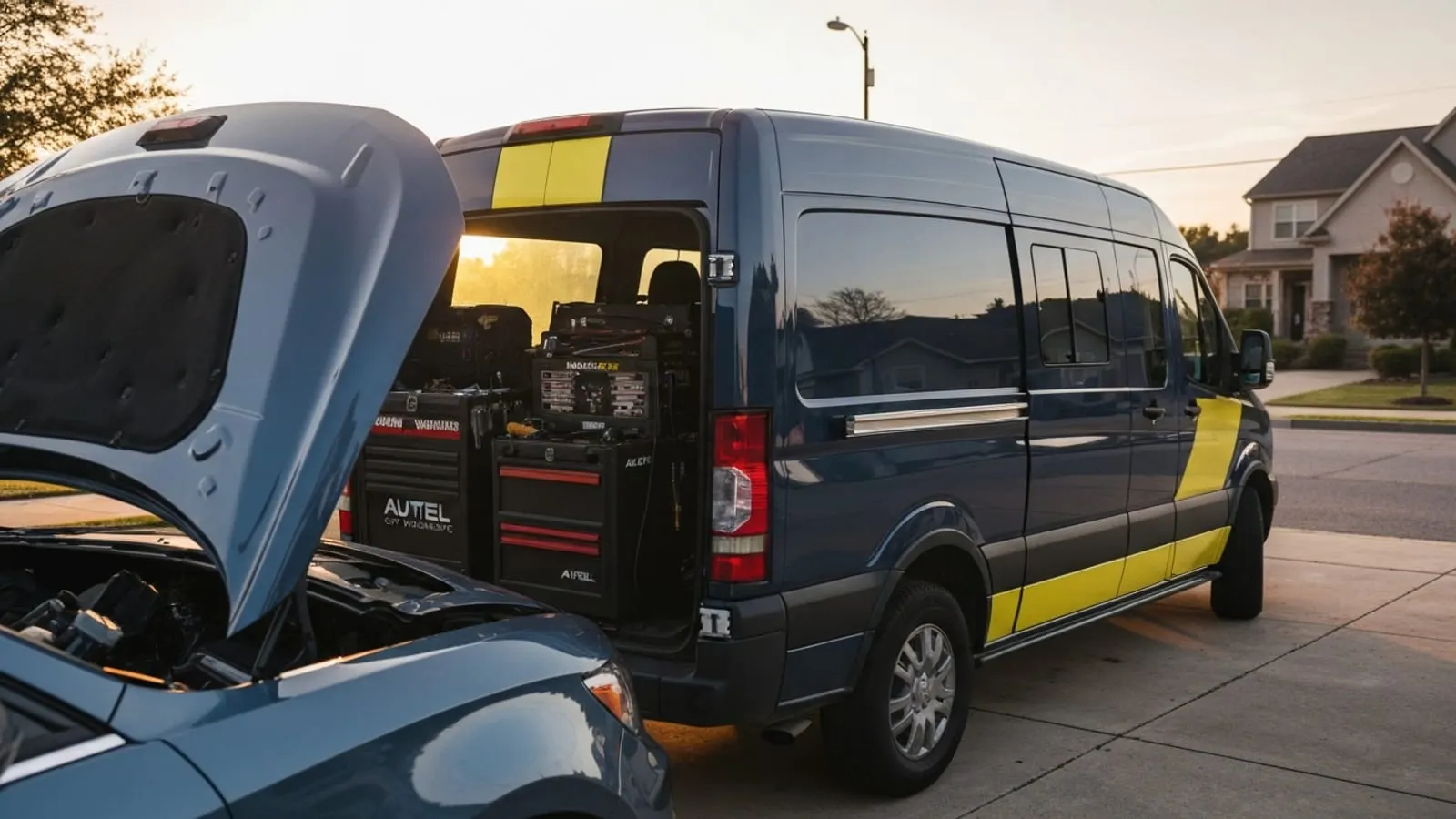
How partner pricing works
No more guessing if your monthly subscription will pay for itself. You only pay when a real, verified lead lands in your inbox.
1. Apply (5 min)
Tell us your business, service area, vehicle makes you handle, and license info. Approval in one business day.
2. Fund your wallet ($100 min)
Add $100, $250, $500 or $1,000 via Stripe. The same wallet covers every lead you accept — no monthly bills, no surprises.
3. Get matched leads ($25 each)
When a customer in your service area submits a request that matches your makes, we deduct $25 from your wallet and route the lead to you in real-time.
Why $25 a lead?
Industry-standard pay-per-lead pricing for automotive locksmith work runs $40 to $80 a lead on directories like Thumbtack, Angi, and HomeAdvisor. According to FieldEdge's home-services lead-cost benchmark, directories often capture 15-40% of a partner's revenue per job — a tax most independents can't pass back to the customer.
We price aggressively at $25 because we'd rather have you working on jobs than calculating CPL break-even. At $25, even a one-key replacement at $180 returns a 7× margin. A smart-key job at $450 returns 18×.
We also give you the right to dispute any lead within 24 hours — wrong number, wrong vehicle, outside service area, duplicate, or already serviced. Approved disputes refund your wallet in full.
Cost per automotive lead, by source
- Thumbtack (automotive locksmith)$45-95
- Angi / HomeAdvisor (automotive)$40-80
- HomeGuide / Networx$30-65
- CarKeyNation$25
Benchmark ranges from public Thumbtack pro forums, Angi partner enrollment materials, and HomeAdvisor service-pro CPL screenshots collected May 2026.
What you get per lead
Every delivered lead includes the full customer context — no cold-calling unqualified strangers.
- Verified customer contact (name, phone, email)
- Vehicle year, make, model, key situation
- Service type + urgency tag
- Photos when uploaded by the customer
- Real-time SMS + email delivery
- 24-hour dispute window — wrong info? Wallet refunded.
The economics behind why $25 per lead works
Industry-standard pay-per-lead pricing for automotive locksmith work runs $40 to $95 per lead on the major directories. Per FieldEdge's home-services lead-cost benchmark, directories often capture 15 to 40 percent of a partner's revenue per job — a tax most independents cannot pass back to the customer without losing the work to a competitor. The economics force partners to quote aggressively, push for unnecessary upsells, or skip vetting steps just to keep margin.
We price at $25 per delivered lead with no monthly subscription because we would rather have our partners working on jobs than calculating CPL break-even. At $25 per lead, a single transponder job at $180 returns a 7x margin. A smart-key job at $450 returns 18x. A luxury European AKL job at $850 returns 34x. That economics keeps the partner healthy enough to quote customers honest prices and do careful work — which feeds the matching engine quality, which drives customer satisfaction, which drives partner volume. The whole loop has to work together.
Per the U.S. Bureau of Labor Statistics OEWS data for automotive technicians, the median locksmith hourly wage has continued to climb as the tool-licensing burden for modern vehicles increases. The lead economics matters more than ever — a partner who is paying $80 per lead on top of $30K/year in tool licensing has very little margin left to absorb a bad lead. Our model is designed to leave that margin for the operator.
What the vetting process looks like
We screen every applicant for three signals before they enter the network — and re-verify on an ongoing basis.
- Verifiable business address. Not just a phone number. We confirm the physical address against state business records and (where applicable) a brief site visit or video walk- through of the operation. Per the FTC consumer protection bulletin on locksmith scams, this is the single biggest signal separating legitimate operators from scams.
- Active state locksmith license where your state requires one. Texas (DPS Private Security Bureau), California (BSIS), North Carolina, Tennessee, Connecticut, Maryland, Nevada, Oklahoma, Louisiana, Illinois, New Jersey, Virginia, and Alabama all require some form of state locksmith licensing. We verify against the state's licensing database.
- Industry credentialing. Either ALOA Master Automotive Locksmith (MAL) credentialing or NASTF Secure Data Release Model registration is required for partners who do work on 2010-and-newer vehicles. Many partners hold both.
On top of those three signals, we maintain a per-partner tool capability profile mapping which makes and model-years you can program. That profile drives the matching engine — your jobs will only be the ones you can actually finish, not whatever happens to come in to your ZIP.
The dispute and accountability system
A pay-per-lead marketplace only works if both sides have real recourse when something goes wrong. Our dispute system is designed to make legitimate complaints easy to file and fast to resolve — on both sides.
Partner-side disputes (you, against a lead)
- Wrong number — phone number provided in the lead is disconnected, not in service, or belongs to someone other than the requester.
- Wrong vehicle — vehicle details in the lead do not match the actual vehicle on arrival.
- Outside declared service area — the address is meaningfully outside the ZIP codes you have on file as your coverage area.
- Duplicate — the same customer submitted the same job multiple times within a short window.
- Already serviced — the customer already had the work done by another shop before you arrived.
Submit the dispute via the partner portal within 24 hours of lead delivery. We investigate within one business day. Approved disputes refund the $25 lead fee to your wallet in full.
Customer-side escalations (customer, against a partner)
- Partner did not show up within the agreed window.
- Quote-and-switch — partner quoted one price on the phone and another price on-site without a legitimate scope change.
- Work quality issues — key does not start the vehicle, fob does not pair, or other functional failures.
- Unprofessional conduct by the on-site technician.
Approved customer escalations result in partner penalty proportional to severity — first-time minor issues get a warning, repeated issues get match-priority reductions, serious or repeated quality failures result in removal from the network. This accountability loop is what keeps lead quality high for the partner side and trust high for the customer side.
Industry insight on the partner side of the marketplace
“The directories killed the small-shop margin a decade ago. You pay $80 a lead, and four other shops paid the same $80 for the same lead. By the time you call the customer, two of those shops have already quoted aggressively and one has lied about their credentials. Then the customer picks whichever shop quoted lowest, and you write off the $80. A pay-per-delivered-lead model with one match per customer is the only way the small shop economics survives long term.”
— ALOA-MAL credentialed Master Automotive Locksmith, 18 years mobile automotive specialty, Texas (anonymized)
Per the J.D. Power 2024 U.S. Customer Service Index Study, customer satisfaction in automotive service has been declining for consecutive years on both wait time and price transparency. Independent mobile operators with healthy lead economics are structurally positioned to outperform the dealer service department on both axes — but only if the lead-cost structure leaves them room to do so.
Frequently asked: partner pricing
How does the $25 per lead pricing actually work?
You fund your wallet via Stripe (minimum $100). When a customer in your service area submits a matched request, $25 is deducted from your wallet and the lead is delivered to you in real-time via SMS and email. No monthly subscription, no minimums, no contracts. You only pay for delivered leads — not for being listed.
Can I dispute a bad lead?
Yes. Every delivered lead has a 24-hour dispute window. Valid dispute reasons include wrong number, wrong vehicle, outside your declared service area, duplicate of a previous lead, or job already serviced. Approved disputes refund your wallet in full.
What credentials do I need to join the network?
Three signals: a verifiable business address, an active state locksmith license where required (per Texas DPS, California BSIS, or equivalent), and either ALOA Master Automotive Locksmith credentialing or NASTF Secure Data Release Model registration for modern vehicle work. We re-verify on an ongoing basis.
Do I have to take every matched lead?
No. You can accept or decline any matched lead within a short window. Declined leads do not deduct from your wallet — only delivered (accepted) leads do. Consistently declining leads in your declared service area lowers your match priority, so we recommend setting your service area to match what you actually want to take.
What partner success looks like across the network
The partner-side metrics that matter most to us are not vanity numbers. They are the inputs to the consumer-facing experience. Here is what we look for in a healthy partner and what we have observed across the network so far.
- Lead-to-job conversion rate — what fraction of delivered leads turn into completed paid jobs. Healthy partners run 65 to 85 percent. Below 50 percent usually means coverage area is too aggressive or quoting practice needs tightening.
- Average response time to delivered lead — how quickly the partner calls or texts the customer after lead delivery. Top partners are under 10 minutes during business hours.
- Quote-to-invoice variance — how often the final invoice matches the not-to-exceed quote. Healthy partners are above 90 percent match rate without scope-change justification.
- Post-job customer rating — average score from our short post-job survey. Network average tracks above 4.6 on a 5-point scale.
- Dispute rate — percentage of delivered leads disputed by either side. Healthy partners stay below 5 percent. Above 10 percent triggers a quality review.
These metrics feed back into match priority. Partners who run healthy on all five get more matched leads. Partners who lapse on one or more get reduced priority until the metric recovers. The system is designed so that the partners who treat customers well win more business — which is exactly the structural alignment a working marketplace needs.
A practical guide to setting your coverage area and tool profile
Two settings determine how many matched leads you get and how successful you are at converting them: your declared coverage area and your tool capability profile. Getting these right is the single biggest lever a partner has over their CarKeyNation economics.
Setting your coverage area
Coverage area is a list of ZIP codes you actively serve. The matching engine sends you leads from those ZIPs (and, for metro-edge ZIPs, adjacent ZIPs as a fallback tier when no in-ZIP partner is available).
The temptation is to claim every ZIP within a one-hour drive radius. The discipline is to claim only the ZIPs you can actually reach in a reasonable response window — typically 30 to 60 minutes door-to-door. Over-claimed coverage areas generate leads you cannot respond to fast enough, which lowers your conversion rate, which lowers your match priority, which lowers your future lead flow. The short-term gain (more leads delivered) becomes a long-term loss (worse positioning across the engine).
Most healthy single-truck partners cover 5 to 15 ZIPs. Multi-truck operations cover 15 to 40. Beyond 40 starts to look like a directory listing rather than a serious mobile operation, and the engine will start to deprioritize you relative to more focused partners in the same metro.
Setting your tool capability profile
The tool profile tells the engine which makes and model-years your diagnostic tool stack can handle. You declare it once and update when your tool stack changes.
Honesty here protects everyone. If you declare capability for a 2024 Range Rover you cannot actually program, the engine will match you to that vehicle, you will arrive without the right tool, the customer will be frustrated, and you will eat the truck-roll cost. The opposite mistake — under-declaring capability — costs you matched leads you could have completed. The honest middle ground is to update the profile every time you add or sunset a tool, and to flag any model-year you are uncertain about so the engine knows to skip it.
We are happy to help you set up the initial profile based on the specific tool kit you have. Email contact@carkeynation.com with a list of your diagnostic tools and we will translate it into a make/model-year capability matrix for the matching engine.
The combined effect on your economics
A partner with a tight, realistic coverage area (15 ZIPs they can actually reach in 45 minutes) and an honest, current tool profile (covering 90 percent of vehicles in those ZIPs) typically runs lead-to-job conversion above 75 percent, average response time under 10 minutes, and post-job customer ratings above 4.7. Those partners get the highest match priority and the most leads. A partner with the opposite settings — over-claimed coverage and inflated tool capability — runs conversion under 50 percent, response time over 30 minutes, and ratings under 4.2. The engine routes around them and they end up paying for leads they cannot close.
The marketplace economics rewards discipline. The settings you declare on day one shape the leads you get for as long as you are in the network. A 15-minute conversation with our partner- operations team during onboarding is the cheapest insurance against months of suboptimal lead flow caused by bad initial settings — we strongly recommend taking it.
Sources & further reading
- FieldEdge. Cost Per Lead Benchmark — Locksmith Industry. fieldedge.com
- U.S. BLS. OEWS — Automotive Service Technicians, 2024. bls.gov
- FTC. Locksmith Scams: When You Need a Locksmith. consumer.ftc.gov
- ALOA. Master Automotive Locksmith Certification. aloa.org
- NASTF. Secure Data Release Model Program. nastf.org
- J.D. Power. 2024 U.S. Customer Service Index Study. jdpower.com
Ready to join the network?
Apply in five minutes. We review within one business day. No credit card needed to apply — you fund your wallet only after we approve your coverage area.