How CarKeyNation Works
A step-by-step walkthrough of what happens after you submit a request — from the 90-second form to the matched partner on your driveway. No black box, no overpromising, just the actual process.
- Form: 90 seconds
- Match: under 5 minutes
- Callback: under 15 minutes
- Arrival: 30-90 minutes typical
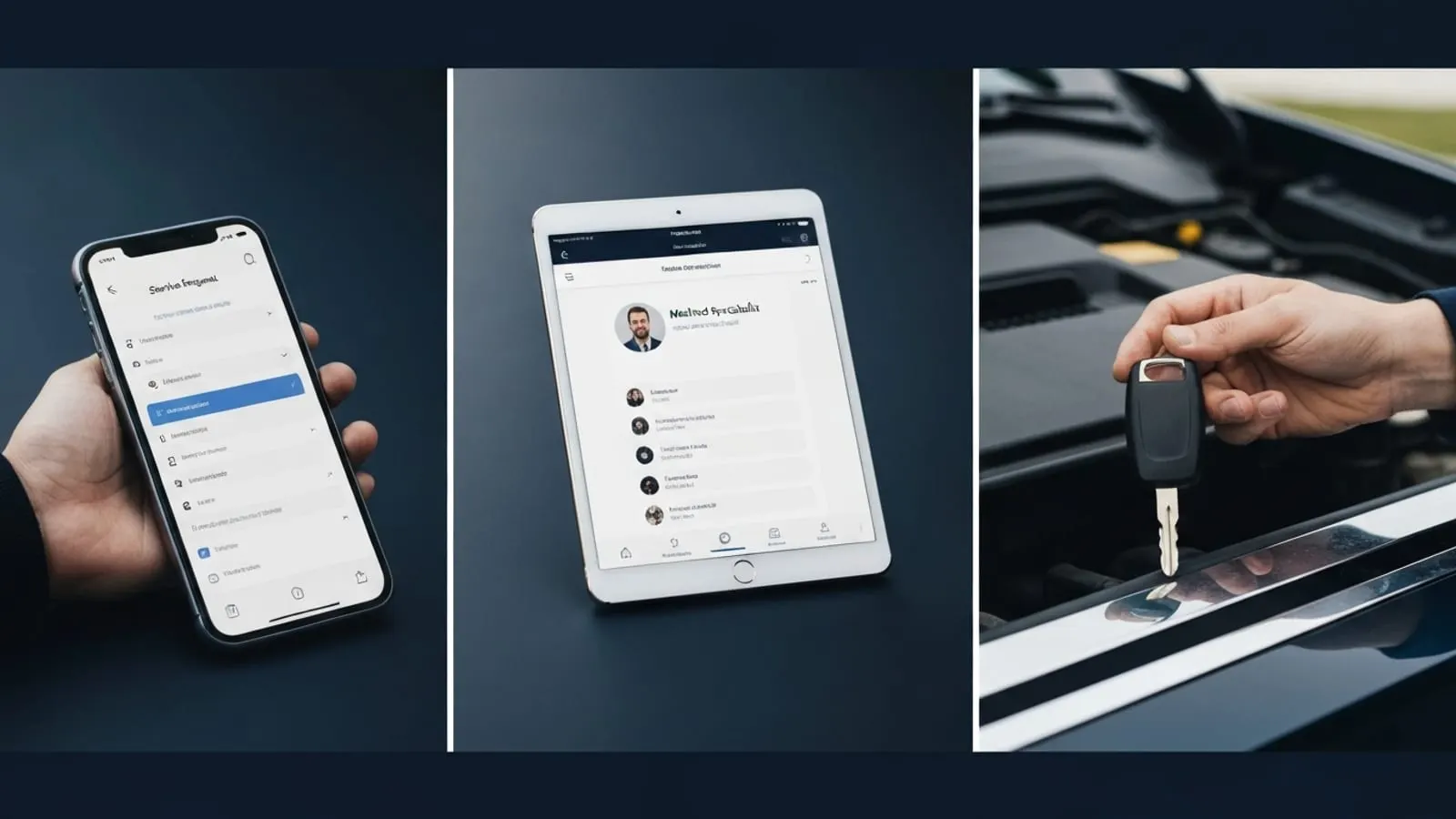
The three-step process, in detail
Step 1: You submit the form (90 seconds)
The form on the homepage captures six pieces of information: your ZIP, your vehicle's year, make, model, a one-line description of the situation, and your contact details. That is intentionally the minimum we need to route the job — we do not ask for unnecessary information, we do not require an account, and we do not send a verification email before processing the request.
The form is intentionally designed to be usable in stressful moments. Per the BrightLocal 2024 Local Consumer Review Survey, the most common reason consumers abandon a local-service inquiry is form complexity — long forms with required fields that demand information the consumer does not have at hand. Our form is the opposite of that. If you cannot remember your model trim, leave it blank. If you cannot find your VIN, leave it blank. The matched partner can collect that information on the callback if needed.
Step 2: We match you to one partner (under 5 minutes)
The matching engine runs three filters in sequence on your submission. First, geographic — which partners cover your specific ZIP and surrounding area. Second, capability — which partners have the diagnostic tool and key blank inventory for your specific year, make, and model. Third, availability — which qualified partners are currently free to take the job (versus mid-route on a previous job or off-shift).
The output is one matched partner. We do not send your job to five partners in a bidding process. We do not sell your contact information to multiple vendors. The matched partner is the only entity that gets your information, and they get it on the understanding that this is a delivered lead they pay for. That economics is what makes the matching work — the partner has skin in the game on every lead, so they have to actually show up and do the job well.
Step 3: The partner contacts you (5 to 15 minutes typical)
The matched partner calls or texts you to confirm scope, quote a not-to-exceed price in writing, and schedule the on-site visit. Per FTC consumer protection guidance, the not-to-exceed quote should be received before any work begins — and it is.
On-site arrival is typically 30 to 90 minutes for non-emergency jobs and as fast as 30 minutes for prioritized emergency requests during business hours. After-hours emergency arrival depends on the specific partner's coverage profile but is typically 60 to 120 minutes.
What happens on the day of service
- ID and ownership verification. The technician verifies your driver's license and proof of vehicle ownership before any work begins. Per FTC and ALOA service standards, this is required.
- VIN read and key file pull via diagnostic tool on the OBD-II port (or, on some newer European vehicles, bench programming).
- Blank cutting on the cutting equipment in the van.
- Programming. The new key is paired to the vehicle's immobilizer and (for fobs) the body control module. Per NASTF's Secure Data Release Model program, the technician must hold active SDRM credentialing for 2010-and-newer key coding on many makes — a credential we screen for in our partner network.
- Verification. Engine start, lock/unlock, panic, and remote-start (where equipped) are all tested before the technician leaves. You should watch every test.
- Written invoice and warranty. Per ALOA standards, the invoice references the VIN, the specific key part number, and the warranty terms on both the work and the hardware.
- Payment. You pay the partner directly — typically credit card or cash. We do not handle consumer billing.
What makes the matching engine actually work
The matching engine is the most important technical asset behind CarKeyNation. The model behind it is simple in concept but careful in execution: every partner in the network has a tool capability profile that maps which makes and model-years they can program. The engine matches your submission against that profile and only dispatches to partners who can actually finish your specific job.
That sounds obvious, but it is not how most automotive locksmith dispatch works. Most directories dispatch by ZIP alone — any locksmith in your ZIP can claim your lead, regardless of whether they have the right tool for your 2024 Range Rover or your 2024 BMW. The customer pays for the wasted truck-roll either way.
Per the U.S. Bureau of Labor Statistics OEWS data for automotive technicians, the automotive service trade has been fragmenting along tool- capability lines for over a decade. The matching engine exists to re-aggregate that fragmented capability at the dispatch layer, so customers do not have to do the matching themselves on a stressed phone call.
The accountability loop that keeps quality high
A vetted marketplace only works if there is real accountability for the work. Ours has three loops:
- Up-front vetting. Every partner is screened for verifiable business address, active state locksmith license where required (per Texas DPS, California BSIS, or equivalent), and either ALOA or NASTF credentialing for modern vehicle work. No partner enters the network without passing all three signals.
- Customer feedback after every job. The customer can provide feedback on the partner's quote accuracy, arrival timing, work quality, and overall experience. That feedback flows directly into the partner's match-priority score.
- Dispute resolution. If a job goes wrong on either side — the partner shows up to a wrong number, or the customer had a bad experience — both sides can raise a dispute within 24 hours. We investigate, and the resolution is binding.
Partners who consistently deliver quality work get more matched leads. Partners who lapse on credentials or consistently underdeliver are removed from the network. That accountability loop is the entire structural difference between a vetted marketplace and an open directory — and it is why the consumer experience is materially better on the marketplace side.
What we tell partners about how the system works
Transparency for the customer requires transparency for the partner. Our partners know exactly how the matching engine prioritizes leads, what feedback signals influence their match priority, and how the dispute resolution process works. The same rules apply to every partner in the network.
Match priority is calculated from three inputs: vehicle-specific tool capability (does this partner have the tool for this exact year-make-model), customer feedback (quote accuracy, on-time arrival, work quality), and recent acceptance rate (partners who consistently accept matched leads in their declared service area get prioritized over partners who consistently decline). The algorithm rewards partners who actually show up and do the job well — which is exactly what the customer wants.
On the dispute side, both partners and customers can raise issues within 24 hours. Common partner-side disputes: wrong number, customer unreachable, vehicle outside declared service area, customer already serviced by another shop, job description does not match reality on arrival. Approved partner disputes refund the $25 lead fee to the partner's wallet. Common customer-side escalations: partner did not show up, partner quoted differently on-site than on the phone, work quality issues. Approved customer escalations result in partner penalty up to and including removal from the network.
What makes the model safer than alternatives
The alternatives a stranded driver typically considers are: Google Maps local pack, Thumbtack / Angi multi-vendor lead distribution, calling random listings out of a phone book or roadside assistance referral, or the dealership service department. Each has structural problems the marketplace model solves.
- Google Maps local pack: heavily polluted by scam operations buying ads with fake addresses. Per the FTC consumer protection bulletin on locksmith scams, this has been a top-five consumer complaint category for over a decade.
- Multi-vendor lead distribution: spams your contact information across five vendors at $40 to $95 per lead, which gets passed back to you in the form of aggressive quoting and rushed work.
- Random listings: no vetting, no accountability, no recourse if the work goes wrong.
- Dealership: 35 to 60 percent more expensive than mobile locksmith on the same job, almost always requires a tow, and per the J.D. Power 2024 U.S. Customer Service Index Study, has been declining on customer satisfaction for consecutive years.
Frequently asked: how it works
How long does the matching process take?
Form submission takes about 90 seconds. Routing to a partner typically takes under 5 minutes during business hours. The matched partner usually contacts you within 5 to 15 minutes of routing. On-site arrival is typically 30 to 90 minutes for non-emergency jobs.
What if no partner is available in my area?
We work with adjacent metros if no partner in your immediate ZIP is available. If we truly have no coverage in your area, we tell you within minutes rather than leaving you waiting — and we point you to the best alternative options (typically a verified local independent or, when appropriate, the dealer service department).
Can I see who is being matched to me before they arrive?
Yes. The matched partner will contact you directly to introduce themselves, confirm scope, and provide a written quote. You can verify the partner's business address and credentials before they dispatch. If for any reason you do not want to work with the matched partner, we re-route to the next best partner without you re-filling the form.
What happens if the technician arrives without the right tool?
Our matching engine pre-screens tool capability before the dispatch, so this is rare in practice. If it does happen, the partner is on the hook for the wasted truck-roll — not you. We will dispatch a different partner who is tool-qualified at no additional cost to you, and the failed partner's lead fee is refunded.
The matching engine, explained more concretely
The matching engine is the most technically interesting part of the marketplace. The high-level filters (geography, tool capability, availability) are simple to describe; the implementation has been refined through real customer and partner data over time. Here is what actually happens in the engine when a lead comes in.
Filter 1: Geographic coverage (sub-second)
Each partner declares a set of ZIP codes they actively cover. The engine filters partners whose coverage includes your submission ZIP. For metro-edge ZIPs, the engine also pulls partners whose coverage extends to adjacent ZIPs as a fallback tier — they get matched only if no in-ZIP partner is available.
Filter 2: Tool capability (sub-second)
Each partner maintains a per-make / per-model-year capability profile mapping which vehicles they can program. The engine filters by intersection with your year-make-model. For year-make-model combinations where no in-ZIP partner has tool coverage, the engine again expands to the adjacent-ZIP tier before declaring a coverage gap.
Filter 3: Real-time availability (sub-second)
Each partner's wallet balance, paused state (declined-too- many recent leads), business-hours setting, and current-route status determine real-time availability. The engine filters out partners who cannot take new work right now.
Ranking the remaining set (sub-second)
From the partners who pass all three filters, the engine ranks by match priority — a weighted combination of historical job quality (customer rating, quote accuracy, on-time arrival), recent acceptance rate, and partner-tier (which is itself a function of credentials + tenure in the network).
Lead delivery
The top-ranked partner receives the lead via SMS and email in real-time, with a brief window to accept or decline. Declined leads are auto-rerouted to the next-ranked partner. The customer experience is that one partner contacts them — they do not see the routing decisions happening behind the scenes.
The whole sequence runs in well under 5 minutes from form submission to first partner outreach during business hours. That speed is intentional: the longer a stranded driver waits without a real callback, the more likely they are to call a Google Maps scam shop out of frustration.
The dispute system, walked through with examples
The dispute system is the back-stop that keeps lead quality high on the partner side and trust high on the customer side. Two real (anonymized) examples show how it plays out in practice.
Example 1: Partner dispute on a wrong-vehicle lead
A partner was matched to a job described in the lead as a 2020 Toyota Camry — a vehicle their tool stack fully covers. On arrival, the customer had a 2018 Hyundai Sonata. The partner had quoted $260 over the phone based on the Camry. The Sonata job was outside the partner's tool capability. The partner submitted a dispute citing wrong vehicle with a photo of the actual vehicle and the original lead screenshot. The dispute was approved within 12 hours, the partner's wallet was refunded the $25 lead fee, and the customer was re-routed to a partner with Hyundai tool capability.
Example 2: Customer escalation on a quote-and-switch
A customer was matched to a partner who quoted $320 by text for a smart-key replacement on a 2021 Ford F-150. On arrival, the partner told the customer the job was more complex than the quote suggested and asked for $580 in cash. The customer paid rather than wait but submitted an escalation the next day with the original text quote and the receipt. The investigation confirmed the partner had not communicated a legitimate scope change. The partner was required to refund the difference, was issued a quality warning, and had their match priority reduced for the next 60 days. A repeat occurrence would have resulted in removal from the network.
Both examples reflect the design intent of the dispute system: a fast, documented investigation with binding outcomes that create real accountability on both sides. The partner side gets recourse against bad leads; the customer side gets recourse against bad partner behavior. The marketplace stays healthy because the incentives align around honest work.
Sources & further reading
- FTC. Locksmith Scams: When You Need a Locksmith. consumer.ftc.gov
- BrightLocal. Local Consumer Review Survey 2024. brightlocal.com
- ALOA. Master Automotive Locksmith Certification. aloa.org
- NASTF. Secure Data Release Model Program. nastf.org
- U.S. BLS. OEWS — Automotive Service Technicians, 2024. bls.gov
- J.D. Power. 2024 U.S. Customer Service Index Study. jdpower.com
Ready to use the service? Submit a request. Want more detail on pricing? FAQ. Looking for partner pricing? Partner pricing.
Ready to get rolling again?
Request a local specialist now — vetted, accountable, and matched to your vehicle.