Ford F-150 and Expedition Key Types by Year (1996-2026)
Which key your Ford truck or full-size SUV actually takes, generation by generation from the first SecuriLock PATS trucks to Phone as a Key, with what each type costs to replace.
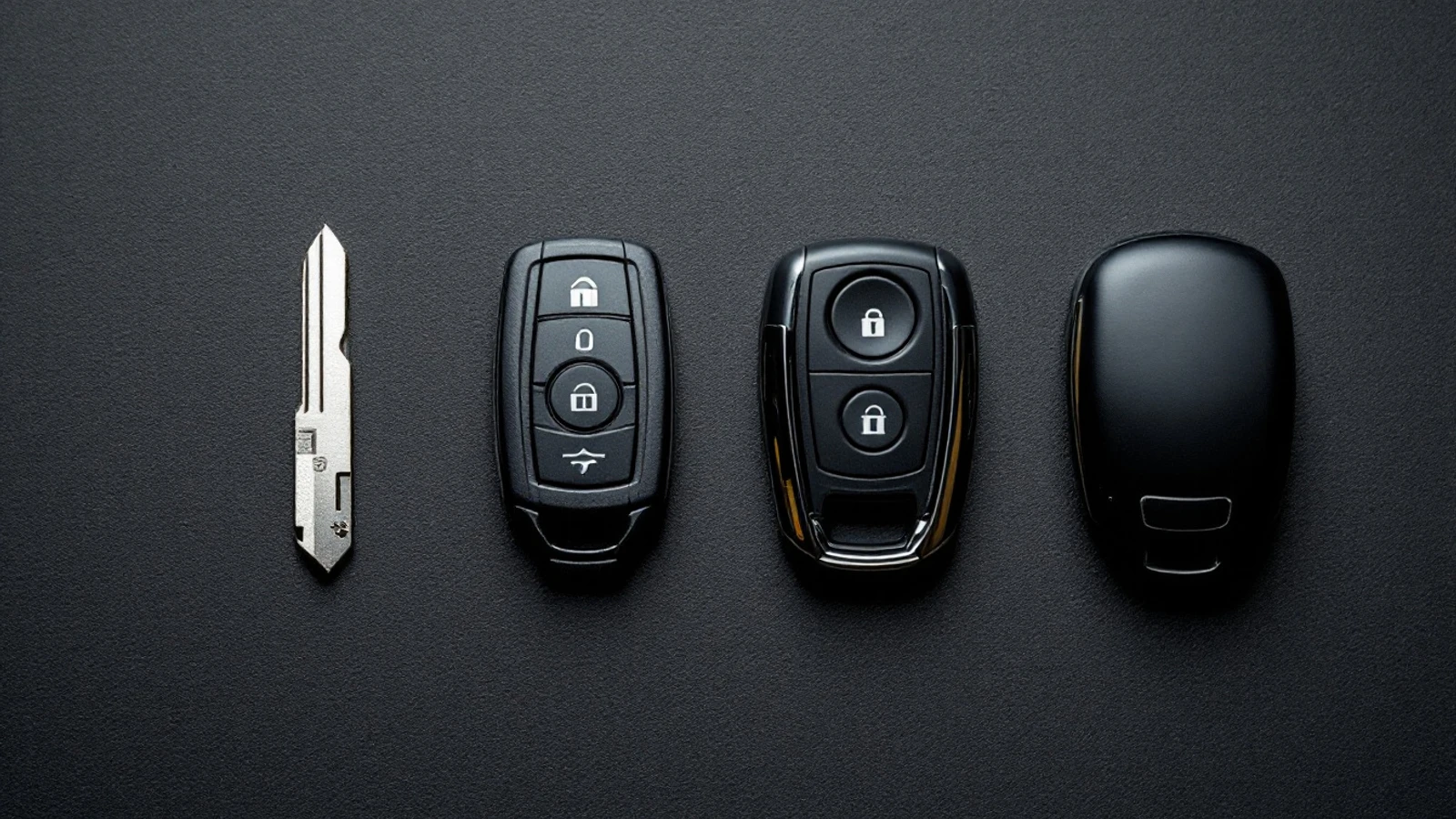
Ford has run four key generations across the F-150 and Expedition since 1996, and the boundaries do not line up neatly with model years. Trim decides as much as year on the trucks built since 2018, which is why two owners of the same model year get quotes hundreds of dollars apart and both are correct.
This guide maps the generations onto years, tells you how to identify yours in ten seconds without any tooling, and gives the replacement cost for each — as of September 2026, drawn from the published ranges on our Ford make page.
The four generations at a glance
| Generation | Roughly | What you hold | Spare | All keys lost |
|---|---|---|---|---|
| SecuriLock PATS H50 | 1996 – 2003 | Bladed key, early transponder | $135 – $195 | $135 – $195, plus PATS Code step |
| PATS H75, 80-bit rolling code | 2003 – 2010 | Bladed key, separate remote | $150 – $220 | $195 – $280 |
| NXP HITAG-Pro | 2011 – 2017 | Bladed key, hardened chip | $175 – $240 | $175 – $240 band, longer visit |
| HITAG-AES proximity | 2018 onward, by trim | Fob in your pocket, start button | $225 – $315 | $295 – $400 |
| Lightning / Mach-E, HITAG-AES with Phone as a Key | 2022 onward | Proximity fob plus phone | $275 – $385 | $275 – $385 |
Two things to read out of that table before anything else.
The spare column is always cheaper than the all-keys-lost column. That gap is the single largest thing an owner still controls, and it is the reason a spare cut this month costs less than a replacement next year.
The proximity row starts by trim, not by year. Ford introduced HITAG-AES from 2018 on selected models and trims — F-150 King Ranch and Platinum among the first — while lower trims kept bladed keys through the same model years. The fourteenth-generation F-150 from 2021 carries proximity on XLT and above. A 2021 F-150 XL and a 2021 F-150 Lariat are not the same quote.
Identify your key in ten seconds
You do not need a part number or a VIN to place yourself on that table. The key in your hand answers it.
A plain metal blade with a moulded plastic head. You insert it into a cylinder and turn it. The transponder chip is inside the head, invisible. This is PATS H50, PATS H75 or HITAG-Pro depending on the year — rows one through three.
A blade plus a separate rubber-buttoned remote on the same ring. Same underlying key, with remote locking as a second device. Common through the middle generations.
A fob you never take out of your pocket. The truck detects it as you approach, and you start the engine with a button. Inside is a small emergency blade that opens the driver's door when the fob battery dies. Rows four and five.
If you are genuinely unsure, our guide to transponder versus smart key walks through the identification in more detail. It applies to any make, not just Ford.
Generation by generation
1996 to 2003: SecuriLock PATS H50
Ford's SecuriLock PATS debuted on the 1996 Mustang with the TI-PATS H50 transponder, and rolled across the truck line from there. These are simple keys by modern standards, and the cheapest programmed Ford keys on the table at $135 to $195.
The one wrinkle is the PATS Code. On certain vehicles in this window, an all-keys-lost job requires an incoming security code before programming will complete. It does not apply when a working key survives, and it does not apply to later generations. A technician running FORScan Pro, Ford IDS or an AutoProPad derives it in the field, so on the right truck it is a step in the visit rather than a trip to a dealer.
Trucks this old also carry a second, unrelated cost risk: cylinder wear. Twenty-plus years of daily cycles wear the wafers inside an ignition lock, and the symptom — a key that works sometimes, where jiggling changes the behaviour — gets misread as a chip fault constantly. Replacing the key fixes nothing in that case.
2003 to 2010: PATS H75, 80-bit rolling code
Ford moved to an 80-bit rolling-code implementation, documented through the Motorcraft Service portal and Ford TIS. Mechanically it is the same experience: a blade, a cylinder, a turn.
This is the generation where the spare-versus-lost gap first becomes substantial in dollars — $150 to $220 with a working key present, $195 to $280 without. That is a $45 to $60 swing on an identical part, and it is entirely down to procedure time.
2011 to 2017: NXP HITAG-Pro
From 2011 Ford moved to NXP HITAG-Pro, a hardened chip family, while keeping the bladed-key format on most trims. A spare runs $175 to $240.
This is the generation that catches Expedition owners. A 2011 Expedition sits exactly on the boundary year, and boundary-year vehicles are the ones where the model year alone genuinely does not settle the question. The VIN does, immediately and unambiguously. If you are calling about a 2010, 2011 or 2012 truck, lead with the VIN and the quote tightens on the spot — what the VIN changes about your quote explains why that one detail does more work than everything else you can say.
Ford's own model coverage lists the Expedition as sharing the F-150 architecture, so an Expedition owner can read the F-150 rows straight down this page. The divergences are in trim availability, not in the immobilizer.
2018 onward: HITAG-AES proximity
True rolling-code encryption and a fob that stays in your pocket. Ford introduced it from 2018 on Mustang GT, F-150 King Ranch and Platinum, and Explorer Limited and Platinum, then broadened it — the fourteenth-generation F-150 from 2021 carries it on XLT and above.
A spare is $225 to $315. With every key lost it is $295 to $400, because the truck has to be walked through a longer relearn from empty rather than told to trust one more key alongside an existing one.
The corresponding Ford dealer figure for an all-keys-lost job on a 2022 F-150 Lariat lands at $425 to $615 — and a truck with no working key cannot drive itself to the service bay, so a tow usually rides on top of that. The full breakdown of where that difference comes from is in our Ford key replacement cost guide, which covers the whole Ford range rather than just the trucks.
Lightning and Mach-E: HITAG-AES with Phone as a Key
The electric side of the line runs HITAG-AES with Phone as a Key layered over it, at $275 to $385.
Phone as a Key is a convenience layer, not a replacement for the physical key. A phone that is flat, replaced, updated or left on a kitchen counter puts you back on the fob, which is why keeping at least one physical key enrolled and working still matters on a Lightning. Treating the phone as the only key is how owners end up needing an all-keys-lost visit on a vehicle that technically has a key sitting in a drawer, unprogrammed.
What Ford does not require, and why that matters
Ford is among the more independent-friendly makes, and it is worth knowing before someone tells you otherwise.
There is no NASTF Vehicle Security Professional restriction on Ford. There is no security gateway authentication step. There is no per-VIN PIN on most vehicles — unlike Honda, where 2019-and-newer Smart Entry vehicles need one before an all-keys-lost job can complete.
What that means practically: a specialist carrying a current Ford license programs a proximity F-150 key in your driveway. When a shop says a Ford is dealer-only, the constraint is almost always their tooling rather than anything Ford has done to the truck. That distinction is the whole subject of who can actually program a car key, and it is the right question to ask before accepting a referral to a dealership.
The genuine exceptions are narrow: an open recall that covers the work (run the VIN through the NHTSA lookup first, because the dealer performs those at no charge), high-voltage propulsion work on the Lightning, and vehicles inside the six-to-eighteen-month firmware-lag window that follows a clean-sheet redesign.
Before you buy a key: three cheaper outcomes
Not every Ford truck that will not start needs a key, and all three of these look identical from the driver's seat.
A flat fob battery. Proximity fobs run a coin cell for roughly two to four years and fade gradually — range shrinks before the fob dies, so it still works held against the door handle but not from across a yard. If your truck reports no key present, what to check when a push-to-start car says no key detected runs through the sequence, including the backup start position that works with a dead fob.
A worn ignition cylinder. Covered above and endemic on high-mileage trucks. The fix is rekeying or replacing the cylinder, not a new key.
A programming fault rather than a lost key. If a key unlocks the doors but will not start the engine, the mechanical cut is right and the enrolment is not. That is a programming visit and a different price.
A fourth, specific to trucks: aftermarket remote-start interference. Work trucks and towing rigs carry more aftermarket electronics than most vehicles, and a degraded transponder bypass coil mimics a failing key precisely.
The spare-key arithmetic on a truck
Using Ford's own published rows, on a 2021 F-150 XLT with one working proximity key:
Cut the spare now. $225 to $315, booked at a time you choose, truck fully usable throughout.
Wait until the last key is gone. $295 to $400 mobile, with the truck immobile wherever it is parked — and if that is a job site rather than a driveway, the cost is not only the key. The dealer alternative is $425 to $615 plus the tow.
The mobile-to-mobile difference is roughly $70 to $85. The difference between the two situations is a working day.
If you are comparing trucks across makes
The generational logic here transfers; the numbers do not. A Silverado runs a completely different set of immobilizer families across a different set of year boundaries, and the fact that both are full-size trucks tells you nothing about how their keys are priced — the Chevrolet key replacement cost guide sets out the GM structure for comparison.
Lincoln shares Ford's underlying architecture, so the shape of a Navigator quote follows this page closely, but Lincoln publishes its own ranges. Confirm against the Lincoln page rather than assuming the F-150 figures carry across.
Getting an accurate number for your truck
Three details put you on one row: model year, trim, and whether a working key still exists. Trim matters more on Ford than on most makes because of the staggered proximity rollout, and it is the detail owners most often leave out.
Add the VIN and the generation resolves exactly. On a 2010 to 2012 truck, or on any 2018-to-2021 F-150, that is the difference between a $175 quote and a $315 one.
Our transponder key programming and proximity key replacement pages describe what each visit involves, and you can start a request on the get help page.
Prices in this guide are as of September 2026 and reflect the published ranges on the CarKeyNation Ford page. Generational boundaries follow Ford's own SecuriLock PATS history; boundary-year vehicles should be confirmed by VIN. Recall status should be verified through the NHTSA VIN lookup.
Frequently asked questions
What key does a 2011 Ford Expedition take?
A 2011 Expedition falls at Ford's move from the 80-bit PATS H75 generation to NXP HITAG-Pro, which is the boundary year in Ford's published generational history. In practice that means a bladed key you insert and turn, with a transponder in the head, and on most trims a separate remote for locking and unlocking. Because 2011 sits exactly on the boundary, the VIN is what resolves which chip family your specific truck carries, and no shop can tell you for certain from the model year alone.
When did the F-150 move to a proximity key?
Ford introduced HITAG-AES proximity keys from 2018 on selected models and trims, including the F-150 King Ranch and Platinum. The fourteenth-generation F-150 from 2021 carries proximity on XLT and higher trims. Below those trim lines, a bladed transponder key remained available well into the same model years, which is why two trucks of the same year can need entirely different keys.
Does the Expedition use the same key as the F-150?
Broadly yes. Ford's own model coverage lists the Expedition as sharing the F-150 architecture, so the generational boundaries and the pricing bands track each other closely. The differences show up in trim availability rather than in the underlying immobilizer, which is why a full-size SUV owner can use the F-150 columns in the table on this page as a working guide.
What does a Ford truck key cost to replace in 2026?
As of September 2026, a pre-2003 PATS H50 key is $135 to $195, a PATS H75 spare is $150 to $220 and $195 to $280 with all keys lost, a HITAG-Pro spare is $175 to $240, and a HITAG-AES proximity key is $225 to $315 as a spare or $295 to $400 with every key lost. Lightning and Mach-E keys run $275 to $385. Those are all-in mobile figures covering the blank, the cut, the programming and the visit.
What is the PATS Code, and does my truck need one?
On certain 1996 to 2003 Ford vehicles, an all-keys-lost job needs the PATS Code — an incoming security code without which programming cannot complete. It is not required when a working key survives, and it does not apply to later generations. A technician running FORScan Pro, Ford IDS or an AutoProPad can derive it, so on the right van it is a step rather than an obstacle.
Is Ford key programming dealer-only on newer trucks?
No. Ford is among the more locksmith-friendly makes: no NASTF Vehicle Security Professional restriction, no security gateway authentication, and no per-VIN PIN on most vehicles. A specialist with a current Ford license programs proximity keys on site. The dealer becomes the right call mainly for open recalls, high-voltage EV propulsion work, and vehicles inside a firmware-lag window after a clean-sheet redesign.
My F-150 has Phone as a Key. Do I still need a physical key?
Yes. Phone as a Key on the Lightning and Mach-E rides alongside the HITAG-AES proximity system rather than replacing it, and a phone that is out of battery, updated, replaced or simply left behind puts you back on the physical key. Treat the phone as a convenience layer and keep at least one working physical key enrolled.
How do I tell which key I have without looking anything up?
Hold the key. A plain metal blade with a plastic head that you insert and turn is a transponder key, and the model year tells you which chip generation. A fob you leave in your pocket while pressing a start button is a proximity key. A fob with a blade that folds or slides out of the body sits in between and is usually a transitional-generation truck. That single observation places you on the right half of any pricing table before anyone quotes you.