Transponder, Fob or Smart Key? Identify Yours Before You Get Quoted
The four car key types on US roads, how to tell in thirty seconds which one your car uses, and what each costs to replace — so you can spot a quote that doesn't match your vehicle.
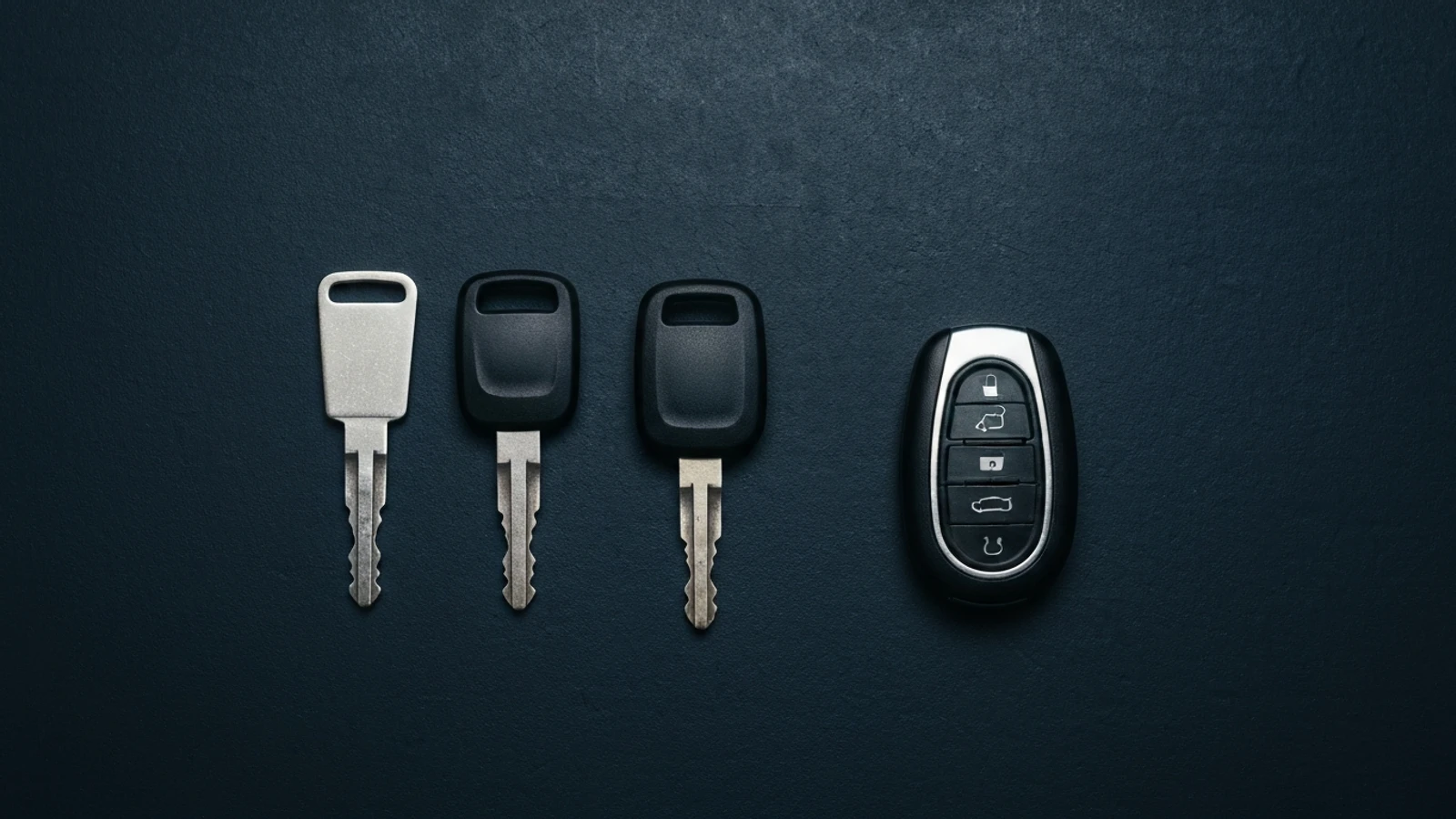
Almost every bad car key quote starts the same way: someone gives a price before establishing which kind of key the car actually takes. Thirty seconds of identification up front is the difference between a number that holds and a number that moves once a technician is standing in your driveway.
There are four types on US roads. This guide explains how to tell them apart, what each costs to replace as of September 2026, and why the price gap between the cheapest and the most expensive is far larger than most drivers expect.
The thirty-second test
Before any of the detail below, one question resolves most cases:
Do you insert a key and turn it, or press a button with the fob in your pocket?
Turn it, and you have a transponder or a flip-style transponder. Press a button, and you have a smart key. That single distinction determines which of two very different pricing tiers you are in, and it is the first thing any competent shop will ask.
The four types
Mechanical key. Metal blade, no electronics. Essentially extinct on cars — you'll find these on older vehicles, trailers and some fleet equipment. A blank is $15 to $35, and there is no programming because there is nothing to program.
Transponder key. A blade with a chip embedded in the plastic head. The blade turns the ignition; the chip answers a challenge from the immobilizer, and the engine only runs if the answer is correct. This became near-universal from the late 1990s. Replacement means cutting the blade and programming the chip — the reason a hardware-store copy turns the ignition but won't start the car.
Flip / switchblade transponder with integrated remote. The same transponder function, folded into a housing with lock, unlock and panic buttons. Two systems in one body: the immobilizer chip and the remote transmitter. Both need programming, which is why these price above a basic transponder. Details on the key fob programming page.
Smart key (proximity, push-to-start). No insertion at all. The vehicle detects the fob nearby, unlocks on a door-handle touch, and permits a button start. Inside is a low-frequency coil, an RF transmitter, the immobilizer chip, plus casing and battery — and a hidden emergency mechanical blade for when a battery dies. Covered on the smart key replacement and proximity key pages.
What each costs, and why
| Key type | How you start the car | Typical replacement, all-in | What drives the price |
|---|---|---|---|
| Mechanical | Insert and turn | $15 – $35 blank | Cutting only; no electronics |
| Transponder | Insert and turn | $180 – $260 all-in | Blade cut + immobilizer programming |
| Flip / switchblade transponder | Insert and turn | $220 – $320 all-in | Above, plus remote transmitter pairing |
| Key fob (remote only) | Separate cut key | $180 – $280 | Remote pairing to the body control module |
| Smart key, mainstream | Push button | $280 – $475 all-in | Immobilizer and BCM programming |
| Smart key, luxury European | Push button | $450 – $1,200 all-in | Above, plus higher-cost OEM fob hardware |
The jump from transponder to smart key is the one worth understanding, because it is where most quote disputes happen.
Hardware. A basic transponder blank is $5 to $25 wholesale. A smart fob blank is $80 to $400 wholesale. Same job description, an order of magnitude apart in parts cost before anyone opens a toolbox.
Labour. A transponder needs one system taught: the immobilizer. A smart key needs two — the immobilizer so the engine will start, and the body control module so entry, proximity detection and remote functions work. Skip either and you get a key that starts the car but won't unlock it, or unlocks it but won't start it. Both are half-finished jobs, and both are avoidable by verifying every function before the technician leaves.
The exception worth knowing: keys with no chip at all
The four types above cover almost everything on the road, but there is a fifth case that is easy to miss because it looks like the cheapest option and, for once, actually is.
Some vehicles never had an engine immobilizer. The best-known examples are two large groups. Chevrolet's GMT800 trucks and SUVs — Silverado from roughly 1999 and Tahoe and Suburban from roughly 2000, both through 2006 — used PassLock, where the anti-theft sensing lives in the ignition lock cylinder rather than in the key. And a large number of US-market Hyundai and Kia vehicles built roughly between 2011 and 2021, on base trims with a turn-key ignition rather than a push-button start, shipped without an immobilizer at all.
In both cases the key is a plain mechanical blade. Nothing to pair, nothing to program, under $135 to cut. If your key is a thin flat blade and your remote is a separate fob on the same ring, check whether you are in this group before you accept a transponder-priced quote. The generation-by-generation breakdown is in Silverado and Tahoe key types by year, and the Hyundai side is covered in Hyundai key replacement cost.
Where each brand sits
Security architecture varies by manufacturer, and it shows in the baselines:
- Toyota / Lexus — DST80 and DST-AES, roughly $150 to $425. See Toyota.
- Ford — PATS and HITAG-Pro, roughly $150 to $400. See Ford.
- Honda / Acura — HITAG-2, HITAG-Pro and AES, roughly $150 to $400. See Honda.
- Jeep / Chrysler / Dodge / Ram — Sentry Key and FOBIK, roughly $175 to $450, with Security Gateway (SGW) and AutoAuth compliance on newer models.
Full coverage at vehicle makes.
One caveat that cuts across all of them: for some 2018-and-newer luxury vehicles — certain BMW, Mercedes-Benz and Range Rover models — OEM key-coding restrictions can route the job to the dealer regardless of key type. That trade-off is covered in dealer versus mobile locksmith car key cost.
Why a hardware-store copy doesn't start the car
This is the single most common surprise in the trade, and it follows directly from the type distinction above.
A key-cutting kiosk duplicates the blade. It reads the mechanical pattern of your existing key and grinds an identical one. On a mechanical key that is the entire job, and the copy works perfectly.
On a transponder key it is half the job. The new blade will slide into the ignition and turn the cylinder — so the steering unlocks and the dashboard lights come on, which is exactly why people assume it worked. But the immobilizer challenges the chip, gets no valid answer, and cuts fuel or spark within a second or two. The engine turns over and dies, or does not fire at all.
The chip has to be programmed to your specific vehicle, and that requires diagnostic equipment the kiosk does not have. A copied blade with an unprogrammed chip is, at best, a door key.
On a push-to-start vehicle the whole premise collapses, because there is nothing to copy. The emergency blade inside the fob can be cut, but it only opens the door — the electronics are the key.
How each type fails
Knowing your type also tells you what is likely to go wrong, which is useful because some symptoms are cheap fixes mistaken for expensive ones.
Transponder keys fail mechanically far more often than electronically. Blades wear, and a worn blade in a worn ignition cylinder produces the classic intermittent no-start that gets better if you jiggle it. Plastic heads crack, and once the head splits the chip can move or fall out. A key that works only in certain positions is usually a mechanical problem, not a programming one.
Flip and switchblade keys add a hinge and a spring, and both are wear items. A flip key that no longer snaps open, or that has developed play at the pivot, is on its way out even while it still works.
Smart keys fail electronically. The most common symptom by a wide margin is simply a flat coin cell — the car stops recognising the fob at distance, then only works when held against the start button, then not at all. That progression is a battery, not a failed key, and it is a few pounds to fix. Before quoting anyone for a replacement smart key, change the battery.
The genuine smart-key failures are water ingress and physical shock — a fob through a wash cycle, or dropped hard enough to crack a solder joint. Those are replacements.
All types are affected by the vehicle battery too. A weak or flat car battery produces symptoms that mimic a key fault on push-to-start vehicles especially. Rule that out first.
The other variable: do you still have a working key?
Key type sets the tier. Whether a working key survives sets which procedure runs inside it.
With a working key present, the vehicle is in a trusted state and can be instructed to accept an additional one. With every key gone, authorisation has to be established from scratch — more tooling, non-destructive entry first, and on many makes an enforced security wait. That carries a surcharge on top of every figure in the table above, explained in what the all-keys-lost surcharge covers.
So a complete quote request contains three facts: key type, model year, and whether a working key exists. Supply those and you'll get a number that holds.
Using this to sanity-check a quote
Once you know your type, certain quotes stop making sense — which is the practical value of the exercise.
A $90 quote on a push-to-start vehicle cannot include the fob, because the blank alone costs more than that wholesale. Either it is a bait figure that grows on arrival, or the shop plans to fit a low-grade aftermarket fob.
A $400 quote on a basic transponder for a mainstream domestic or Japanese car is well outside the $180 to $260 range with no obvious reason. Ask what justifies it; there may be a legitimate answer for an unusual vehicle, and if there isn't, you have learned something.
A quote given without asking the key type is not a quote. It is an opening position.
And a "diagnostic fee" to determine which key your car takes is charging you to answer a question the VIN already answers, over the phone, for free.
The used-car problem
One scenario deserves calling out because it catches people who have done nothing wrong: buying a used vehicle and being handed exactly one key.
It is extremely common, particularly on older transponder cars where the second key disappeared somewhere in a previous owner's life. The buyer notices, thinks I'll sort that out at some point, and then the single key is lost eighteen months later — at which point the job is an all-keys-lost callout rather than a routine spare.
Two things are worth doing shortly after any used purchase:
Get a second key cut. While you have a working one, this is an add-a-key job at the standard rates in the table above. After you don't, it isn't.
Consider wiping the stored key list. You have no idea how many keys exist for a car you just bought, or who has them. The previous owner may genuinely not know either. Having the vehicle's stored keys cleared and only your keys re-taught is the same visit as cutting the spare, and it closes that question permanently. This is the one piece of used-car housekeeping most owners skip and occasionally regret.
Credentials, briefly
Type identification tells you what work is needed. Credentials tell you whether the person quoting may legitimately perform it.
In Texas, locksmiths are licensed by the Texas Department of Public Safety Private Security Program. Ask for the licence number and check it against DPS rather than trusting a compliance badge on a website — other agencies are commonly named in its place online.
Per NASTF's Secure Data Release Model program, automotive locksmiths pairing keys on many 2010-and-newer vehicles must hold active SDRM registration, which requires a background check and ongoing compliance. On a modern smart-key vehicle this is the practical line between a technician who can complete your job and one who cannot.
Quick reference
Before you call, gather:
- Key type — the thirty-second test above.
- Year, make and model.
- VIN — windscreen base on the driver's side, or your insurance documents.
- Whether any working key exists.
- Push-to-start, yes or no — this alone moves you between pricing tiers.
Then ask for one all-in number covering blank, cut and programming, plus any drive-out charge for outlying areas. If you want the underlying systems in more depth first, the transponder programming and automotive locksmith pages go deeper on each.
One last use for the thirty-second test: it is the first question worth answering when a key stops working rather than gets lost. A transponder that fails makes the engine fire and die within a second or two — the cause list for that is in car starts then dies immediately. A car that accepts one key and refuses another has already proved the fault sits in the key rather than the vehicle, which is the cheap half of every price table above and is walked through in one key works, the other doesn't.
Knowing your key type does not make the replacement cheaper. It makes the quote honest — and on a distress purchase made at the roadside, that is most of the battle.
Key type is the same question wherever you are parked — what changes by location is which specialist carries the right blank and tool. You can see the partner bench for your area on our Texas coverage page or via the makes directory for your specific vehicle.
Know your type? Request a specialist and we'll match you to a vetted local technician with the right tool and credential for your exact vehicle.
Frequently asked questions
How do I tell a transponder key from a smart key?
Start the car. If you physically insert a key and turn it, you have a transponder or flip-style transponder. If you press a button while the fob stays in your pocket or bag, you have a smart key. That single test settles it for the overwhelming majority of vehicles, and it is the first thing any competent shop will ask you.
Is a key fob the same thing as a smart key?
Not quite, and the loose usage causes real confusion when quoting. 'Key fob' commonly means a remote that handles lock, unlock and panic while a separate cut key starts the car — or the remote half of a flip key. A smart key does those remote functions and also authorises push-button starting through proximity detection. A smart key is always a fob; a fob is not always a smart key.
Why is a smart key so much more expensive?
Hardware and labour, in that order. A smart fob blank costs $80 to $400 wholesale against $5 to $25 for a basic transponder blank, because it packs a low-frequency coil, an RF transmitter, the immobilizer chip, a casing and a battery. The labour is heavier too: pairing a smart key means programming both the immobilizer, so the engine will start, and the body control module, so entry and proximity work.
My car is push-to-start but the fob has a hidden metal blade — why?
That is the emergency mechanical key, and every push-to-start vehicle has one. It exists so you can open the driver's door if the fob battery dies or the vehicle battery is flat. It is cut to your door lock, which is why smart key replacement includes a cutting step even though nothing gets inserted in an ignition.
What does each key type cost to replace?
As of September 2026: basic transponder keys run $180 to $260 on most domestic and Japanese vehicles, flip-style and switchblade transponders $220 to $320, key fob programming $180 to $280, and mainstream smart keys $280 to $475. Luxury European smart keys run $450 to $1,200. Those are all-in figures covering blank, cut and programming.
Can I identify my key type from the VIN before I call?
A shop can, and that is the point of having it ready. The VIN identifies the exact trim and security architecture, which determines the correct blank and the programming path. That is why a good locksmith asks for it before quoting — a number given without it is a guess that can move once the technician sees the car.
Does the key type change what a locksmith can do on-site?
The type changes the tooling, not the location. Transponder, fob and smart key work are all routinely completed where the car sits — driveway, car park or roadside. Per ALOA service standards a qualified mobile locksmith should finish the job in one visit without towing. Where the type does matter is credentials: many 2010-and-newer vehicles require the technician to hold NASTF SDRM registration for that make.