Dealer vs. Mobile Locksmith: What a Car Key Really Costs in DFW
A line-by-line cost comparison of replacing a car key through a Dallas-Fort Worth dealership versus a mobile automotive locksmith — including the tow, the lost day, and the cases where the dealer genuinely wins.
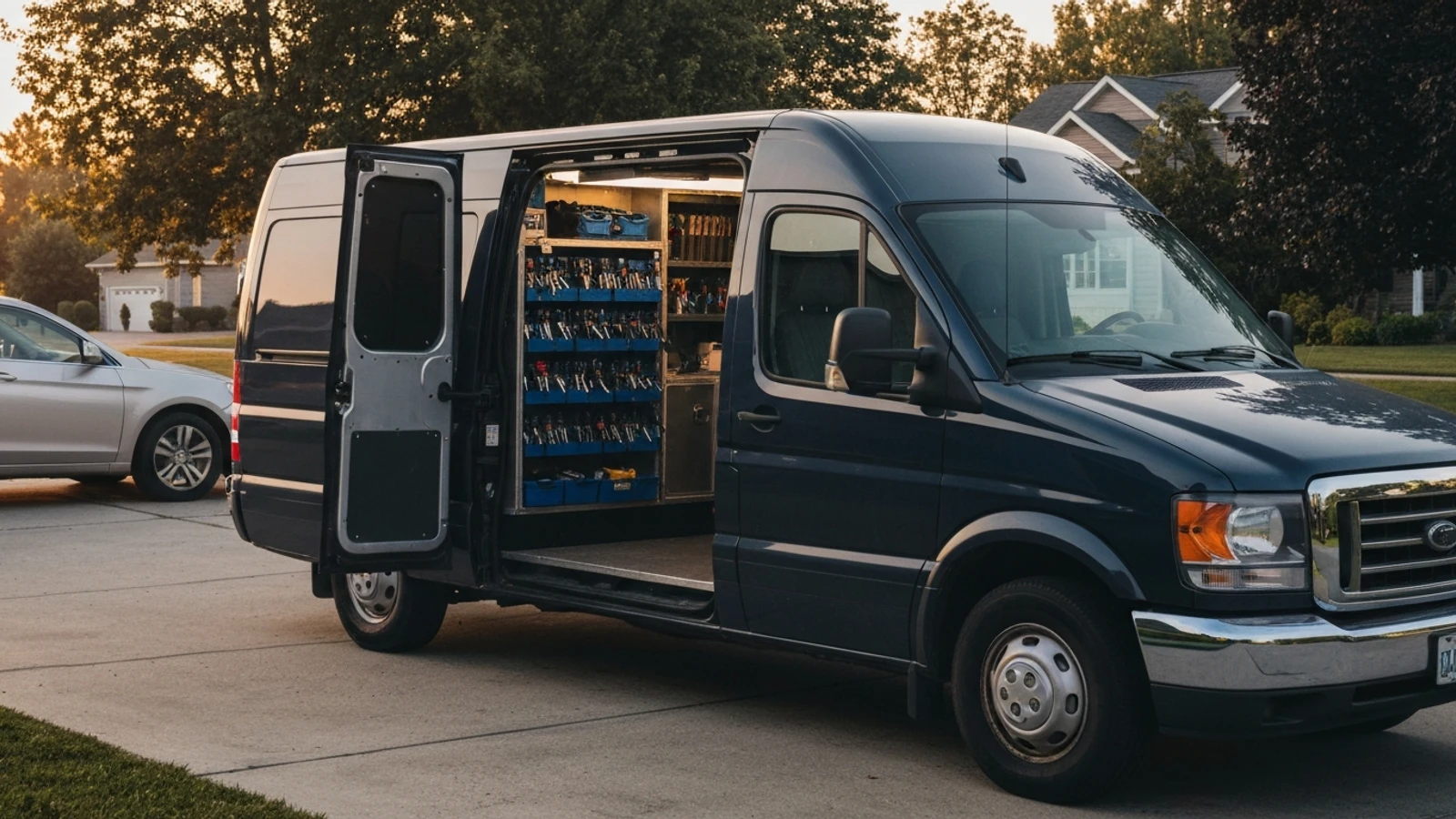
Losing a car key is one of the few unplanned expenses where the same job, on the same car, on the same afternoon, can cost wildly different amounts depending on nothing more than which phone number you dial first. This guide breaks down where that gap actually comes from across the Dallas–Fort Worth metroplex, what each path really costs once you count the tow and the lost day, and — importantly — the specific cases where the dealership is the correct answer rather than the expensive one.
All figures below are as of July 2026 and reflect the ranges published across our service pages. They are all-in numbers: blank, cut, and programming.
The headline number, and what hides underneath it
Most people comparison-shop a car key the way they'd comparison-shop a tyre — one number against another number. That framing is what makes the dealer quote look closer than it is, because the dealer's number is only one line on a bill that has at least two more.
Per the AAA Your Driving Costs 2024 report, dealership replacement of these same keys averages 35 to 60 percent higher than a qualified mobile locksmith. That is the parts-and-labor comparison alone. Then the dealership generally requires a tow, because the programming equipment lives in the service bay and does not travel. And because service bays run on appointments, the car often sits until the next available slot.
A mobile automotive locksmith inverts all three: the tool comes to the car, the job is quoted all-in, and most work is completed in 30 to 90 minutes on-site.
Line-by-line: the same key, two paths
| Cost line | Mobile locksmith | Dealership |
|---|---|---|
| Basic transponder key (domestic / Japanese) | $180 – $260 all-in | 35–60% higher per AAA 2024 |
| Flip / switchblade transponder | $220 – $320 all-in | 35–60% higher per AAA 2024 |
| Smart key, mainstream brand | $280 – $475 all-in | 35–60% higher per AAA 2024 |
| Smart key, luxury European | $450 – $1,200 all-in | Often the only option (see below) |
| Tow to the service bay | Not required | Generally required |
| Time to completion | 30–90 min, one visit, on-site | Appointment-dependent, often multi-day |
| Where the work happens | Your driveway, lot, or roadside | Dealer service bay |
The tow line is the one that quietly reshapes the comparison. It is a real cost you pay to a third party, and it converts a roadside inconvenience into a logistics problem — arranging the truck, meeting it, then arranging your own transport home. None of that appears on either quote.
Where the price actually comes from
Three variables set your number, and none of them is the shop's postcode.
Key type. This is the single biggest driver. A mechanical blank is $15 to $35. A basic transponder blank is $5 to $25 wholesale, while a smart fob blank runs $80 to $400 wholesale — a spread of more than an order of magnitude before anyone touches a programming tool. If you want to know which type your car takes before you call, the transponder programming and smart key replacement pages describe each system and which vehicles use it.
Programming depth. A transponder needs the immobilizer taught to accept the new chip. A smart key needs that plus body-control-module programming so the car unlocks, recognises proximity, and starts on the button. Two systems, two procedures, roughly double the bench time.
Whether a working key survives. This is the cliff edge. With a working key in hand, the vehicle can usually be told to accept an additional one. With every key gone, the technician must establish authorisation from scratch — a longer, tooling-heavier procedure that carries a surcharge on top of the ranges above.
The line nobody quotes: what your time is worth
Both paths produce an invoice. Only one of them also produces a logistics problem, and because that cost lands on your calendar rather than your card, it rarely enters the comparison at all.
The mobile path is roughly linear. You call, you wait for a technician, the work happens where the car already is, you drive away. Most jobs run 30 to 90 minutes on-site. Your involvement is one uninterrupted block.
The dealership path forks. You arrange a tow, wait for the truck, meet it, sort out your own transport home or to work, wait for the service department's next available appointment, then return to collect the car. That is typically two separate trips plus a tow window, spread across at least one working day and often more.
Neither of those is a moral argument — sometimes the dealer is genuinely the right call, as covered below. But if you are weighing a quote gap that looks modest on paper, the tow and the lost day are the two lines that usually decide it, and both belong in the comparison before you commit.
There is a scheduling wrinkle worth knowing too: dealership service departments run on appointment books that are fullest early in the week and before public holidays. A key lost on a Friday afternoon can easily mean a car that sits until Monday or Tuesday. Mobile availability fluctuates with demand as well, but it is measured in hours rather than business days.
What happens to the lost key
A question that comes up surprisingly late in most conversations: if someone finds the key you lost, can they still drive your car?
On a properly completed job, the answer should be no — because the technician can wipe the vehicle's stored key list and re-teach only the keys physically present. That deauthorises every key not in the room, including the one in a car park somewhere with your registration plate visible through the windscreen.
This is worth asking for explicitly, and it is worth understanding the trade-off. Deauthorising every prior key means any spare you do still own — the one in a drawer, the one your partner carries — stops working and has to be re-taught in the same visit. So the right instruction depends on your situation:
- Key genuinely lost in public, especially with anything identifying the vehicle attached to it: deauthorise everything and bring every remaining spare to the appointment.
- Key broken, or lost somewhere secure like your own home: no need to wipe. Simply adding a key is faster and cheaper.
A technician who does not raise this distinction is not thinking about your security, only about the ticket. Raise it yourself.
Per-make reality check
Brands price differently because their security architectures differ, not because of any markup convention:
- Toyota / Lexus — DST80 and DST-AES systems, roughly $150 to $425 depending on generation. See Toyota key replacement.
- Ford — PATS and HITAG-Pro, roughly $150 to $400. See Ford key replacement.
- Honda / Acura — HITAG-2, HITAG-Pro and AES, roughly $150 to $400. See Honda key replacement.
- Jeep / Chrysler / Dodge / Ram — Sentry Key and FOBIK, roughly $175 to $450, with Security Gateway (SGW) and AutoAuth requirements on newer models that add a compliance step.
The full brand list is at vehicle makes.
When the dealer is genuinely the right call
An honest comparison has to include the cases where the cheaper path does not exist.
For some 2018-and-newer luxury vehicles — certain BMW, Mercedes-Benz, and Range Rover models — the dealer path may be required because of OEM key-coding restrictions. The manufacturer withholds the coding authority, and no independent tool closes that gap legitimately. A locksmith who insists otherwise on one of these vehicles is either about to fail or about to do something you don't want done to your car.
Two more situations favour the dealer: an open recall or warranty claim touching the immobilizer or body control module, where you want the work on the manufacturer's record; and a vehicle already at the dealership for other work, where the marginal tow cost is zero.
Everything else — the overwhelming majority of what's parked in DFW driveways — is squarely mobile-locksmith territory.
Credentials worth checking before you book
Price is only half the decision. The other half is whether the person quoting it is allowed to do the work.
In Texas, locksmiths are regulated by the Texas Department of Public Safety Private Security Program. That is the licensing authority — other state agencies are frequently named online in its place, so verify the licence against DPS itself rather than taking a badge on a website at face value.
Separately, per NASTF's Secure Data Release Model program, automotive locksmiths who pair keys on many 2010-and-newer vehicles must hold an active SDRM registration — a credential requiring a background check and ongoing compliance. For a modern vehicle, SDRM registration is the practical dividing line between a locksmith who can legitimately complete your job and one who cannot.
Three questions cover it:
- Are you licensed under the Texas DPS Private Security Program?
- Do you hold SDRM registration for my vehicle's make and year?
- Is the number you just quoted all-in — blank, cut, and programming?
If the third answer wobbles, the quote will grow on arrival.
What a fair quote sounds like
A good quote is specific before the technician is dispatched. It names your key type, states one all-in number or a tight range, asks whether you still have a working key, and discloses any drive-out charge for outlying areas up front.
A quote that should worry you does the opposite: a suspiciously low headline figure with no key type attached, a refusal to commit until someone is standing at your car, or — the classic — a "diagnostic fee" on a job whose diagnosis is simply which key does this car take, a question answerable from the VIN over the phone.
Per ALOA service standards, the job should be completed in one visit with engine start and all lock, unlock, and panic functions verified before the technician leaves. Verify them yourself while the technician is still there. A key that starts the car but won't unlock the doors is a half-finished job, and it is far easier to resolve in the driveway than over the phone the next morning.
Get the spare made while you still have a key
The cheapest car key you will ever buy is the second one, purchased while the first still works.
Every price in the table above assumes an add-a-key job — a working key exists, the vehicle is in a trusted state, and the technician instructs it to accept one more. Lose the last key and the same vehicle moves onto a different procedure entirely, with a surcharge on top of those figures. The details are in what the all-keys-lost surcharge covers, but the summary is simple: a spare cut today costs meaningfully less than the same key cut in an emergency, and it removes the emergency altogether.
The economics are strongest on push-to-start vehicles, where the gap between a planned spare and an all-keys-lost callout is widest, and on any car that only ever came with one key — a common situation on used purchases, where the second key vanished at some point in the vehicle's earlier life. If you bought used and were handed exactly one key, you are one bad afternoon away from the most expensive version of this job.
Reading the invoice
A complete invoice should let you see what you paid for. Expect these lines, whichever path you took:
- The key itself, named by type — not "part."
- Cutting, where a blade exists. Push-to-start fobs still contain an emergency blade that gets cut.
- Programming, ideally distinguishing immobilizer work from body-control-module work on a smart key.
- All-keys-lost surcharge, separately stated if it applied.
- Drive-out or mileage, if you are outside the usual service radius.
Keep it. If your insurer or a manufacturer roadside program reimburses key replacement, an itemized invoice showing key type and programming labor is normally what they want to see, and reconstructing one after the fact is unpleasant. It also matters if the key later develops a fault — the invoice is what establishes what was fitted and when.
The same comparison, one make at a time
The dealer-versus-mobile gap is easiest to judge on published figures for a single make. Toyota's Smart Key all-keys-lost job runs $295 to $425 mobile against $375 to $625 at the dealer; Ford's proximity equivalent is roughly $300 to $380 mobile against $425 to $615; Honda's Smart Entry job is $295 to $400 mobile against $425 to $650. Full breakdowns:
- Toyota key replacement cost (2026)
- Ford key replacement cost (2026)
- Honda key types by year
- Nissan key replacement cost (2026)
- Hyundai and Kia key types by year
The same gap shows up outside key work. On ignition cylinder replacement the published bands are $220 to $450 mobile against $400 to $750 at a dealer, and the tow applies there too because a car that will not start cannot be driven in — our car ignition repair cost guide breaks that down.
Whichever path you take, it is worth confirming the person arriving is actually equipped for your vehicle rather than merely close to it. Who can actually program a car key covers the credentials and tooling that separate the two.
The practical sequence
If you are standing next to a car you can't start right now:
- Establish the key type. Push-to-start means a smart key. A key you physically turn is transponder or flip-transponder. If unsure, the automotive locksmith overview walks through identification.
- Check whether any working key exists — a spare in a drawer at home changes both the procedure and the price.
- Have the VIN ready. It determines the correct blank and the programming path, and it is what lets a shop quote accurately before dispatch.
- Get an all-in number, and ask the three credential questions.
- Verify every function before the technician leaves.
Most DFW drivers who follow that sequence land inside the ranges in the table above, same day, without a tow. The ones who overpay usually did nothing wrong except call the first number they found while stressed — which is exactly the moment a vague quote does the most damage.
The economics here are not unique to North Texas — the tow, the appointment book, and the key-type pricing tiers work the same way everywhere we operate. If you are reading this from outside the metroplex, the same comparison applies in every metro on our Texas coverage page and across the wider network.
Ready to compare real quotes for your vehicle? Request a specialist and we'll match you to a vetted local technician with the right tool and credential for your exact car.
Frequently asked questions
Is a locksmith always cheaper than the dealer for a car key?
For most non-luxury vehicles, yes — and by a meaningful margin. Per the AAA Your Driving Costs 2024 report, dealership replacement of the same keys averages 35 to 60 percent higher than a qualified mobile locksmith, and dealerships generally require a tow. The exception is a narrow one: some 2018-and-newer BMW, Mercedes-Benz, and Range Rover models carry OEM key-coding restrictions that route the job to the dealer regardless of who you call first.
Why does the dealer need my car towed when a locksmith doesn't?
Because the dealer's programming equipment lives in the service bay and does not leave it. A mobile automotive locksmith carries the diagnostic tool to the vehicle, so the work happens wherever the car is sitting. Per ALOA service standards, a qualified mobile locksmith should complete the job in one visit without towing — if a shop tells you to tow the car to them first, that is a red flag, not standard practice.
What does a basic transponder key cost in Dallas-Fort Worth?
A basic transponder key cut and programd by a qualified mobile locksmith runs $180 to $260 on most domestic and Japanese vehicles, and $220 to $320 for flip-style or switchblade transponders. European luxury runs higher. These are all-in figures that include the blank, the cut, and the programming — not a parts-only quote that grows once the technician arrives.
How much more is a push-to-start smart key?
Mobile smart key replacement runs $280 to $475 for most mainstream brands and $450 to $1,200 for luxury European brands. The gap is hardware plus labor: a smart fob blank costs $80 to $400 wholesale against $5 to $25 for a basic transponder blank, and pairing one requires both immobilizer and body-control-module programming rather than immobilizer alone.
Does my insurance or roadside plan cover key replacement?
Sometimes, and it is worth ten minutes on the phone before you book anything. Some comprehensive auto policies and manufacturer roadside programs reimburse key replacement, occasionally with a specific claims process that must start before the work is done. Ask what documentation is required — an itemized invoice showing the key type and the programming labor is usually enough, and any reputable locksmith will provide one.
Is the price different in Dallas versus Fort Worth or Arlington?
Not materially. The cost drivers are your vehicle's key type, its model year, and whether you still have a working key — not which DFW suburb you are parked in. What does change with location is response time, because it depends on which specialist is closest when you call. Drive-out or mileage charges for outlying areas should be quoted up front, never added at the end.
Can I just buy a blank fob online and have someone program it?
You can, and it goes wrong often enough to be worth warning about. Cheap online blanks frequently ship with the wrong frequency or chip type for your exact vehicle, and some arrive already paired to another car and cannot be reset. Most locksmiths will attempt programming on a customer-supplied fob but will not warranty it, and you still pay the programming labor when it fails. The saving is usually smaller than it looks.