Key Fob Falling Apart? New Shell or New Fob, and What Each Costs
A cracked case, worn-through buttons or a loose blade does not always mean a new key. How to tell whether a shell swap will fix your fob, when it will not, and what each route costs in 2026.
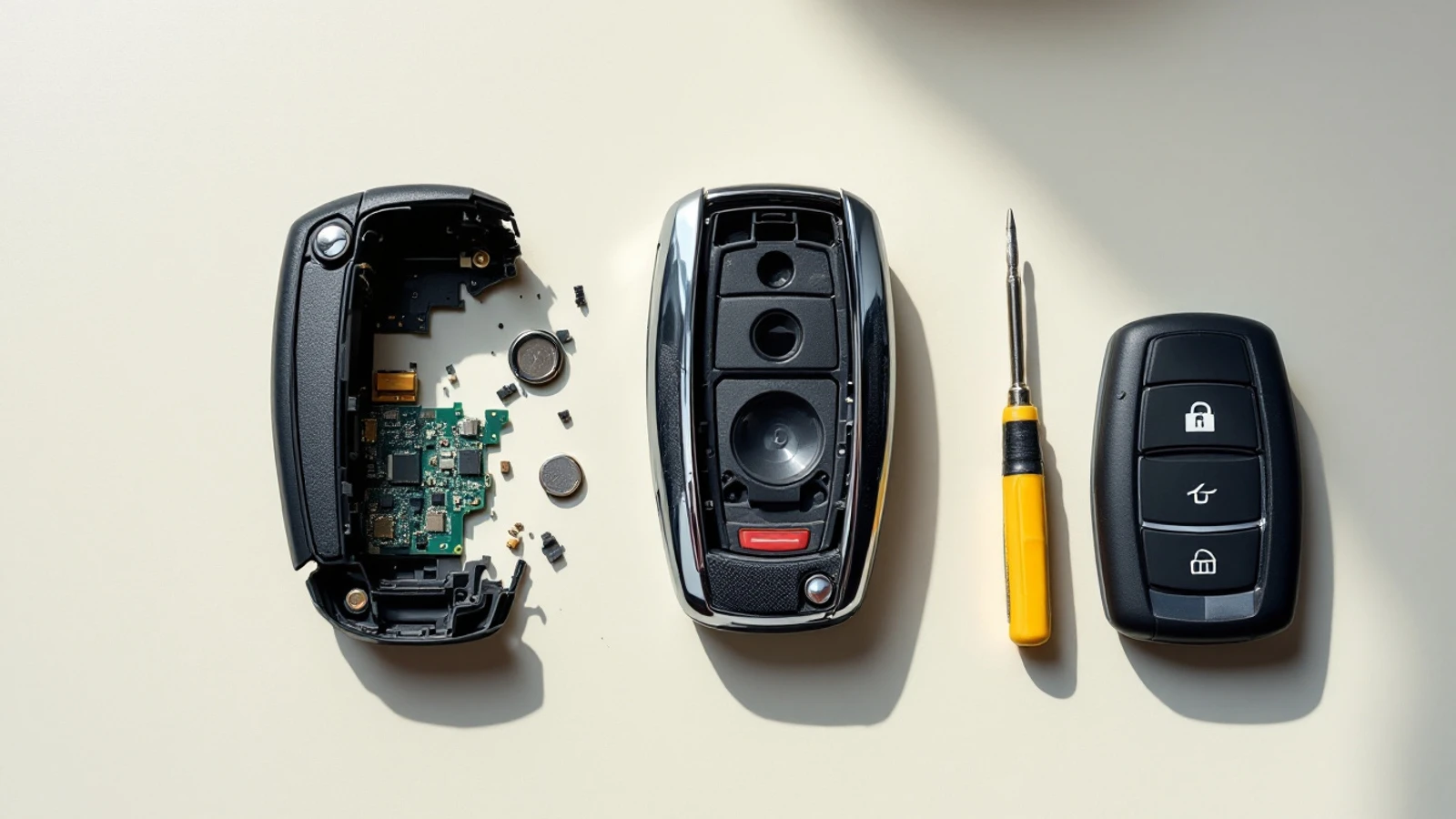
A key fob that is falling apart usually does not need replacing. If the chip and circuit board inside are undamaged, moving them into a new shell restores the key for roughly half the cost of a fresh one, according to our service pages as of September 2026. A new key only becomes necessary when the electronics themselves are damaged. The trick is telling which situation you are in before you pay for the more expensive answer.
A cracked case, worn-through buttons, a snapped key ring loop and a wobbling flip blade all look like a dying key. Most of them are housing problems. The car does not care what the plastic looks like. It cares whether the chip inside answers, and whether the remote transmits when you press a button. This guide explains how to tell a housing problem from an electronic one, what each repair costs, and when a shell swap is a false economy.
What is actually inside a key fob
Every modern car key has two jobs, and they are handled by different parts.
The transponder chip is what lets the engine start. The car's immobilizer reads it at close range when you turn the key or press the start button. On most keys it is mounted on the circuit board. On some older remote-head keys it is a separate small glass or ceramic capsule sitting loose in a pocket of the plastic shell.
The remote circuit board handles locking, unlocking and, on smart keys, hands-free entry. It carries the buttons' switches, the radio transmitter and the battery contacts.
The shell is everything else: the plastic case, the rubber button pad, the key ring loop, and on flip keys the hinge and the metal blade.
A shell swap moves the chip and board into a new case. As long as the chip and board are undamaged, the car cannot tell the difference, because nothing it checks has changed. That is why re-housing is cheaper than a new key: there is no new chip to buy and, in most cases, no immobilizer programming to do.
Housing problem or electronic problem?
Work through the symptoms. The table covers the failures we see most often.
| What you notice | Usually a | Typical route |
|---|---|---|
| Case cracked or split along the seam | Housing problem | New shell |
| Rubber buttons worn through or missing | Housing problem | New shell with fresh button pads |
| Key ring loop snapped off | Housing problem | New shell |
| Flip blade loose, will not lock open, or snapped | Housing or blade problem | New blade and hinge, or new flip shell |
| Battery cover will not stay on | Housing problem | New shell |
| Buttons press but nothing happens, with a fresh battery | Could be either | Test the board before deciding |
| Car will not start with this key but did yesterday | Electronic problem | Test the chip; new key if it is dead |
| Key went through the washing machine | Could be either | Dry out, fresh battery, then test |
| Board visibly corroded, cracked or burnt | Electronic problem | New key |
The two ambiguous rows are the ones where it pays to have someone test the key rather than guess. A fob whose buttons do nothing may have worn switches on the board, or it may have a board that is fine sitting in a shell whose contacts have broken. Those look identical from the outside and cost very different amounts to fix.
Test it yourself before you pay anyone
Three quick checks narrow it down.
Fit a fresh coin cell of the correct type, the right way up. A surprising share of "broken" fobs are a flat battery in a tired case, and a case that has been dropped often has a battery contact that has shifted. Our guide to a fob that only works up close covers how battery decline shows up.
Try starting the car. If the car starts with this key, the transponder chip is fine, whatever the case looks like. That alone tells you the expensive part of the key is still good.
Try the buttons with the case held firmly closed. If the fob works only when you squeeze it, the board is probably fine and the shell is no longer holding it in contact. That is the textbook case for a shell swap.
If the car will not start with the key and does with your spare, the chip or board has failed, and a new key is the answer rather than a new shell. Our guide to one key working and the other not walks through that comparison in more depth.
What each route costs
As of September 2026, these figures come from our key fob programming page and smart key replacement page. The shell swap is described there as roughly half the cost of a fresh key rather than as a fixed band, because the saving scales with how expensive the key is in the first place.
| Route | Typical cost |
|---|---|
| Fresh coin cell | a few dollars |
| Re-house an existing fob in a new shell | roughly half the cost of a fresh key |
| Re-program an existing remote-only fob | $25 – $60 |
| New remote-only fob, programmed | $50 – $120 |
| New standard transponder-plus-remote fob, cut and programmed | $180 – $280 |
| New flip or switchblade fob | $220 – $320 |
| New smart proximity fob, Toyota, Honda or Hyundai | $280 – $450 |
| New smart proximity fob, Ford or GM | $300 – $475 |
| New smart proximity fob, BMW, Mercedes or Audi | $450 – $850 |
That table is the whole argument for trying the shell first. On a mainstream proximity key, roughly half of a $280 to $475 key is real money. On a German luxury key where a new one runs $450 to $850, the saving is larger still. And a shell swap on a smart key is quoted on our smart key page as about a 20-minute job.
When a shell swap is a false economy
There are four situations where paying for a new shell is the wrong call.
The board is damaged. Corrosion from water, a cracked board from a heavy drop, or a burnt component near the battery contacts all mean the electronics are the problem. A new shell houses a dead board.
The button switches themselves are worn out. On keys used heavily for years, the tiny switches soldered to the board wear flat. A fresh rubber pad presses on a switch that no longer clicks. If new button pads do not bring the buttons back, stop there.
The chip is lost. On older keys where the transponder sits loose in the shell, a cracked case sometimes lets the chip fall out. If the key unlocks the doors but will not start the car and the chip pocket is empty, that key needs a new chip programmed, which moves it into new-key territory. Our guide to a new key that unlocks the doors but will not start the engine explains why remote and immobilizer are separate.
It is your only key and it is already failing. A shell swap fixes the case, not the fact that you have one key. If that key is lost or dies later, you are into an all-keys-lost job, which costs noticeably more. Our guide to what the all-keys-lost surcharge covers explains why. When your only key has reached the falling-apart stage, adding a spare in the same visit is usually the better spend.
Flip keys and broken blades
Flip and switchblade keys fail in their own ways, almost all of them mechanical.
The spring that pushes the blade open weakens, so the blade will not fully deploy. The pin that holds the blade in the hinge works loose. And the blade itself can snap at its thinnest point, usually after being used as a lever or turned hard in a stiff lock.
In most of those cases the electronics are untouched. A replacement blade has to be cut to match your car, which is a key-cutting job rather than a programming one, and fitted into your existing head or a new flip shell. If a piece of the snapped blade is still in the ignition or a door lock, deal with that first; our guide to a key stuck in the ignition covers the stuck-key side.
Aftermarket shells: what to watch for
Replacement shells are sold cheaply online, and for a simple remote-head key a careful owner can fit one. The common mistakes are predictable:
- A shell that almost fits. Button positions, battery holders and board clips vary between model years that look identical. A near-miss shell leaves the board loose, which recreates the fault you were fixing.
- An uncut blade. Most replacement shells come with a blank blade. It will not open your door or turn your ignition until it is cut to your car.
- A chip left in the old case. On keys where the transponder is not on the board, it has to be moved across. Forget it and the key unlocks the car but will not start it.
- Counterfeit housings for smart keys. On proximity keys, a poor shell can shield the board's antenna enough to shorten range noticeably.
A specialist doing the swap cuts the blade, moves every part, fits a fresh cell and tests starting, locking, unlocking and hands-free entry before leaving. That testing is most of what you are paying for.
What the visit looks like
On a straightforward re-house, a mobile specialist opens the old fob, moves the board and chip into the new shell, cuts the blade if one is needed, fits a new battery and tests every function. On a smart key our service page puts that at about 20 minutes. If the test shows the board is the problem after all, a good specialist tells you before fitting anything, so you are not paying for a shell and then a key.
Have the car there. The only honest way to confirm a re-housed key works is to start the car with it and try every door, and a specialist who re-houses a key without testing it on the vehicle has not finished the job.
Where to start
If your fob is cracked, worn or loose but the car still starts with it, a shell swap is very likely the cheapest fix that works. If the car no longer recognises the key, test it against your spare before deciding. And if the key in your hand is the only one you have, consider adding a second key in the same visit.
Our makes directory lists the brands we cover, and our state-by-state cost comparison explains why a key repair costs much the same in Pennsylvania as it does in California. When you are ready, get help matches you with a vetted automotive specialist near you.
Frequently asked questions
My key fob case is cracked. Do I need a whole new key?
Often not. The part that matters to the car is the chip and the circuit board inside. If those are undamaged, they can be moved into a new shell and the key keeps working exactly as before, with no programming needed for the immobilizer. Our service pages put a shell swap at roughly half the cost of a fresh key. A new key is only necessary when the board or chip is damaged too.
How much does a key fob shell replacement cost compared with a new fob?
As of September 2026, re-housing an existing fob in a new shell runs roughly half the cost of a fresh key, according to our key fob and smart key pages, and is about a 20-minute job for a smart key. For reference, a new standard transponder-plus-remote fob runs $180 to $280 cut and programmed, a flip-style fob $220 to $320, and a mainstream smart proximity fob $280 to $475.
The buttons on my fob are worn through. Is that fixable?
Usually. Worn rubber button pads and missing button covers are a housing problem, not an electronic one, so a new shell with fresh button pads normally fixes it. If the buttons still do nothing after a new shell, the switches on the circuit board themselves may be worn or damaged, and that is when a new fob becomes the better answer.
Will I have to reprogram my key after a shell swap?
For the immobilizer, usually not, because the same chip goes into the new shell and the car already trusts it. If the shell also needs a new blade, that blade has to be cut to match your car. On some fobs the remote may need a simple re-sync after the board has been out of its case. A specialist tests starting, locking and unlocking before leaving.
Can I buy a cheap shell online and do it myself?
On many simple remote-head keys, yes, with care. The risks are a shell that does not quite fit the board, a transponder chip left behind in the old case, and a blank blade that nobody has cut. Some chips sit loose in the old shell rather than on the board, and forgetting to move one produces a key that unlocks the doors but will not start the engine.
My key went through the washing machine. Shell or new fob?
Dry it thoroughly with the battery out before testing, then fit a fresh cell. If the chip is intact but the buttons are dead, a shell swap restores it for roughly half the cost of a fresh key. If the car will no longer recognise the key at all, the chip is likely damaged and full replacement is required.
Does a broken flip-key blade mean I need a new key?
Not necessarily. On many flip and switchblade keys the blade and the hinge are replaceable parts, and a new blade can be cut to your car and fitted to your existing head. The electronics stay where they are. If the head itself is cracked around the hinge, moving everything into a new flip shell is the usual fix.
Is a shell swap a good idea if it is my only key?
It is a fine repair, but it is also a good moment to add a second key. If your only key has reached the point of falling apart, a spare made while it still works is far cheaper than an all-keys-lost job later. Many drivers do both in the same visit.