Your Key Fob Only Works Up Close: Diagnosing Lost Range
A fob that used to work from across the parking lot and now needs to touch the door handle is failing gradually, and gradual failure has a short list of causes. Here is how to find yours before it strands you.
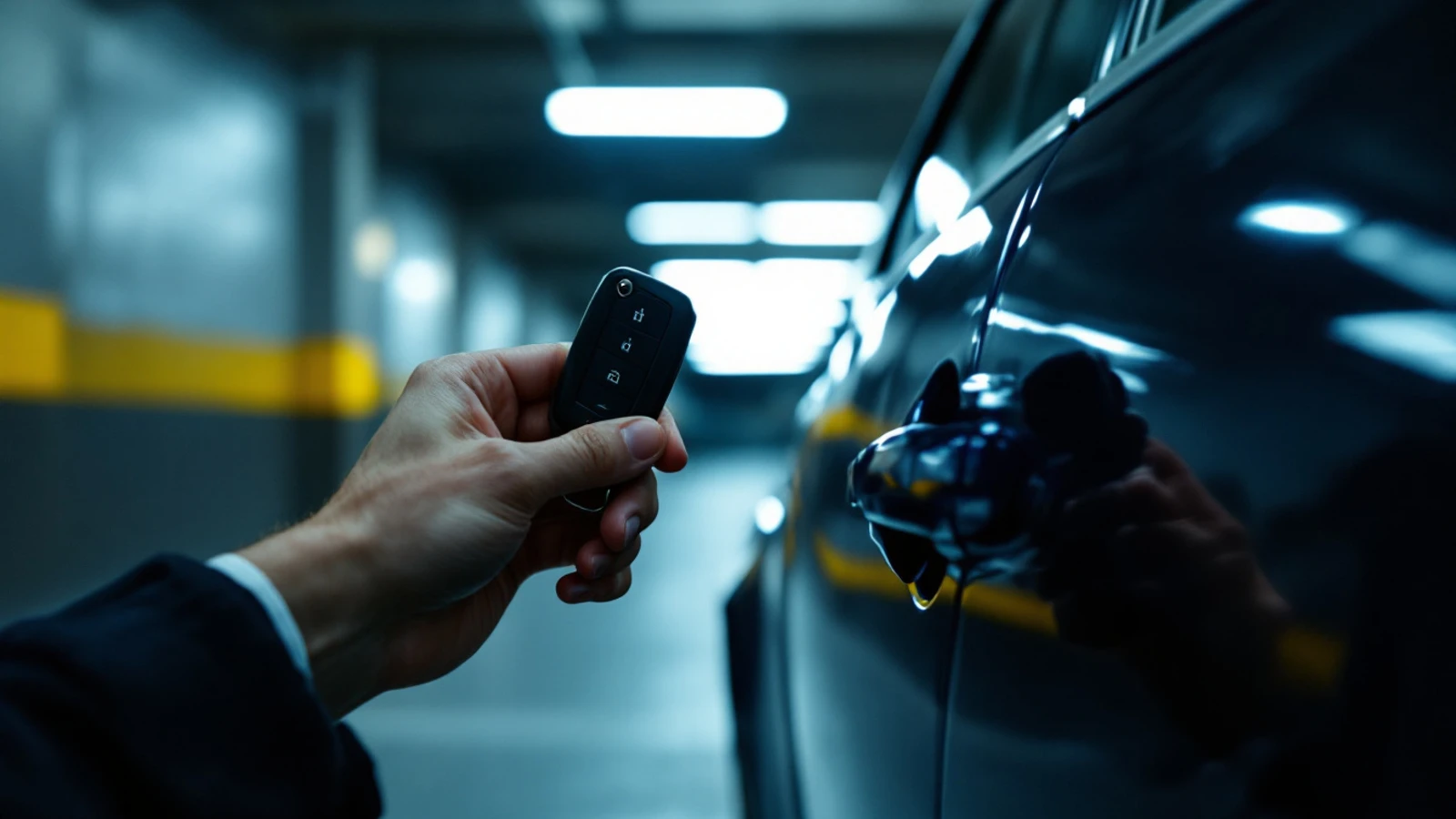
There is a specific moment people describe on these calls. You used to press unlock walking out of the store and hear the car chirp from thirty feet away. Now you are standing at the door, holding the fob against the handle, pressing twice.
Shrinking range is not random failure. It is a fob telling you it is running out of something, and the list of what that something can be is short. Working through it takes about ten minutes and usually ends at a part that costs a few dollars.
The important thing about this symptom is the timing. A fob that has lost range has not failed yet, which means you get to fix it on your schedule rather than in a parking lot at night. That advantage disappears the moment you ignore it.
What is actually happening
A remote fob is a small low-power radio transmitter. Press a button and it broadcasts a short coded message. The vehicle's receiver listens for it.
Whether that message arrives depends on three things: how strongly the fob transmits, how well the vehicle receives, and how much competing radio noise sits between them. Range is the visible product of all three.
Because the fob's transmit power depends on battery voltage, and because a coin cell loses voltage progressively rather than all at once, a weakening battery produces exactly this symptom: not a fob that stops working, but a fob that works from steadily shorter distances over weeks or months.
That progressive curve is the single most useful clue you have. Sudden total failure suggests something broke. Gradual shrinkage suggests something is draining.
The diagnosis, in the order that costs least
Step 1: The two-fob comparison
If your vehicle came with two fobs, this is the highest-value test available and it costs nothing.
Take both to the same spot, same distance, same orientation, and try each.
- Only one fob is weak. The fault is inside that fob. Continue to step 2.
- Both fobs are weak. The fob is probably not the problem. Suspect the vehicle's receiver or the location itself, and go to step 4.
Most people skip this and start buying parts. Do not skip it.
Step 2: Change the battery
On a single weak fob, the battery is the leading suspect by a wide margin.
Nearly every fob opens with a coin or a small flat-blade tool at a seam in the case, and many proximity fobs require sliding out the emergency blade first to release a catch. The cell inside is a standard coin type, printed with its designation on the face. The part is about $3.
Two things to get right while you are in there:
- Orientation. Note which face is up before removing the old cell. Installing it inverted is the most common reason a fresh battery appears not to work.
- Skin contact. Handle the new cell by its edges. Finger oil on the contact faces raises resistance, and on a component this small that is not a negligible effect.
Reassemble, then retest at the distance where the fob used to work. If range is restored, you are finished.
Step 3: If a fresh battery did not fix it
Now you are looking at the fob's internals or its pairing. Three possibilities, in descending order of likelihood.
Antenna or solder damage. A fob spends its life in a pocket being dropped, sat on, and flexed. A hairline crack in a solder joint or a fractured antenna trace weakens transmission without stopping it. Externally the fob looks fine.
Water ingress. A fob that has been through a wash cycle, a rainstorm in a coat pocket, or a spill can corrode internally. Corrosion is progressive, which again produces gradual rather than sudden failure.
Pairing degradation on rolling-code systems. Less common than the first two, but on some systems a fob can drift out of correct synchronization with the vehicle's receiver, producing unreliable rather than absent operation. That is a reprogramming fix, not a hardware one.
A technician can distinguish these quickly. The distinction matters because reprogramming is far cheaper than replacement.
Step 4: If both fobs are weak
The vehicle side or the environment.
Location interference. Fobs transmit at low power on shared unlicensed frequencies. Dense concrete parking structures, nearby transmitters, and certain commercial equipment can raise the local noise floor enough to swamp a perfectly healthy signal. The tell is geographic: range is normal everywhere except one place. If that describes your situation, nothing is broken.
Vehicle receiver fault. Genuinely uncommon, but real. If both fobs are weak in every location, the receiving side warrants diagnosis.
A recent vehicle battery replacement or electrical work. Some vehicles need a re-sync of remote functions afterward. If range changed abruptly right after service, mention it.
What each fix costs
Figures are as of August 2026 and reflect the ranges published on our service pages.
| Outcome | What is done | Typical cost |
|---|---|---|
| Weak coin cell | Battery replaced, done yourself | ~$3 part |
| Weak coin cell | Battery replaced by a technician at your location | under $135 all-in |
| Fob sound, pairing lost | Re-program an existing remote-only fob | $25 – $60 |
| Fob sound, more complex system | Programming only | $60 – $150 |
| Remote-only fob failed | New fob supplied and programmed | $50 – $120 |
| Transponder-plus-remote fob failed | New fob cut and programmed | $180 – $280 |
| Flip or switchblade fob failed | New fob cut and programmed | $220 – $320 |
| Smart proximity fob failed, mainstream brand | New fob supplied and programmed | $280 – $450 |
Read the top and bottom rows together. The difference between the cheapest and the most expensive outcome is roughly a hundred-fold, and the only thing that determines which one you are on is diagnosis.
That is the entire argument for spending ten minutes on the steps above before buying anything. A great many replaced fobs did not need replacing.
Proximity fobs: why this matters more
On a push-button vehicle, the stakes are higher than on a bladed key, because the fob does more.
A remote-only fob that dies costs you the convenience of remote unlocking. You still have a metal key. On a proximity vehicle, the same dead fob takes out passive entry and push-button start as well.
Manufacturers build a fallback for exactly this. Most proximity vehicles will start if you hold the fob directly against a specific point, often the start button itself or a marked spot on the steering column, so the vehicle can read the transponder at close range without needing the radio. Your owner's manual documents where.
Find that spot now, while the fob still works. A proximity fob showing reduced range is telling you that fallback is going to matter soon.
There is also a mechanical emergency blade hidden inside virtually every proximity fob, which opens the driver's door when the fob has no power at all. Knowing it is there is the difference between an inconvenience and a lockout. Our guide to lockout versus key replacement covers which situation you are actually in when the car will not open.
Things that look like range loss but are not
Three situations get reported as a weak fob and are something else entirely. Recognizing them saves a visit.
One button works, another does not. That is a button or contact failure inside the fob, not a range problem. The radio is transmitting fine; a specific switch has worn out. Fobs live in pockets and get pressed thousands of times, and the unlock button almost always fails first because it is used most.
The fob works but the door does not open. If the vehicle chirps, the lights flash, and the door still will not open, the signal arrived. You have a mechanical door latch or lock actuator problem, which is a different trade of work entirely.
Range collapsed suddenly rather than gradually. Sudden failure points at physical damage — a drop, a wash cycle, a crushed case — rather than a draining battery. The fix may be the same, but the diagnosis path is different, and a fob that has been wet should be opened and inspected rather than simply re-batteried.
Range is fine but the car does not always start. On a proximity vehicle this points toward the vehicle's start system or the transponder rather than the remote radio. They are separate functions inside the same fob, and they can fail independently.
Range collapsed on the first cold morning of the year. This is the seasonal version of the same fault and it is worth separating out, because the timing misleads people. A coin cell that is already part-discharged delivers less at low temperature, so a fob that was merely marginal in October stops working outright in December. The tell is that it recovers when warmed in a closed hand. If that describes yours, the cell is near the end of its life rather than the fob being damaged, and what actually fails below freezing covers the rest of the cold-weather list, including the vehicle-battery symptoms that get misread as key faults.
Preventing the next one
Fob failures are one of the few automotive problems that are genuinely predictable, which makes them preventable.
Replace the coin cell on a schedule. Most fob batteries last somewhere between two and four years in normal use. If you cannot remember replacing yours, it is due. At roughly $3 a cell, replacing both fobs preemptively costs less than one avoidable service call.
Keep the second fob in service. A spare that lives permanently in a drawer has its own battery quietly draining, and its own chance of being dead precisely when you need it. Rotate them occasionally so both stay proven.
Keep fobs dry and unloaded. The two most common physical failures are water ingress and case flex. A fob in a back pocket gets sat on daily.
Know your vehicle's fallbacks before you need them. Two things are worth locating in the owner's manual while everything still works: where the emergency blade is concealed inside the fob, and where to hold the fob to start the vehicle when its battery is flat. Both take two minutes to find at home and are very difficult to work out in a dark parking lot.
Treat shrinking range as a warning, not a quirk. That is the whole point of this symptom. It is the one failure mode that announces itself in advance.
What a legitimate quote looks like here
Because this symptom has such a wide range of possible fixes, it is also a place where an unqualified responder can turn a $3 problem into a several-hundred-dollar invoice.
A technician handling this properly will:
- Test before selling. Battery voltage is measurable in seconds. So is whether a second fob behaves differently.
- Quote the diagnosis and the fix separately, so you can see what you are paying for.
- Offer reprogramming before replacement where the fob is physically sound.
- State the all-in figure up front rather than a "starting at" number that grows on arrival.
If the first move is to sell you a new fob without opening the old one, that is the moment to ask what was tested. Our guides to deposits and payment: what a legitimate shop asks and customer-supplied key fobs cover the surrounding practices worth knowing before you book.
The one thing to do today
If your fob has lost range, replace the battery. It is three dollars and one minute, it resolves the majority of these cases, and if it does not resolve yours you have eliminated the leading cause for the price of a coffee.
Then, if range is still short, get it looked at while the fob still works. A weak fob is a scheduling problem. A dead one is not.
Our key fob programming and proximity key replacement pages cover what each visit involves, and you can start a request on the get help page.
Cost ranges are as of September 2026 and reflect the published ranges on the CarKeyNation service pages.
Frequently asked questions
Why does my key fob only work when I am right next to the car?
Shrinking range is nearly always a weakening power source or a degraded antenna inside the fob. A coin cell that has dropped below full voltage still produces a signal, just a weaker one, so the working distance collapses gradually rather than failing outright. Less often the cause is a cracked solder joint on the fob's antenna, water damage inside the case, or radio interference at that specific location.
Is a fob that only works up close about to stop working entirely?
Usually yes, if the cause is the battery. A coin cell loses voltage progressively, so shrinking range is the warning stage that precedes total failure. Treating it as a scheduled fix rather than an emergency is the whole advantage of noticing early. On proximity vehicles, a fob that fails completely also stops passive entry and push-button start, which is a considerably worse moment to discover it.
How much does a key fob battery cost?
The coin cell itself is roughly a $3 part on most vehicles, and the swap takes about a minute once the case is open. If you have a technician come to you, a battery replacement visit runs under $135 all-in. It is the cheapest outcome on this entire list, which is exactly why it should be ruled out before anything else is bought.
If a new battery does not fix it, what is next?
Reprogramming, if the fob is otherwise sound. Re-pairing an existing remote-only fob typically runs $25 to $60, and programming-only on more complex systems runs $60 to $150. If the fob's internal antenna or board is damaged, a replacement is required instead: $50 to $120 for a new remote-only fob programmed, $180 to $280 for a standard transponder-plus-remote, and $280 to $450 for a mainstream smart proximity fob.
Could the problem be the car rather than the fob?
It can be, and there is a simple test for it. If you have a second fob, try it from the same distance in the same place. If both fobs are weak, suspect the vehicle's receiver or local radio interference. If only one is weak, the fault is in that fob. That single comparison saves more misdiagnosis than any other step in this guide.
Why does my fob work fine at home but poorly in one parking garage?
Radio interference is location-specific. Key fobs transmit at low power on shared unlicensed frequencies, and dense concrete, nearby transmitters, and some commercial equipment can raise the local noise floor enough to swamp a healthy signal. If range is normal everywhere except one place, the fob is probably fine and the location is the variable.
Should I replace the fob or just the battery, if the fob is old?
Start with the battery every time, because it is a few dollars and it resolves the majority of range complaints. Replace the fob when a fresh battery does not restore range, when the case is cracked or has been wet, or when buttons have become intermittent. Age alone is not a reason to replace a fob that still works at full range.