You Have a New Car Key. Here Are the Six Things to Do Before You Forget
Most car key advice stops when the engine starts. The half hour afterwards decides whether you ever pay for this again — deauthorising the old key, keeping the invoice, and getting the spare policy right.
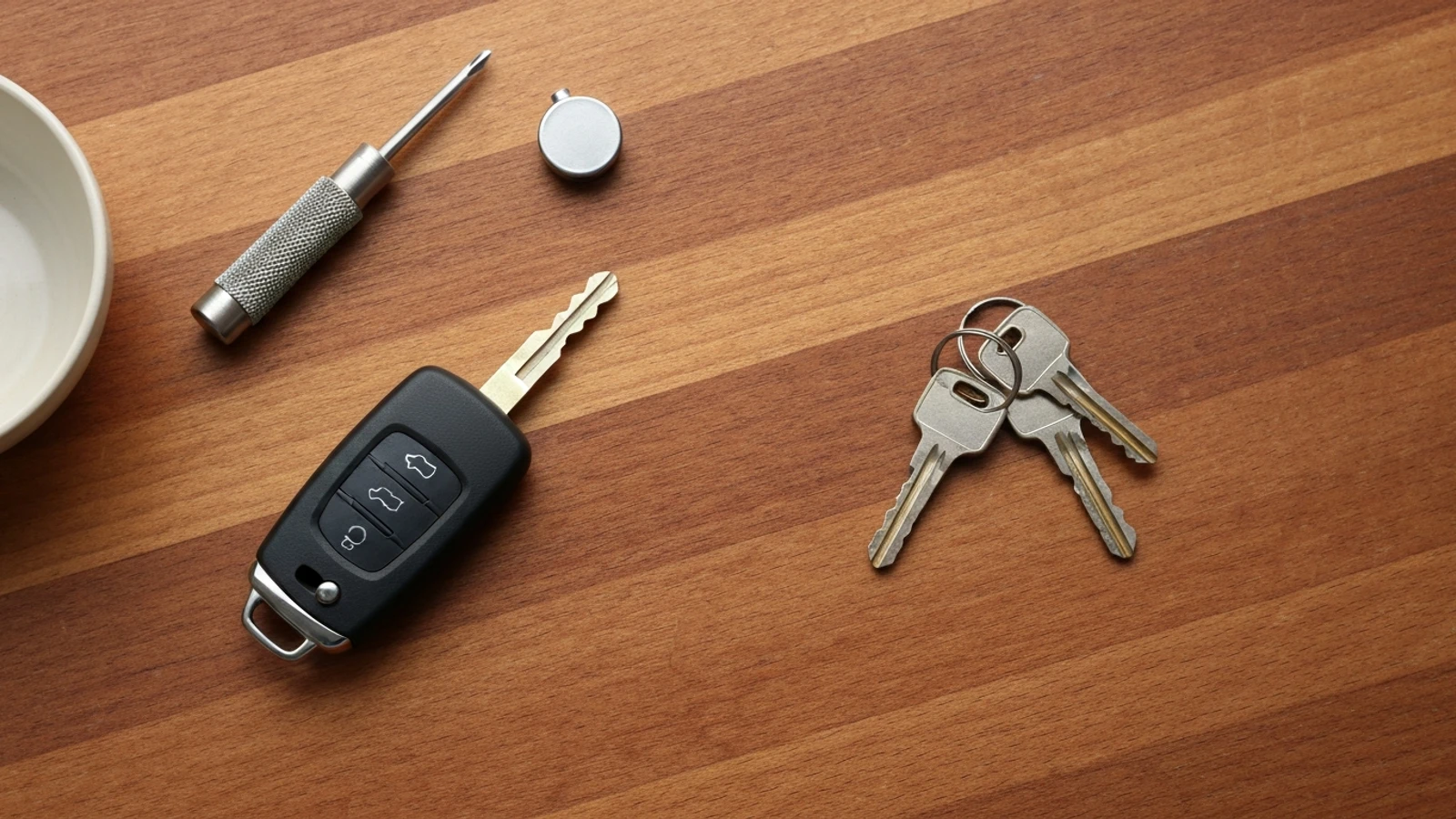
Almost every guide about car keys ends at the same moment: the engine starts, the technician leaves, the problem is solved.
The half hour after that is what decides whether you are back here again in eighteen months, and whether the key you lost is still capable of driving your car away. This guide covers the six things worth doing while the details are fresh — several of them only possible while the technician is still standing in your driveway.
Figures are as of August 2026 and reflect the ranges published across our service pages.
1. Decide what happens to the old key — before the technician leaves
This is the most important item on the page and the one most commonly missed, because it has to be raised rather than assumed.
When a key is replaced, there are two possible outcomes. The vehicle can be told to accept an additional key, leaving every previously paired key working. Or the stored key list can be wiped and re-taught to only the keys physically present, which makes every key not in the room permanently useless.
Those are very different security outcomes, and the right one depends on how you lost the key:
| Situation | What to ask for |
|---|---|
| Key lost in public, especially with ID or address attached | Deauthorise everything — bring every remaining spare |
| Key lost at home or somewhere secure | Simply add a key — cheaper and faster |
| Key snapped or physically damaged, pieces in hand | Simply add a key |
| Vehicle recently bought used, unknown key history | Deauthorise everything |
That last row deserves emphasis. If you bought a used car and were handed one key, you have no idea how many others exist or who holds them. A previous owner, a former partner, a dealership that kept a copy. Wiping the key list is the only way to know.
A technician who raises this distinction unprompted is thinking about your security. If they do not raise it, raise it yourself.
2. Test everything while someone is still there
Per ALOA service standards, the job should end with engine start and all lock, unlock and panic functions verified. Verify them yourself — it takes two minutes and it is dramatically easier to resolve a problem in your driveway than by phone the following morning.
- Start the engine.
- Lock and unlock with the remote buttons, from a few paces away.
- Press the panic button and confirm it triggers and cancels.
- On a smart key, walk up to the car with the fob in your pocket and confirm proximity detection works without pressing anything.
- On any key with a blade, check it physically opens the driver's door. Every push-to-start fob contains an emergency mechanical key for exactly the moment your fob battery dies.
Point five catches a surprising number of otherwise-complete jobs. The blade is easy to overlook because nothing is ever inserted into an ignition on a push-button car — right up until the battery is flat and it is the only way in.
3. Keep the invoice
The paperwork has more downstream value than most drivers expect. A complete invoice names the key by type rather than as a generic "part," the cutting line, the programming line, any all-keys-lost surcharge stated separately, and any drive-out or mileage charge.
Three reasons to file it somewhere you will find it:
Reimbursement. Some comprehensive auto policies and manufacturer roadside programmes cover key replacement. What they generally want is an itemised invoice showing the key type and the programming labour. Reconstructing one months later is unpleasant and sometimes impossible.
Future faults. If the key stops working in six months, the invoice establishes what was fitted, by whom, and when — which is the difference between a warranty conversation and a new job.
The next technician. Whoever pairs your next key can see exactly what is already on the vehicle, which shortens their work.
Our guide to deposits and payment covers what a complete invoice should contain in more detail.
4. Count your working keys, honestly
Stand still and count how many keys you now hold that actually start the car.
If the answer is two or more, you are in good shape. Nothing urgent to do.
If the answer is one, you are one bad afternoon from the most expensive version of this job — and you now know exactly what that costs, because you just paid it.
The arithmetic is not subtle:
| Job | Spare made while a key works | Replacement after every key is lost |
|---|---|---|
| Basic transponder | $140 – $220 | $220 – $320 |
| Smart proximity, mainstream | $240 – $400 | $320 – $475 |
| Luxury European smart key | $420 – $750 | $550 – $1,200 |
The all-keys-lost surcharge alone is $100 to $250 through a locksmith, and $200 to $500 plus a tow through a dealership. A spare made in advance removes it permanently.
There is a second saving too: with a car that still drives, you can visit a locksmith storefront and avoid any travel charge, or book a normal-hours scheduled slot instead of an emergency callout. Our comparison of same-day versus scheduled appointments covers how much that positioning is worth.
5. Store the spare somewhere that makes sense
A spare only helps if you can reach it without the car. That rules out the obvious bad idea immediately.
Do not hide it on the vehicle. A magnetic box under the bumper or inside a wheel arch defeats the entire purpose of an immobilizer — you have carefully paid for a security system and then attached the bypass to the outside of it.
Do not attach anything identifying to it. No registration number, no address, no house keys on the same ring. A found key with an address is a different problem from a found key.
Sensible options: a drawer at home, a trusted second household, a workplace locker, or a small safe. The test is simple — could you retrieve it within an hour, without the car, at nine on a Sunday evening?
6. Note the battery type now
A flat coin cell is one of the most common reasons a fob "stops working," and it is worth being able to distinguish that from an actual fault.
Most fobs take a standard coin cell — commonly a CR2032 or CR2025 — and open with a small screwdriver or the edge of a coin. Write the type down now, while the fob is new and you have a moment, rather than at the point where the car will not unlock.
Symptoms of a dying battery are recognisable: reduced range, needing to be closer to the car, buttons working intermittently, or a dashboard warning about key detection. None of those is a programming fault, and none needs a technician.
What does need attention is a fob whose buttons have stopped working while the engine still starts normally. That is usually a reprogram at $25 to $60, not a replacement — being sold a full smart key for a remote fault is one of the more common overpays. The key fob programming page covers which symptoms fall into which category.
What to write down while it is fresh
You have just acquired specific knowledge about your own vehicle that took a technician and a diagnostic tool to establish. In six months you will not remember it, and re-establishing it costs another call.
Five lines in a note on your phone, or on the back of the invoice:
| Detail | Why you will want it |
|---|---|
| Your exact key type | Stops you being quoted for the wrong category next time |
| The fob battery type | A flat cell becomes a two-minute fix, not a callout |
| Who did the work, and when | Warranty conversations start here |
| How many working keys you now hold | Determines whether you need a spare |
| Whether old keys were deauthorised | Tells the next technician what state the car is in |
That last row is the one people never record and frequently need. If a key turns up in a coat pocket two years from now, knowing whether it was wiped tells you instantly whether it is a working spare or a piece of plastic.
The security question worth thinking through once
Most drivers consider key security exactly once — at the moment they lose one. It is worth ten minutes now instead, because the decisions are easier when nothing is on fire.
Where does your spare live, and who can reach it? A spare kept by a family member in another household is more resilient than one in a drawer at the same address, and vastly more useful than one hidden on the car.
What is attached to your keys? A registration plate number, a house key and an address tag on one ring turns a lost key into a lost car and a lost house. Splitting vehicle keys from house keys costs nothing and removes that entire scenario.
Who else has ever had a key to this car? For a used purchase, the honest answer is that you do not know — which is the case for wiping the key list rather than adding to it.
Would you know if a key went missing? A spare you never check could be gone for months. Looking at it occasionally is the whole practice.
None of this requires spending anything. It is the difference between a lost key being an inconvenience and a lost key being a security event.
When to think about the next one
A key is not a permanent object, and it is useful to know what the failure modes look like before they arrive.
Battery — the most common by a wide margin, and not a fault. Reduced range and intermittent buttons are the signature. A few dollars.
Case wear — buttons that stop responding to pressure while the fob still starts the car. Shell replacement is often possible without re-programming, because the electronics move across.
Water exposure — the one genuine emergency in this list. A fob that has been swimming should be dried out immediately and not tested repeatedly while wet. Damage here is frequently permanent.
Blade wear — on any key with a cut blade, years of use round the edges. A key that has become fussy in the door lock is wearing out, and it is worth cutting a fresh one from the code rather than copying a worn original.
Three of those four are cheap if caught early and expensive if ignored until the key stops working entirely while you are somewhere inconvenient. Our comparison of lockout versus key replacement covers how to tell a failing key from a genuine lockout when it happens.
The one-page summary
| Do this | When | Why |
|---|---|---|
| Decide on deauthorising old keys | Before the technician leaves | Only chance to do it in the same visit |
| Test start, locks, panic, proximity, blade | Before the technician leaves | Two minutes now, a phone call otherwise |
| File the itemised invoice | Same day | Reimbursement, warranty, future work |
| Count working keys | Same day | Determines whether you need a spare |
| Book a spare if you hold only one | Within a few weeks | Removes the surcharge permanently |
| Note the fob battery type | Same day | Prevents a callout for a flat cell |
Two of those six can only be done while someone is still standing at your car, which is why they are first. The rest cost nothing but a few minutes at the kitchen table.
The underlying point is that you have just bought expensive knowledge about your own vehicle — what key it takes, what it costs, who can do it. Writing down the small details while they are fresh is what stops you paying for that knowledge twice.
Need a spare made now that the emergency is over? Request a specialist and we will match you to a vetted local technician for your exact vehicle. Published ranges by brand are at vehicle makes, and our frequently asked questions cover the rest.
Frequently asked questions
Can someone still use my lost key to drive my car?
Only if the new key was simply added rather than the old ones deauthorised. A properly completed job can wipe the vehicle's stored key list and re-teach only the keys physically present, which makes every missing key useless. This does not happen automatically — you have to ask for it, and it is the single most important thing to raise while the technician is still there.
Why would I not want every old key deauthorised?
Because it also kills any spare you still own. A key in a drawer at home or one your partner carries stops working and has to be re-taught in the same visit. So the right instruction depends on the situation: deauthorise everything if the key was lost in public, and simply add a key if it broke or was lost somewhere secure like your own home.
What should I check before the technician leaves?
Five things, and they take two minutes. Start the engine. Lock and unlock with the remote. Test the panic button. On a smart key, confirm the car detects the fob without you pressing anything. And check the mechanical blade opens the driver's door — every push-to-start fob contains one.
Why does the invoice matter after the job is done?
Three reasons. Some comprehensive auto policies and manufacturer roadside programmes reimburse key replacement and want an itemised invoice showing key type and programming labour. If the key develops a fault later, the invoice establishes what was fitted and when. And a future technician can see exactly what is already paired to the vehicle.
Should I get a second key made straight away?
If you now hold only one working key, yes — and it is the cheapest key you will ever buy. A spare made while a working key exists avoids the all-keys-lost surcharge of $100 to $250 entirely. A spare basic transponder runs $140 to $220 against $220 to $320 for the lost-key version of the same job.
Where should I keep the spare?
Somewhere secure that is not the vehicle and not attached to anything identifying it. A magnetic box under the bumper defeats the entire purpose of an immobilizer. A drawer at home, a trusted second household, or a workplace locker all work. What matters is that it is retrievable without the car.
Do I need to do anything about the fob battery?
Note the battery type now rather than when it dies. A flat smart-key battery is a common cause of a fob that suddenly stops working, and replacing one costs a few dollars against a call-out for something that is not actually broken. Most fobs take a standard coin cell and open with a small screwdriver or a coin.