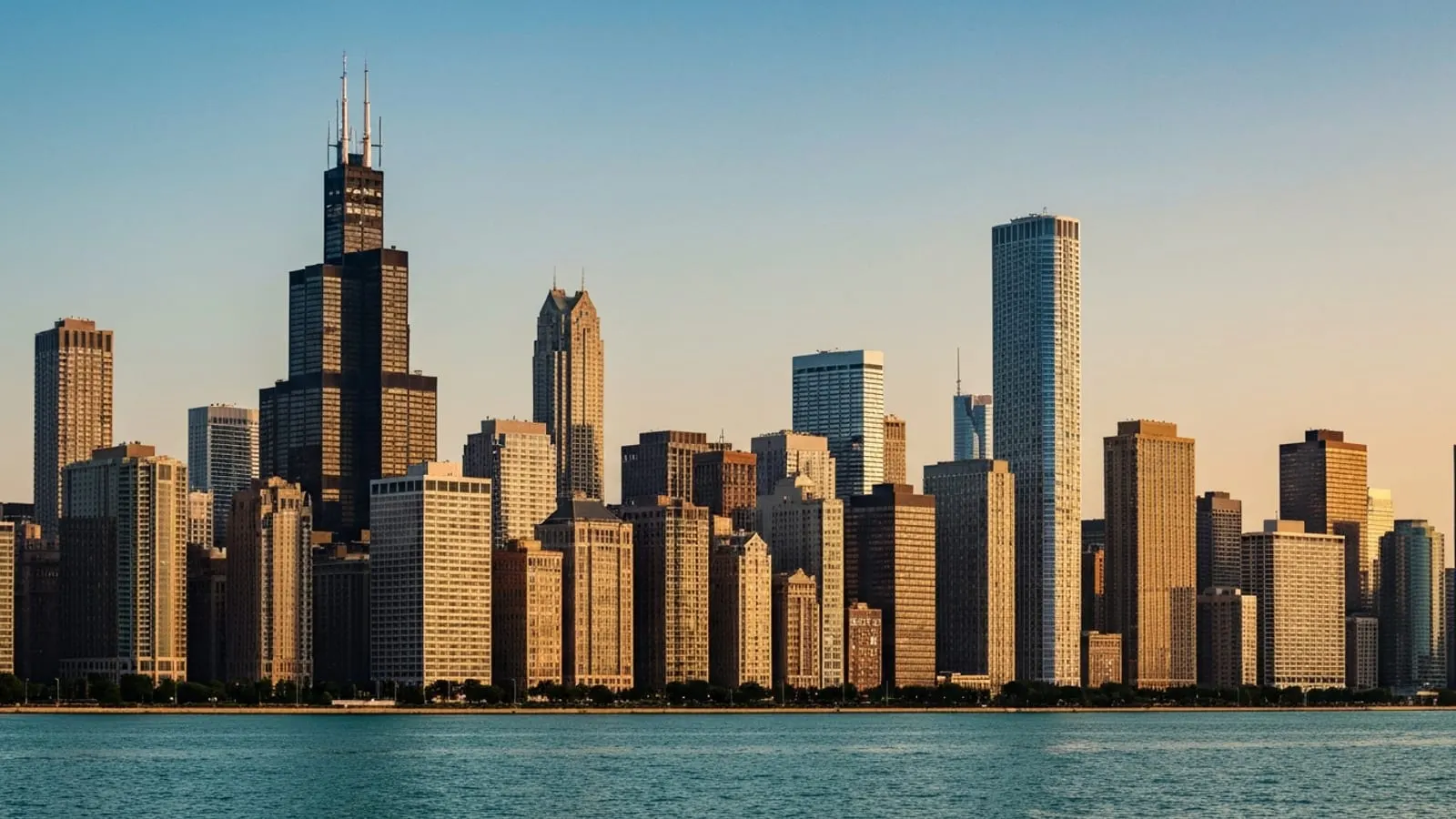
Lost Car Keys in Chicago? Get a Vetted Local Specialist
From the Loop to Edgewater to Hyde Park, CarKeyNation routes Chicago drivers to IDFPR-licensed automotive key specialists with the right tooling for your make.
Car key emergencies in Chicago
Chicago is the third-largest city in the United States and the unambiguous economic capital of the Midwest, with a 2020 U.S. Census Bureau population of 2,746,388 across a 234-square-mile footprint inside Cook County. The Chicago-Naperville-Elgin combined statistical area pushes total addressable metro population above 9.6 million. The local geography is organized around the Loop at the lakefront, with the Chicago River system splitting the central business district and the I-90/94 Kennedy Expressway, I-290 Eisenhower Expressway, I-55 Stevenson Expressway, and Lake Shore Drive carrying most commuter traffic to and from the neighborhoods.
Per the NICB Hot Spots Report, the Chicago-Naperville-Elgin metropolitan area has appeared in the report's top per-capita vehicle theft tables in multiple recent years, with the post-2020 spike in Hyundai and Kia thefts (the well-publicized 'Kia Boys' TikTok vulnerability) hitting Chicago especially hard. A meaningful share of theft and theft-recovery incidents become automotive-key emergencies — either because the thief took the spare with the vehicle, or because the owner needs a documented rekey before the Illinois Secretary of State Vehicle Services Division and the insurance carrier will close the claim.
Beyond the theft-recovery channel, Chicago's brutal winter climate is the single largest driver of automotive key emergencies in the city. Sub-zero January and February temperatures drain CR2032 and CR2025 fob coin cells in days rather than months; salt-and-brine winter road treatment corrodes door lock cylinders on older Civics, Camrys, F-150s, and Silverados; and lake-effect snow storms produce extended periods when CTA L parking lots, Streeterville garages, and curbside spots on Lake Shore Drive become impassable. The most common Chicago scenarios we route into the CarKeyNation network are: a dead-fob lockout on a 2018+ smart-key vehicle in a CTA Park-and-Ride; a snapped transponder blade in a 2005-2015 Honda Civic, Toyota Camry, or Ford F-150 ignition after sustained cold; an all-keys-lost replacement on a Ford Super Duty or Chevrolet Silverado where the owner-of-record paperwork has to be verified before programming begins; and Tesla Model 3 / Model Y key-card or phone-key pairing in West Loop, River North, and Lincoln Park where Tesla density is highest.
Mobile dispatch is almost always the right call in Chicago. Towing a non-running vehicle from, say, Hyde Park to a brand dealer in Evanston or Skokie can cost $175-$425 by itself, and Chicago-area Toyota, Honda, Ford, and Chevrolet dealers typically book key-and-program appointments 7-14 business days out for non-warranty work. A mobile specialist with a current Autel IM608 Pro, Smart Pro, or equivalent finishes most jobs in 30-60 minutes in your driveway, an Edgewater alley, a Loop parking garage, a Wicker Park curbside spot, or a Bronzeville two-flat front pad.
Chicago neighborhoods we cover
Chicago is famously a 'city of neighborhoods' — 77 officially designated community areas plus countless local subdivisions. CarKeyNation partners in Chicago cover the full City of Chicago footprint within ZIP ranges 60601-60707, plus immediate suburban Cook County and the inner DuPage County ring. We don't lock you into one specialist — we match by your make, your job type, and your nearest partner with the right tooling.
- The Loop / South Loop / West Loop / Fulton Market (60601, 60603, 60604, 60605, 60606, 60607)
- River North / Streeterville / Gold Coast / Old Town (60610, 60611, 60654)
- Lincoln Park / Lakeview / Wrigleyville / Boystown (60613, 60614, 60657)
- Wicker Park / Bucktown / Logan Square / Humboldt Park (60622, 60647, 60651)
- Pilsen / Little Village / Bridgeport / McKinley Park (60608, 60616, 60623, 60632)
- Hyde Park / Kenwood / Bronzeville / Woodlawn / Washington Park (60615, 60637, 60653)
- South Shore / Chatham / Auburn Gresham / Englewood (60619, 60620, 60621, 60649)
- Edgewater / Andersonville / Uptown / Rogers Park (60626, 60640, 60660)
- Avondale / Irving Park / Albany Park / North Center (60618, 60625, 60630, 60641)
- Norwood Park / Edison Park / Jefferson Park / Portage Park (60631, 60634, 60646, 60656)
- Beverly / Mount Greenwood / Morgan Park / West Lawn / Garfield Ridge (60629, 60638, 60643, 60655)
Chicago's freeway geography drives the partner-routing logic. Per Illinois Department of Transportation (IDOT) traffic counts, the Kennedy Expressway (I-90/94) through Logan Square and the Eisenhower (I-290) through East Garfield Park each carry well over 200,000 vehicles per day, with the Dan Ryan (I-90/94) south of the Loop and the Stevenson (I-55) through Pilsen close behind. A partner based in Logan Square may actually reach Streeterville faster than a partner based off North Michigan Avenue during the 4:30-6:30pm peak, depending on which leg of the Kennedy or Lake Shore Drive is moving. Our routing accounts for current-time traffic, not just distance-from-pin.
Beyond the City of Chicago, the same CarKeyNation network covers Evanston, Skokie, Oak Park, Berwyn, Cicero, Forest Park, Niles, Park Ridge, Lincolnwood, Wilmette, Glenview, Morton Grove, Lansing, Calumet City, Blue Island, and the inner ring of Cook County suburbs. If your vehicle is registered to a Chicago address but the actual lockout is at O'Hare, at Midway, in Schaumburg, or at the Old Orchard mall garage, our system routes by current location rather than registration.
What it costs in Chicago
Chicago automotive key pricing in 2026 reflects three factors: the local labor cost base (the Chicago-Naperville-Elgin MSA is a top-tier metro per BLS OEWS metro data for SOC 49-9094), the local fleet mix (heavy Ford F-150 / Silverado / Honda / Toyota in the working-class neighborhoods, elevated BMW / Mercedes / Audi / Tesla density in River North, Lincoln Park, Gold Coast, and the North Shore), and Chicago's geography (jobs in Edgewater, South Shore, or Garfield Ridge carry real drive-time from the Loop, especially during weekday peak).
Typical CarKeyNation specialist ranges in Chicago (mobile, on-site, including programming):
- Basic transponder spare (2005-2015 Civic/Camry/F-150/Silverado): $145-$235
- Smart Key spare with working master present (2018+ Toyota/Honda/Hyundai/Kia): $215-$355
- Smart Key all-keys-lost (2018+): $305-$485
- Ford F-150 / Super Duty PATS programming: $185-$385
- Chevrolet Silverado / GMC Sierra Hitag2-Ext / PASS-Lock relearn: $235-$435
- Ram 1500 SKIM programming with Stellantis Security Gateway: $215-$425
- Hyundai / Kia immobilizer reset post-recovery (Kia Boys vulnerability): $185-$385
- BMW comfort-access all-keys-lost (2007+ E9X/F30/G20/G30): $395-$795
- Tesla Model 3 / Model Y key card or phone-key pairing: $145-$245
- Mercedes-Benz FBS4 (2015+) all-keys-lost: $375-$945
- Ignition cylinder rekey / replacement (Toyota/Honda/Nissan): $185-$385
These ranges reflect what IDFPR-licensed locksmiths actually charge in 2026 — they are not 'starting at' marketing prices designed to bait a $19 ad. Per the FTC Consumer Alert on locksmith scams, a published price of $19, $29, or $49 for a 'lockout' on a national directory is the single strongest predictor that the on-scene quote will be five to ten times higher. Real Chicago automotive key work cannot be done for $19, especially on modern smart-key and immobilizer-equipped vehicles.
Dealer pricing in the Chicago metro for the same jobs runs 45-115% higher per the OEMs' own owner portals, plus the tow if the car isn't drivable to the dealer. For a 2022 Toyota Camry Smart Key all-keys-lost, the menu rate at Chicago-area Toyota dealers runs $555-$715; the mobile-locksmith equivalent ranges $305-$455. The dealer's posted labor rate is the dominant driver — Chicago is a high-cost market for skilled trades, particularly inside the city limits where commercial real-estate costs flow through to the customer.
How to avoid Chicago locksmith scams
Illinois is one of the strictest states in the country for locksmith licensing — a fact most Chicago consumers do not know, and that scam operators exploit aggressively. Every locksmith operating in Illinois must hold a license issued by the Illinois Department of Financial and Professional Regulation (IDFPR) under the Private Detective, Private Alarm, Private Security, Fingerprint Vendor, Locksmith, and Private Security Contractor Act of 2004 (225 ILCS 447). Licensure requires a fingerprint-based criminal background check, a written examination, proof of $1,000,000 in general liability insurance, a $5,000 surety bond, and ongoing continuing education. IDFPR maintains a public license lookup that any consumer can use from a phone in under 30 seconds: the IDFPR Online License Lookup.
The Illinois Attorney General Consumer Protection Division accepts complaints against unlicensed operators, and IDFPR has authority to investigate, sanction, and refer for prosecution. The combination of mandatory state licensure plus mandatory $1M liability insurance plus mandatory $5,000 bond plus mandatory criminal background check makes Illinois one of the most consumer-protective states in the country for locksmith work — but only if the consumer actually verifies the license. Concrete red flags to watch for in Chicago:
- A national 'locksmith near me' ad with a price under $30 — the published price is a bait-and-switch. IL requires licensure, and licensed operators do not need bait pricing.
- Unbranded white van, no name on the vehicle, no business card, no IDFPR license number on the truck. Look for the license number — legitimate IL operators display it (typically a 7-digit number prefixed '197' for company license).
- On-arrival quote 4-10x higher than the phone quote, with pressure to 'just authorize $XXX' to start drilling.
- Insistence on drilling the lock or ignition immediately, claiming the chip is 'high-security' so it can't be picked. Nearly every modern Toyota, Honda, Nissan, Ford, GM, Hyundai, and Kia ignition can be picked or impressioned by a competent locksmith — drilling is almost never the right first move.
- Refusal to provide a written estimate before work begins. Per IDFPR rules and the ALOA code of conduct, the customer is entitled to one.
- Cash-only with no receipt, no invoice, and no warranty.
- The technician cannot or will not produce their individual IL locksmith license, only the 'company license' — Illinois requires individual licensure as well for anyone performing locksmith work.
CarKeyNation only routes jobs to IDFPR-licensed partners who provide a written estimate, document both the company and the technician's IDFPR license numbers on the invoice, and provide a written 90-day workmanship warranty on the key programming. If a CarKeyNation-dispatched specialist ever asks for cash with no receipt, our admin team wants to know immediately — we de-list partners who fail this audit. The combination of Illinois's strict state licensure plus our private network audit is what separates the network from a directory.
Most common vehicles we service in Chicago
Chicago's vehicle mix reflects the Midwest working-vehicle bias plus a meaningful layer of imported luxury concentrated in River North, Lincoln Park, Gold Coast, the West Loop, and the North Shore suburbs. F-150 and Silverado are very common across the South Side, Southwest Side, and the bungalow-belt Northwest Side. Camry / Civic / RAV4 / CR-V form the commuter backbone across virtually every neighborhood. Subaru AWD is over-indexed because of the brutal Chicago winters. And Tesla, BMW, Audi, and Mercedes penetration is consistently higher per capita than the U.S. average in the lakefront high-rise neighborhoods.
- Ford F-150, Super Duty, Ranger, Bronco, Mustang — Ford is the volume truck leader. PATS programming through OBD is routine.
- Chevrolet Silverado, Tahoe, Suburban, Equinox, Malibu — GM's Hitag2-Ext and PASS-Lock systems require the right programmer and a valid security code.
- Toyota Camry, Corolla, RAV4, Highlander, Tacoma, Sienna — Toyota dominates Chicago's commuter fleet; Smart Key 2018+ is daily work.
- Honda Civic, Accord, CR-V, Pilot, Odyssey, HR-V — Honda's HISS through 2017 and Smart Entry 2018+ are well-supported.
- Hyundai Elantra, Sonata, Tucson, Santa Fe + Kia Forte, Optima, Sportage, Sorento, Telluride — very high volume in Chicago. 2011-2021 models affected by the well-publicized 'Kia Boys' theft vulnerability where post-recovery immobilizer reset and steering column repair is often required.
- Subaru Outback, Forester, Crosstrek, Impreza — AWD over-indexed in Chicago because of winter; Subaru's Keyless Access fob programming requires the correct token.
- Nissan Altima, Sentra, Rogue, Frontier, Titan — NATS transponder work on pre-2017; NATS-Plus Intelligent Key on 2017+.
- Ram 1500, 2500, 3500 — SKIM programming via OBD with Stellantis Security Gateway considerations for 2018+.
- BMW 3-Series, 5-Series, X3, X5, X7 — comfort-access fob programming requires CAS3/CAS4/FEM and the correct token-based programmer.
- Mercedes-Benz C-Class, E-Class, GLC, GLE, S-Class — FBS3/FBS4 immobilizer requires specialized tooling.
- Tesla Model 3 / Model Y / Model S / Model X — key card pairing and phone-key authentication; no traditional chip. Rivian R1T / R1S also appearing more frequently in the West Loop and Lincoln Park.
If you drive a model not on this list, the network still likely covers you. The CarKeyNation lead form asks for your make + model + year, and we route to the partner whose tooling matches. Some makes (early Volvo XC90 with the Tier-2 immobilizer, certain Maybach trims, ultra-low-volume EVs) may legitimately require a dealer-only solution; in that case we'll tell you up-front before charging.
When we'll get to you in Chicago
Honest answer: response time in Chicago is a function of which corridor you're on, what time of day it is, and what the weather is doing. The CarKeyNation network typically has 5-12 active partners with capacity in the Chicago metro at any given time during business hours and 2-5 partners with after-hours capacity. The actual minutes from dispatch to driveway depend on where you are, where the nearest available partner is, and whether the Kennedy / Eisenhower / Dan Ryan / Stevenson / Edens system is moving.
Typical drive-time targets we hit in Chicago, per IDOT corridor data:
- Loop / River North / Streeterville / West Loop: 25-45 min off-peak, 50-90 min PM peak
- Lincoln Park / Lakeview / Wrigleyville: 30-50 min off-peak, 55-100 min PM peak on Lake Shore Drive
- Wicker Park / Bucktown / Logan Square / Humboldt: 30-55 min
- Pilsen / Little Village / Bridgeport: 30-55 min
- Hyde Park / Kenwood / Bronzeville: 35-60 min off-peak, 60-110 min PM peak on Lake Shore Drive south
- South Shore / Chatham / Auburn Gresham: 40-70 min
- Edgewater / Andersonville / Uptown / Rogers Park: 35-60 min off-peak, 60-100 min PM peak on the Kennedy or LSD north
- Avondale / Irving Park / Albany Park: 35-60 min
- Norwood Park / Edison Park / Jefferson Park: 40-70 min
- Beverly / Mount Greenwood / Morgan Park: 45-80 min from the central Loop
- O'Hare / Park Ridge / Schaumburg ring: 50-90 min depending on Kennedy state
- Midway / Garfield Ridge / Burbank: 40-70 min
After 8pm Chicago traffic clears dramatically — most after-hours jobs land in 30-50 minutes regardless of neighborhood, assuming weather cooperates. In active lake-effect snow events or sub-zero wind-chill conditions, add 20-40 minutes to every estimate; partner safety comes first and we will not push a technician onto an unplowed Lake Shore Drive at 3am. Per AAA Roadside Assistance benchmarks, honest ETA estimates correlate with both customer satisfaction and partner retention; we tell you the realistic window up front rather than promise 25 minutes and arrive in 90.
Chicago automotive key insight
“Consumers should always confirm that any locksmith arriving on-scene is licensed in their state, carries proper identification, and provides a written estimate before work begins. A reputable automotive locksmith will not ask you to sign a blank invoice and will be transparent about exactly which key, chip type, and programming step the job requires.”
— Mary May, Executive Director, Associated Locksmiths of America (ALOA Security Professionals Association)
ALOA's guidance applies with extra force in Chicago, where Illinois's strict locksmith licensing regime has been one of the most-circumvented in the country by out-of-state scam dispatchers running national 'locksmith near me' ads. The single most protective consumer action — beyond using a vetted network like CarKeyNation — is to verify the on-arrival technician's IDFPR license on the IDFPR Online License Lookup from your phone before authorizing any work.
“Vehicle theft continues to challenge drivers and law enforcement across the country. The most effective protection is a layered approach: keep keys and fobs out of unattended vehicles, park in well-lit areas, and use both visible and electronic anti-theft technology. A small change in routine prevents the majority of opportunistic thefts.”
— David Glawe, President & CEO, National Insurance Crime Bureau (NICB)
The NICB's prevention guidance maps directly onto Chicago's actual theft pattern. Chicago has been hit harder than most U.S. metros by the 2021-2024 Hyundai / Kia 'Kia Boys' wave, where vulnerable 2011-2021 models without engine immobilizers were stolen by simply pulling the steering-column shroud and turning a USB connector in the ignition. If your vehicle has been recovered, do not drive it until a licensed automotive locksmith has rekeyed the ignition, replaced the steering column lock, and confirmed the immobilizer status — otherwise the same vulnerability remains exploitable.
How CarKeyNation verifies every Chicago specialist
The single most consequential difference between calling a vetted network and calling the first paid ad on a search-result page is the verification trail behind the technician who actually arrives at your door. The U.S. Federal Trade Commission has published consumer guidance on locksmith scams documenting a recurring pattern of harm: a low advertised price ($19, $29, $49) that turns into a $300-$900 on-arrival quote from an unlicensed contractor with no business address and no warranty. Every step of the CarKeyNation verification flow for Chicago is designed to filter those operators out of the dispatch pool before the customer ever sees them.
Business registration and bonding. Every Chicagopartner must hold a verifiable business registration in Illinois, a current general-liability insurance certificate naming CarKeyNation as an additional insured, and a surety bond covering the work scope. We hold a current Certificate of Insurance on file for every active partner and re-verify annually. A locksmith with no bond and no insurance is, in practical terms, leaving the consumer with no recourse if something goes wrong during the programming — which is why we will not route to one.
ALOA credentialing. The Associated Locksmiths of America operates the national trade association and publishes a member directory. Our Chicago specialist pool prioritizes ALOA members in good standing, particularly those holding the Master Automotive Locksmith credential. ALOA membership is a baseline indicator of training, continuing education, and a written code-of-ethics commitment to providing written estimates and not engaging in bait-and-switch pricing on arrival.
NASTF VSP registration for restricted-access work. The National Automotive Service Task Force runs the Vehicle Security Professional registry, which is the manufacturer- recognized credential for accessing the Secure Data Release Model. For any Chicago job involving a restricted-access programming step (Stellantis Security Gateway vehicles, certain BMW and Mercedes procedures, late-model FCA / Jeep / Ram), the assigned specialist must be VSP-registered. VSP registration requires a background check, fingerprint submission, and ongoing renewal — it is not a paperwork credential, and it filters out the operators who simply could not pass the background check.
Tool and license inventory verification. Beyond the credentialing, we verify that each Chicago specialist actually carries the tools needed for the work — current Autel IM608 license, Smart Pro license, VVDI Key Tool Plus license, or the OEM-equivalent tool family for the makes and years they are authorized to work on. A specialist with valid credentials but expired tool licenses cannot reliably complete a job, so we track the tool side of the verification separately and refresh it as new license cycles begin.
Written estimate and 90-day workmanship warranty. Every CarKeyNation-dispatched Chicago job ends with a written, itemized receipt showing the make, model, year, VIN, key type, chip family, programming step, and total price. The work carries a 90-day workmanship warranty from the assigned specialist. If a key fails within that window for any reason traceable to the original programming, our admin team coordinates the rework at no charge to the customer. That is the practical accountability layer that does not exist when a customer calls a random ad.
Common diagnostic mistakes to avoid before calling for a Chicago key
Before assuming you need a full key replacement in Chicago, there are four quick diagnostic checks any vehicle owner can do that occasionally save the cost of a service call entirely. Our intake operators run through these with every customer, but the underlying logic is worth knowing in advance so the conversation moves faster.
1. Try a fresh fob battery first. Proximity Smart Keys use a CR2032 or CR2025 coin cell that lasts roughly two to four years under normal use. A failing battery often presents as a key that works intermittently — sometimes it unlocks the door, sometimes it doesn't — which customers frequently interpret as a failing key when the actual fix is a four-dollar battery. Pop the fob open with a small flathead screwdriver, swap the cell, and try again. If the symptoms resolve, you have saved a service call entirely.
2. Confirm the immobilizer light behavior. Most modern vehicles display an immobilizer or key icon on the dashboard for a few seconds during ignition cycle. If the icon stays solid or blinks rapidly when you try to start the car, the issue is in the chip-recognition handshake — which is the locksmith's domain. If the icon goes out normally but the car still refuses to crank, the issue is more likely electrical (battery, starter, ignition switch wear) than key-related, and a different specialist may be the right call.
3. Check that the fob is not soaked or recently washed. Water intrusion into a proximity fob (left in pants pockets through a wash cycle, or dropped in a Chicago pool) damages the internal circuitry and the symptoms can take days to fully appear. If your fob got wet recently, that is almost certainly the root cause, and a replacement is the right path — but knowing that going in helps the on-arrival specialist quote the correct replacement fob hardware without diagnostic delay.
4. Try the physical valet key blade. Most modern proximity fobs contain a mechanical valet blade that unlocks the driver door manually. If your fob has stopped working entirely, the valet blade still gets you into the vehicle, where many modern vehicles allow a backup-start procedure (holding the dead fob against a specific point on the steering column or push-button start area). The owner's manual documents the backup procedure for your specific make and year. If the backup works, the issue is fob battery or fob transmission rather than immobilizer pairing — cheaper fix, faster turnaround.
None of these four checks replace a professional diagnosis when the situation calls for one, but they sort out the scenarios where a $4 battery or a 30-second valet-key check solves the problem before a $200-$400 service call is necessary. CarKeyNation's intake operators will walk you through them on the phone before dispatching a specialist in Chicago.
After-hours, weekend, and holiday service in Chicago
Car key emergencies do not respect business hours, and a realistic conversation about Chicago mobile-locksmith availability outside of weekday daytime hours is one of the most useful things we can offer at intake. The honest answer is that after-hours service in Chicago exists, but the partner pool with capacity at 11pm on a Saturday is a fraction of the pool with capacity at 11am on a Tuesday — and pricing reflects that supply curve.
Weekday evenings (6pm-10pm). A meaningful share of the Chicago partner network maintains evening capacity Monday through Thursday. Response times typically run 15-30 minutes longer than the off-peak benchmark we quote for the same neighborhood during business hours, primarily because there are fewer specialists actively on the road and the closest available partner may be farther away. Pricing in this window is usually within $25-$50 of the daytime flat-rate for the same job — most partners do not charge a formal after-hours premium until later in the evening.
Late nights (10pm-6am). The Chicago late- night pool is small. We can usually route a partner to a genuine emergency (a parent locked out with a child inside the vehicle, a driver stranded in an unsafe location) but the realistic ETA is typically 60-120 minutes from dispatch, and an after-hours premium of $75-$185 applies to most programming work. For a non-urgent spare-key job, we strongly recommend waiting until morning — both the cost and the partner-availability math improve dramatically.
Weekends. Saturday daytime in Chicago sees full network coverage, often matched or close to weekday daytime availability. Saturday evening drops to the weekday- evening profile. Sunday is the tightest day of the week in most metros — many Chicago specialists treat Sunday as a family or rest day and only the after-hours-rotation partners are reachable. Sunday pricing typically includes a 15-25% premium over weekday rates for the same job.
Holidays. Major U.S. holidays (Thanksgiving, Christmas Day, New Year's Day, Independence Day) operate on the late-night model regardless of clock time — small partner pool, longer ETAs, and a $100-$250 holiday premium on programming work. For non-urgent jobs, we recommend rescheduling to the next non-holiday business day; the savings are real and the wait is usually under 24 hours. Per AAA Roadside Assistance benchmarks, major holidays are also the peak lockout volume days of the year nationally — partner pools are stretched in every metro, not just Chicago.
Our intake conversation accounts for time-of-day from the first question. The realistic ETA we quote is always anchored to the partner pool actually available in your specific window, not the optimistic best-case business-hours estimate.
Frequently asked questions
How fast can a locksmith reach me in Chicago?
Off-peak, most Chicago addresses land in 30-60 minutes. During PM peak on the Kennedy, Eisenhower, Dan Ryan, or Lake Shore Drive (4-7pm weekdays), expect 55-110 minutes depending on your neighborhood and the freeway state. In active lake-effect snow or sub-zero conditions, add 20-40 minutes for safe travel. Our dispatch shows live drive-time before you commit so you know the realistic ETA before authorizing.
Is the locksmith licensed in Illinois?
Yes. Illinois law requires every locksmith and locksmith company to hold an IDFPR license issued under 225 ILCS 447, with a mandatory criminal background check, written exam, $1,000,000 liability insurance, and $5,000 surety bond. CarKeyNation only routes to partners who provide both their company and individual IDFPR license numbers on the invoice, and you can verify both in real time on the IDFPR Online License Lookup. If a company cannot show you a valid IDFPR license number, do not let them touch your vehicle.
How much does a Ford F-150 key cost in Chicago?
Most 2015-2024 Ford F-150 key jobs run $185-$385 with a CarKeyNation partner depending on whether you have a working master key (spare) or are starting from all-keys-lost. Chicago-area Ford dealer pricing for the same work runs $395-$655. The mobile specialist programs the new key through the OBD port on-site, typically in 30-45 minutes, with no tow required even in winter.
My Hyundai or Kia was stolen and recovered — what do I need?
If your 2011-2021 Hyundai or Kia was affected by the 'Kia Boys' vulnerability, do not drive it after recovery until a licensed automotive locksmith has rekeyed the ignition cylinder, replaced or repaired the steering column lock (often physically broken during theft), and confirmed the immobilizer chip status. CarKeyNation partners typically charge $185-$385 for the rekey-plus-immobilizer-reset job in Chicago, and many insurance carriers (State Farm, Allstate, Progressive, Geico) will reimburse the work as part of the recovery claim — get the written invoice with the IDFPR license number on it for the claim.
Sources
- Illinois Department of Financial and Professional Regulation (IDFPR) — Locksmith Licensing under the Private Detective, Private Alarm, Private Security, Fingerprint Vendor, Locksmith, and Private Security Contractor Act of 2004 (225 ILCS 447)
- IDFPR Online License Lookup — verify any Illinois locksmith license in real time
- NICB 2023 Hot Spots Report (auto theft rankings by state + metro)
- BLS OEWS Locksmiths & Safe Repairers (49-9094)
- AAA Roadside Assistance Service Data
- U.S. Census Bureau American Community Survey (ACS) 5-year metro estimates
- Office of the Illinois Attorney General — Consumer Protection Division
- Illinois Secretary of State — Vehicle Services
- Illinois Department of Transportation (IDOT) — Traffic Counts & Highway Statistics
- Illinois Tollway — Traffic & Roadway Statistics
- ALOA (Associated Locksmiths of America) Service Standards
- NASTF (National Automotive Service Task Force) VSP Registry
- FTC Consumer Alert — How to Find a Reliable Locksmith
Ready to get rolling again?
Request a local specialist now — vetted, accountable, and matched to your vehicle.